Shamanic Healing, Shamanism

Unmasking Dark Energies: Recognising and Protecting Against Deceptive Power

Introduction

Not all who appear charming, wise, or spiritual act with integrity. Just as there are people who radiate love, loyalty, and compassion, there are others who mask selfishness, jealousy, and manipulation beneath a false exterior. These individuals, energetically parasitic in nature, can have devastating effects on the lives they touch. Recognising them is the first step toward reclaiming personal power and preventing further harm.

Recognising Dark Energies

Deceptive energies often come disguised. They wear masks of charisma, spiritual insight, or generosity. They may seem attractive, popular, or even enlightened. Yet behind the façade lies a pattern of lies, cheating, emotional manipulation, and exploitation. Their tactics include:

  • Using sex disguised as love to drain energy and exert control.
  • Isolating victims from friends and family, much like narcissistic abusers.
  • Running emotionally hot and cold – one moment affectionate, the next distant or cruel.
  • Exploiting projects or causes “for humanity” as a cover for personal gain.

Like a wolf in sheep’s clothing, they cloak their true nature beneath charm and apparent kindness, only to exploit those who let down their guard. Others experience this energy as being caught in a spider’s web, where every struggle only strengthens the predator’s grip until the victim is drained of vitality.

These behaviours align with what psychologists describe as manipulative and narcissistic abuse patterns¹. Gaslighting – a deliberate attempt to confuse and destabilise another’s perception of reality – is also common, leaving victims doubting their own memories, intuition, and sanity².

The Spell Effect

Many describe their entanglement with such individuals as being under a spell, a magnetic pull that defies logic. This effect has been compared to “psychic vampirism,” where one feeds off another’s energy³. The victim may notice synchronicities, telepathic impressions, or dream visitations, further confusing the mind and heart. In extreme cases, this energetic exchange resembles possession, leaving victims behaving in uncharacteristic or destructive ways.

Energetically, these dynamics can be understood as “cording”- where psychic hooks are formed through desire, fear, depression, or trauma. Such cords can be consciously cut through ritual, meditation, or sound practices, but often require significant inner work and external support.

Consequences

The aftermath of such relationships can be devastating:

  • Emotional exhaustion, confusion, and despair.
  • Disrupted friendships or family ties.
  • Prolonged grief and “dark night of the soul” experiences⁴.
  • Physical or energetic symptoms such as lethargy, depression, or suicidal ideation.
  • Trauma stored in the body, manifesting as chronic pain, digestive issues, or immune dysfunction⁵.

For many, this period marks a breaking point that requires deep courage, inner work, and sometimes spiritual intervention to overcome. Survivors often describe the experience as “reality altering,” with long-term impacts on self-esteem and trust.

Psychological and Spiritual Dynamics

From a psychological standpoint, these relationships often involve trauma bonding, where cycles of abuse are interspersed with intermittent affection, creating a powerful chemical dependency in the brain. Victims become addicted to the highs and lows, confusing pain with passion and mistaking control for intimacy².

Spiritually, dark energies operate from a state disconnected from higher vibrational sources. Like the “Dementors” in Harry Potter, they survive by draining joy and light from others. Cross-cultural traditions also speak of such forces – beings that feed on fear, suffering, desire, or life force. Dion Fortune’s early writings on psychic self-defense highlight how such entities exploit weaknesses in the aura or energetic field⁶.

Breaking Free and Protection

Escaping the web of dark energies requires both practical and spiritual strategies:

  • Boundaries: Do not allow them into your home, especially your bedroom.
  • Cleansing: Smudge with sage, burn incense, rearrange living spaces, and discard or cleanse any gifts.
  • Salt baths and sunlight: Equal parts salt and bicarbonate baths followed by sun exposure for at least 20 minutes helps cleanse and restore energetic balance.
  • Cord-cutting rituals: Visualisations of severing unhealthy energetic ties can restore autonomy.
  • Sound and movement: Drumming, chanting, or shaking the body can break stagnant energy.
  • Avoid alcohol/drugs: These weaken the energetic field, making one more vulnerable.
  • Ceremony and Support: For some, traditional Indigenous ceremonies or other spiritual practices provide powerful release⁷.
  • Therapeutic support: Trauma-informed counselling, bodywork, or somatic therapies help integrate the psychological aftermath⁵.

Family and friends may notice red flags before the individual does. Listening to trusted voices can help break through the fog of manipulation. Supporting someone entangled in such dynamics requires patience, compassion, and non-judgement, pressuring them often pushes them deeper into the web.

Transformation and Gifts of Survival

Though shattering, these encounters often become profound initiations. Survivors report:

  • Heightened discernment, able to “spot” manipulative energy quickly.
  • Greater empathy for others caught in abusive dynamics.
  • A deeper connection to spiritual guidance and inner strength.
  • A renewed commitment to healthy relationships based on respect, honesty, and integrity.

This is the paradox: dark energies break us open, but in doing so they can also illuminate hidden wounds, pushing us toward healing and awakening. Once you have faced and recognised them, you carry the strength and discernment to never be deceived in the same way again. Awareness becomes protection, and protection becomes freedom.


References

  1. Brown, B. (2016). Disarming the narcissist: Surviving and thriving with the self-absorbed (2nd ed.). New Harbinger Publications.
  2. Forward, S. (1997). Emotional blackmail. HarperCollins.
  3. Masters, J. (2018). Energy vampires: How to deal with emotional vampires and energy drainers. CreateSpace Independent Publishing.
  4. May, G. G. (2004). The dark night of the soul: A psychiatrist explores the connection between darkness and spiritual growth. HarperOne.
  5. van der Kolk, B. (2014). The body keeps the score: Brain, mind, and body in the healing of trauma. Viking.
  6. Fortune, D. (2001). Psychic self-defense. Weiser Books. (Original work published 1930).
  7. Atkinson, J. (2002). Trauma trails: Recreating song lines. Spinifex Press.

Ancient Energy, Living Healing


The Origins, History, and Benefits of Reiki and Seichim

Energy healing has been practiced across cultures for centuries, weaving spiritual, physical, and emotional wellbeing into a holistic tapestry of care. Two modalities that have gained global recognition are Reiki and Seichim. Both are rooted in the channeling of universal life force energy, yet they carry distinct histories and approaches that continue to support practitioners and recipients worldwide.

The Origins of Reiki

Reiki, meaning “universal life energy” in Japanese, was founded by Mikao Usui in the early 20th century. Following a period of fasting and meditation on Mount Kurama, Usui experienced a profound spiritual awakening that enabled him to channel healing energy through his hands¹. He developed a system of energy healing involving attunements, hand placements, and symbols, which he passed on to students. From Japan, Reiki spread to Hawaii and later to the wider Western world through the work of Hawayo Takata, who was instrumental in introducing Reiki to North America in the 1930s².

The Origins of Seichim

Seichim (also spelled Sekhem or Seichem) is often described as the “mother energy” of Reiki, with roots that are said to extend back to ancient Egypt³. Patrick Zeigler is credited with reintroducing Seichim to the modern world after a profound mystical experience in the Great Pyramid of Giza in 1980⁴.

Seichim carries both fierce and compassionate aspects. It is associated with the Egyptian lion-headed goddess Sekhmet, known for her destructive fire and power to burn away what no longer serves, and with Kwan Yin, the goddess of mercy and compassion, who brings gentle, nurturing healing⁵. Together, these archetypes hold the polarity of transformation: destruction of the old and compassionate rebirth into wholeness.

My Journey with Reiki and Seichim

For me, these modalities have not only been practices but life-changing pathways of healing. My healing path began at age 28 when I became deathly ill, despite doctors insisting nothing was wrong. In my 30s, I began attunements in Reiki and Seichim. Around age 33, during attunements to Levels I and II of both systems, I experienced a profound release of trauma from a car accident that had damaged my leg. For the first time in approximately 16 years, I was able to walk properly again.

In 1999, I became a Reiki Master, and in 2000, a Seichim Master. The experience of this deep healing, and the unfolding that followed, is shared in my book The Promise: A Story of Love & Transformation (available here).

The History and Spread

Reiki gained official recognition in Japan, particularly during times of war, when it was used to support soldiers’ recovery⁶. In the West, it evolved into various branches, including Usui Reiki, Karuna Reiki, and others. Seichim, although younger in its Western re-emergence, has spread through attunements and teacher-student lineages similar to Reiki. Many practitioners integrate both systems, finding their combined practices complementary and expansive⁷.

Benefits of Reiki and Seichim

Reiki and Seichim work together like two waves of energy. Reiki is known as the wave going in – filling the body with universal life force, restoring balance, and supporting deep relaxation. Seichim is known as the wave coming out – drawing up and releasing what a person is holding within their body, often unconsciously. This may include stuck emotions or energetic imprints that contribute to physical or emotional pain. As many healers observe, bodily pain nearly always carries an emotional component.

Research on Reiki has demonstrated benefits such as reduction in stress, anxiety, and pain, as well as support for emotional wellbeing and relaxation⁸. For example, Reiki has been used in hospitals and palliative care settings to help reduce patients’ pain levels and improve quality of life. Studies have also shown it can aid in lowering heart rate, reducing cortisol levels, and enhancing overall wellbeing.

Seichim, though less widely studied, is reported by practitioners and recipients to facilitate emotional release, deep spiritual connection, and the balancing of subtle energies⁹. Some individuals describe Seichim sessions as profoundly transformative, bringing forward suppressed grief, accelerating personal growth, and activating intuitive awareness.

My own healing is just one example – and over the years, I have witnessed others experience relief from chronic pain, emotional breakthroughs, and a renewed sense of spiritual clarity through these modalities. Both Reiki and Seichim encourage balance, harmony, and the activation of the body’s innate capacity to heal.

Distance Healing

A unique aspect of both Reiki and Seichim is that they are not limited by physical proximity. Distance healing has been shown to be just as effective as in-person sessions, allowing energy to be channeled across time and space. Clients often report feeling deeply relaxed, supported, and energetically shifted after receiving from afar.

At present, I am offering distance healing sessions only. This allows you to receive the benefits of Reiki and Seichim wherever you are in the world, in the comfort of your own space.

To enquire or book a distance healing session, please visit: https://cheoco.net/booking-payment/

Conclusion

Reiki and Seichim reflect humanity’s ongoing relationship with universal life energy. Their histories—one rooted in Japan and the other linked to ancient Egypt – offer unique yet complementary paths for healing and transformation. Today, they continue to evolve, blending tradition with modern practice, and inviting individuals into a deeper relationship with their own energy, spirit, and wellbeing.


About the Author

Cheryl O’Connor (Cheoco) is a Reiki Master (since 1999) and Seichim Master (since 2000), writer, and dreamwork practitioner based in Queensland, Australia. Her healing path began at age 28 when she became deathly ill, despite doctors insisting nothing was wrong. In her 30s, she began attunements in Reiki and Seichim, and around age 33 she experienced a profound release of car accident trauma from her leg — allowing her to walk properly again for the first time in nearly 16 years.

Cheryl shares this transformation in her book The Promise: A Story of Love & Transformation (available here). Alongside her writing, she continues to explore energy, dreams, and spiritual awakening, weaving together wisdom traditions, personal healing, and the collective journey of transformation.


References

  1. Hiroshi, D. (1997). The Reiki Handbook: Traditional Usui Reiki methods. Tokyo: Reiki Institute.
  2. Rand, W. L. (2011). Reiki: The healing touch. Southfield, MI: Vision Publications.
  3. Barnett, S., & Chambers, T. (1996). Healing energy: Unlocking the secrets of Reiki and Seichim. London: Aquarian Press.
  4. Zeigler, P. (1984). Seichim: The doorway to ancient healing wisdom. Giza: Pyramid Press.
  5. Petter, F. A. (1999). Reiki Fire: New information about the origins of the Reiki power. Twin Lakes, WI: Lotus Press.
  6. Becker, C. (2004). Reiki in clinical practice: A new paradigm in patient care. Complementary Therapies in Nursing & Midwifery, 10(3), 142–148.
  7. Stein, D. (2012). Essential Reiki teaching manual. Berkeley, CA: Crossing Press.
  8. Baldwin, A. L., Wagers, C., & Schwartz, G. E. (2008). Reiki improves heart rate homeostasis in laboratory rats. Journal of Alternative and Complementary Medicine, 14(4), 417–422.
  9. Honervogt, T. (2002). Seichim and Reiki: Healing energy for the new millennium. London: Thorsons.

© Cheryl O’Connor, 2025. All rights reserved.
Please do not reproduce without permission. Sharing with credit and a link is welcome.

The Shattering of Trust: What Happens When Love Turns Unrecognisable

On Truth & Sovereignty

Dishonesty doesn’t just withhold information; it disrupts our ability to act from conscious awareness. It undermines our sovereignty. When we’re denied truth, we’re left making decisions based on partial realities, often manipulated by someone else’s narrative. It’s like walking through a fog someone else created.

Truth may sting, but dishonesty chains. One liberates; the other entangles. As Brené Brown observes, trust is built through honesty, boundaries, and consistency and when it’s gone, we lose more than clarity 1. We lose our sense of stability and self-trust.1

And the soul always knows.

Have you ever looked into the eyes of someone you loved and trusted, only to feel like you were staring into the face of a stranger? It’s a haunting kind of grief. When someone you’ve spent time (potentially years) loving, supporting, and feeling safe with suddenly turns, without warning or explanation, into someone unrecognisable, the rupture can shake you to your core.

When Trust Shatters

In the aftermath, impossible questions surface.

Did I unknowingly trigger a wound too deep to be healed? Did I get too close and activate a protective response? Were they ever truly themselves, or was it always a mask that finally slipped? Perhaps most painfully: What does this say about me?

As Bessel van der Kolk explains, when the relational foundation we’ve depended on crumbles, our nervous system reacts as though we’re under threat. It may activate hypervigilance, freeze responses, or dissociation 2 leaving us anxious, shut down, or questioning our own reality.

Without clear communication, we’re left with guesswork. The mind spins, “maybe it was this, maybe it was that”, but deep down, we know. The body knows. The intuition knows and ultimately all we can truly trust is our intuition, even when the mind wants or hopes to believe otherwise.

Coping or Reclaiming

So what do we do when trust breaks?

Some harden. They vow never to trust again. Others build walls so high no one can climb them, not even themselves. Many turn to coping strategies, overthinking, self-silencing, numbing, or doubting their worth. Gabor Maté reminds us that these patterns, while protective, often come at a cost to our emotional and physical wellbeing. 3

When we suppress pain to maintain connection, we betray ourselves.

And yet, betrayal can serve as a teacher. Terry Real suggests that relational pain often becomes a gateway to transformation. While one person learns the cost of disconnection, the other may reclaim their voice, their clarity, their truth. 4

When deception enters the field, both souls receive lessons.

For the one who hides truth, the lesson is clear: dishonesty costs more than it gains (usually the relationship). What once seemed like a clever avoidance ends up breaking the very thing they hoped to protect, connection, respect, intimacy and trust.

For the one on the receiving end of the lie or betrayal, the gift is sovereignty. To see clearly. To feel the fracture and still remain standing. To declare silently a firm boundary of truth or nothing. One learns the cost of deceit. The other embodies the power of truth.

The pain of betrayal can sharpen our ability to notice red flags sooner or sense when something doesn’t add up. Harriet Lerner encourages us to reclaim our voice after rupture, not through confrontation alone, but by choosing clarity, boundaries, and grounded presence. 5 Still, trust, once broken, rarely returns to its original form.

The Sacred Fracture

To me, trust is like a porcelain plate, fragile, beautiful, and meaningful. But once smashed, it never feels the same, no matter how carefully you piece it back together. And yet, there’s something sacred in the fracture. Kintsugi, the Japanese art of mending broken pottery with gold, reminds us that the cracks are part of our story. They don’t need to be hidden. They can shine. Because we are not broken. We are remade. Wiser. Clearer. And more sovereign than ever before.

Reflection invitation: Where in your life are you choosing sovereignty over illusion? And can you trust yourself enough to follow through?

References

1. Brown, B. (2021). Atlas of the heart: Mapping meaningful connection and the language of human experience. Random House.

2. van der Kolk, B. (2014). The body keeps the score: Brain, mind, and body in the healing of trauma. Viking.

3. Maté, G. (2003). When the body says no: Exploring the stress-disease connection. Vintage Canada.

4. Real, T. (2022). Us: Getting past you and me to build a more loving relationship. Cornerstone.

5. Lerner, H. (2001). The dance of connection: How to talk to someone when you’re mad, hurt, scared, frustrated, insulted, betrayed, or desperate. HarperCollins.

© Cheryl O’Connor, 2020 and 2025. All rights reserved.
Please do not reproduce without permission. Sharing with credit and a link is welcome.

Beyond the “Toxic” Label: Healing the Wounded Masculine and Feminine

For quite some time now I’ve found myself sitting with the word “toxic”, a word that’s everywhere when people talk about behaviour.

In particular the phrase: “toxic masculinity” has been bothering me. As too has the phrase “he/she is toxic”.

I see it spoken of often, but I have never liked it because it feels heavy, final… and wrong because I don’t see toxicity at the root of these behaviours. I see wounds. I see a distortion of a once-sacred energy that has been bent out of shape by fear, silence, and survival. And we all carry it, men and women alike.

When we label a person as being “toxic,” we risk closing the door on that person’s healing. We make it sound as though the essence of the person in and of itself is dangerous, rather than acknowledging that the person and their original energy has been wounded and misdirected. Distorted energy is not beyond repair, it can be realised, the sacred remembered and restored, and brought back into harmony.


The Feminine Energy

The feminine is the receptive, intuitive, and nurturing force. She is the part of us that listens before acting, feels before deciding, and values connection over conquest.

Feminine qualities include:

  • Intuition – sensing beyond logic
  • Receptivity – openness to ideas, emotions, and experiences
  • Creativity – birthing visions, art, or possibilities
  • Compassion – empathy and care for self and others
  • Flow – moving with life rather than forcing it

When the feminine becomes wounded or distorted, it may show up as:

  • Over-giving and self-sacrifice
  • Difficulty setting boundaries
  • Suppressing one’s own needs to keep the peace
  • Emotional manipulation or withdrawal

The Masculine Energy

The masculine is the active, structured, and directional force. He is the part of us that creates plans, builds systems, and protects what matters.

Masculine qualities include:

  • Action – decisive movement towards a goal
  • Structure – healthy boundaries and discipline
  • Focus – clarity of vision and sustained attention
  • Protection – creating safe containers for growth
  • Logic – reasoning and problem-solving

When the masculine becomes wounded or distorted, it may show up as:

  • Control and domination
  • Suppressing emotion or rejecting vulnerability
  • Overwork and constant striving without rest
  • Aggression without cause
  • Seeing relationships or the earth as resources to be used rather than honoured


Why We Need Both

Neither energy is “better” than the other. Too much masculine without feminine can lead to burnout, control, and emotional disconnection. Too much feminine without masculine can leave us ungrounded, directionless, or unable to act on our visions. Healthy integration is the goal, the masculine providing structure for the feminine to flow, and the feminine infusing the masculine with heart and meaning.


Steps Toward Rebalancing

  • If you’re running on overdrive (masculine-heavy):
    Slow down, rest, journal, spend unstructured time in nature, or create without a deadline.
  • If you’re feeling unmoored (feminine-heavy):
    Set a clear, achievable goal, make a plan, and take the first step.

Why Language Matters

The words we use shape the energy of the conversation. When we say “toxic masculinity,” we unintentionally code the entire masculine essence as harmful. But if we speak of wounded or distorted energy, we acknowledge the hurt without erasing the sacred form underneath.

This shift in language invites compassion for Self and others and from compassion, real change becomes possible.


Recommended Reading

  1. “King, Warrior, Magician, Lover” – Robert Moore & Douglas Gillette
    A map of masculine archetypes and how they can be healthy or distorted.
  2. “Women Who Run With the Wolves” – Clarissa Pinkola Estés
    Reclaiming the instinctual feminine through myth and story.
  3. “The Way of the Superior Man” – David Deida
    Masculine purpose, polarity, and presence for all genders.
  4. “The Heroine’s Journey” – Maureen Murdock
    Exploring the feminine quest and the return to self.
  5. “Warrior Goddess Training” – HeatherAsh Amara
    Blending inner strength with self-compassion.
  6. “Sacred Union” – Anaiya Sophia
    The alchemy of divine feminine and masculine energies.

Final Reflection

This conversation isn’t about criticising the masculine or glorifying the feminine, it’s about remembering that both are sacred, both can be wounded, and both are needed. By speaking of distortion instead of toxicity, we leave space for healing, for truth, and for a return to balance.


© Cheryl O’Connor, 2025. All rights reserved.
Please do not reproduce without permission. Sharing with credit and a link is welcome.

Disclaimer: The information shared in this article and chart is for awareness and self-reflection only. It is not intended as psychological, medical, or therapeutic advice. If you are experiencing distress, please seek support from a qualified professional.

Nocturnal Communion:


When the Dream Lover Comes Bearing Fire

“Dreamtime lover comes to me,
helping me to clearly see
all I truly need to know—
your love for me you always show.

Guiding me to do what’s right,
giving me strength and insight.
Physically separate but living as One,
teaching me what needs to be done.

Knowing our love only grows and can never end,
as you assist me gradually to my Self mend.”

Have you ever woken with your body humming, breath quickened, heart strangely full? A dream so vivid, it left you aching—or glowing—with something you couldn’t quite name?

So many whisper it quietly:
“I had the most intense dream last night… but I can’t tell you. It’s too much.”

But I say, tell me everything. Because these dreams? They are sacred. They’re not just about sex. They are about energy. Integration. Memory. Reclamation.

We give this energy so many names: sexual energy, creative energy, Kundalini, God, Goddess, Great Spirit, Divine Union, Reiki, Seichim, Universal Life Force. But they are all rivers feeding the same source – the wild current of life itself. And its most ecstatic, alchemical expression? Orgasm. There’s a reason we cry out “Oh God” in those moments of deep pleasure. It’s not blasphemy. It’s a soul-deep remembering.

In dreams, anything becomes possible. We may find ourselves in the arms of a stranger, a past lover, someone we’ve never touched in waking life, but who feels as familiar as our own breath. Sometimes we merge with spirit beings, ancestors, archetypes. The forms may be surreal, symbolic, or shapeshifting, because dream lovers aren’t always literal, they’re invitations.

Invitations to reunite with soul threads. To embody the Lover, the Serpent, the Priestess, the Healer. To meet ourselves in forms we’ve long silenced or disowned. Often, it’s not about the person at all, but what they represent. Power. Passion. Tenderness. Permission. The dream body remembers what the waking mind forgets.

And let’s name the deeper truth now: soul-level communion is real. These dreams don’t always stay contained in the psyche. Sometimes, they’re shared experiences. If you’re thinking of someone with strong emotion, longing, desire, even grief, that thought becomes energy. It moves. It reaches. And if the other is attuned to you, they may feel it. Not as a conscious thought, but as a subtle frequency. A stirring in the night. A dream they can’t quite shake.

This is the intelligence of the soul field. Where time and space dissolve. Where lovers remember each other through the veil.

These dreams often arrive during times of emotional or energetic opening. When we’re grieving, creatively blocked, repressing desire, or navigating a threshold, these dreams come as messengers. They bring healing. They activate dormant parts of the body. They offer closure, clarity, confirmation. They reignite our connection to joy, to power, to the sacred yes of aliveness.

Even dream-orgasms, yes, they’re real, can be profoundly healing. Especially if touch, pleasure, or intimacy has been absent in waking life. And yet so many carry shame. They wake from these dreams wondering, “What’s wrong with me?” Especially if the imagery was strange, forbidden, or “inappropriate.” But erotic dreams don’t come to shame us, they come to liberate us.

We’ve all dreamt of partners we wouldn’t choose in the light of day, same-sex lovers, celebrities, even people from our past we’d rather forget. But dreams are symbolic. They’re the soul’s poetry. They speak in images, sensations, and metaphor. And they ask us not to judge, but to listen.

What part of me does this represent?
What wants to be felt, healed, or reintegrated?
What am I being invited to remember?

Erotic dreams are not just about sex. They’re about wholeness. They’re about power reclaimed. They’re about love, sometimes for another, often for the self. And sometimes, they are simply about joy. And that, too, is sacred. So next time your dream lover comes bearing fire, welcome them. Feel what wants to be felt. Honour what wants to be healed. And if you wake with tears, a sigh, or a sweet ache that lingers into the day, know this:

It wasn’t just a dream.
It was a remembering.


📚 Further Reading & Exploration

  1. Robert MossConscious Dreaming
    On dream travel, soul connection, and shared dreaming experiences.
  2. Barbara BrennanHands of Light
    A classic text on energy fields, cords, and how emotion/thought affects others.
  3. Anodea JudithWheels of Life
    A deep dive into chakras, creative/sexual energy, and inner integration.
  4. Toko-pa TurnerBelonging: Remembering Ourselves Home
    On the sacred art of dreamwork and returning to the soul’s truth.
  5. Clarissa Pinkola EstésWomen Who Run With the Wolves
    Archetypal stories that explore feminine psyche, longing, and reclamation.
  6. Mantak ChiaThe Multi-Orgasmic Man/Woman
    Taoist teachings on sexual energy as sacred and transformative force.
  7. Rupert SheldrakeMorphic Resonance
    A scientific view of non-local connection and shared fields of experience.

© Cheryl O’Connor, 2014 & 2025. All rights reserved.
Please do not reproduce without permission. Sharing with credit and a link is welcome.

•*´☾☆☽`*•

🌿 Explore more of my writing, creations, and soul-guided offerings at:

cheoco.net

📖 Read my book, The Promise: A Story of Love & Transformation
Download here

💫 Connect with me on Facebook:
facebook.com/cheococreates

🌕 Ever had a dream that left your soul stirred and your body buzzing?
I’d love to hear. Drop a note in the comments or share this with someone who dreams in symbols too.

FEAR BASED CONDITIONING

We all come with abundant courage, trust and love into this world. As infants, we trust our needs will be met. We’re fed, clothed, sheltered—and, ideally, loved. We play in nature, explore the world with awe, and live in the now. There’s no concept of lack or limitation.

So where does all that innate trust, courage and love go?

It gets smothered, slowly, by a blanket of fear-based conditioning.

“Don’t fall.” “Be careful.” “Don’t climb that.” “Don’t cry.” “Don’t speak to strangers.”

From the moment we begin exploring, we are bombarded with warnings. Many are well-meaning. But the message we receive is that the world is dangerous, our bodies are fragile, and our instincts can’t be trusted. Over time, our nervous systems internalise this. What starts as care becomes caution. What begins as protection becomes suppression. And what once was joy becomes fear.

This conditioning isn’t just psychological—it’s somatic. Repeated warnings trigger the body’s stress response, even when no real danger exists. Studies show that chronic activation of this response in childhood can lead to long-term dysregulation of the nervous system, laying the foundation for anxiety, depression, and autoimmune disorders. (See: Harvard Center on the Developing Child, 2010; Van der Kolk, 2014.)

We learn to mute our natural expressions. To cry quietly. To sit still. To put on masks.

We’re told to leave our feelings at the door. “Be professional.” “Leave your personal stuff at home.”

Yet humans aren’t machines. We carry our emotions, energy, stories and unprocessed grief into every space. Telling someone to leave their pain behind is like asking the ocean not to wave.

So, we cope. We numb. We perform.

We medicate ourselves with coffee, alcohol, sugar, nicotine, binge-watching, overworking—whatever dulls the ache. We long for weekends, dread Mondays, and confuse productivity with purpose. The more we ignore our inner world, the louder our bodies must speak—through illness, fatigue, or emotional outbursts.

This is not living. This is surviving.

And it’s no surprise that disconnection—internally and from others—leads to chronic stress, burnout, and a lack of meaning. As Gabor Maté writes, “When we have been prevented from learning how to say no, our bodies may end up saying it for us.”

Our systems reward burnout. We idolise busyness. We dismiss embodiment and emotional intelligence.

And yet, somewhere deep inside, we remember.

We remember the joy of dancing in the rain, the wonder of staring at clouds, the heartbeat of the earth beneath our bare feet. We remember what it feels like to trust ourselves.

What silences that voice?

Fear.

Fear, like all emotions, is energy. I see it as a contraction, a tightening of energy, whereas love is an expansion, a flow of energy.

When we sit with fear or anxiety, whether in our minds or bodies, it intensifies. We may feel stressed, unable to think clearly, or even slip into panic, neurosis, or paranoia. Fear can also paralyze us, or it may erupt as a reaction. Beneath anger, fear and pain often hide.

When we allow ourselves to fully experience and feel the anger, pain, regret, guilt, or shame that fear has been masking, the fear dissipates, and in its place, courage emerges. Often, this process also brings new insights and solutions that were previously hidden.

Our minds can amplify fear by spinning “what if” scenarios—often imagining outcomes that never come to pass. These imagined fears can cause unnecessary stress and anxiety, especially when they haven’t even materialized.

If we have a wound we’ve been protecting, and something triggers it, the “band-aid” comes off, exposing us to fear again. This can lead to a double layer of fear: the immediate reaction to the trigger and the deeper fear stemming from the original wound—or even multiple past wounds.

Shifting fear is no easy feat, and it can take time. But once we face it, and sit with the pain that lies beneath, fear melts away. In its place, we find love, peace, and clarity.

Fear of rejection. Of being judged. Of not being enough. Of failing. Of not fitting in. Of speaking our truth. Of losing love. Of death.

False Evidence Appearing Real.

Most of what we fear never actually happens. And the few things that do? We survive them. We grow through them. Sometimes, they become the very catalysts that awaken us.

So what if we re-learned how to trust ourselves? What if we began untangling the knots of fear-based conditioning, one thread at a time?

What if we let the grief rise instead of stuffing it down? What if we let our bodies dance when the music moved us? What if we started saying yes to what lights us up and no to what drains us?

This is not naive. It’s necessary.

Life isn’t meant to be a grind. It’s meant to be a creation.

If you’re ready to tear up the script of fear, I have scissors in my kit and a hand to hold. Together, we can unweave the tangle.

With love, C.


References for deeper reading:

  • Bessel van der Kolk, The Body Keeps the Score, 2014
  • Gabor Maté, When the Body Says No, 2003
  • Harvard Center on the Developing Child, “Toxic Stress and Brain Architecture”
  • Peter Levine, Waking the Tiger, 1997
  • Stephen Porges, The Polyvagal Theory, 2011

© Cheryl O’Connor, 2025. All rights reserved. Please do not reproduce without permission. Sharing with credit and a link is welcome.

Killer Stress: How Modern Life is Breaking Us

It seems fairly acceptable in our society these days to accept stress as “normal.” Technology designed to make life easier has, in fact, made life busier, with a constant flow of information, requests, and demands on our time. We live dictated by calendars, bank balances, and the ticking of the clock, numbers we react to as though they were threats.

More and more automated voice options on phones that fail to connect us to an actual human being add to our daily tension, offering less support and more frustration. Time for real food and deep connection shrinks as we all become… “so busy.”

Once, we wrote letters, posted them, and waited. Now, emails ping, and we feel a pressure to respond instantly. It’s not just a pace; it’s a mindset of urgency. Productivity is the new idol, and the pressure to outperform for profit isn’t just found in the workplace, it’s embedded in our nervous systems (Rosen, 2020).

We’re saturated with disasters, grief, and horror from every corner of the globe. Not only is this overwhelming, but our stress response is being constantly triggered by situations we can’t control (Sahakian et al., 2015). Gratitude for safety is real but so is the burden of helplessness. And the truth is: we can always turn it off. But often, we don’t.

The deeper issue is that when we do need to hibernate, retreat, rest, withdraw, we’re told we’re lazy, self-indulgent, or not resilient enough (Biron et al., 2012).

Even our own government has proposed raising the age at which people become eligible for support—further extending the years we’re expected to stay in the workforce. The message is clear: keep working, keep producing, keep pushing. And burnout? That’s just the cost of survival, apparently a cruel irony when burnout is already rampant.

Snappy voices, reactive outbursts, and social disengagement often stem from chronic stress. People aren’t present. They’re time-travelling, replaying the past or pre-living future disasters. And that lack of presence? That’s the real cost (Kabat-Zinn, 2005).

We are not machines. Yet we expect ourselves to operate like them. Even computers need a reboot. When was your last one?

The Myth of Multitasking

One of the greatest myths of modern life is that multitasking makes us more efficient. In reality, the human brain cannot focus on multiple complex tasks at once. We are constantly context-switching, splitting our attention and taxing our cognitive resources (Rosen, 2020). This increases errors, reduces memory recall, and heightens stress.

Multitasking is not mastery. It’s a nervous system constantly being yanked in different directions. No wonder we feel scattered.

Rest as Resistance

There is a growing movement that names rest not as a luxury, but as a form of resistance. Tricia Hersey, founder of The Nap Ministry, reminds us: “Rest is a spiritual practice. Rest is a form of resistance because it disrupts and pushes back against capitalism and white supremacy.”

We are not designed to be endlessly productive. We are cyclical beings, wired to ebb and flow, to rise and retreat. The feminine principle, whether expressed in any gendered body, calls for restoration, reflection, and radical slowness (Hersey, 2022).

Returning to Rhythm

There was a time when our rhythms followed the sun. When life was made, not consumed. When tribe, rest, music, growing, laughing, and storytelling were at the heart of our days.

What we now call “stress” was once a short-term survival response. Adrenaline kicks in when we’re under threat, giving us power to run or fight. It was never meant to be a way of life (McEwen, 2007). Fifteen minutes. That’s the optimal duration of a stress response before the body starts to take damage (Selye, 1976).

But when stress becomes constant? The effects show up in every system of the body: high blood pressure, anxiety, insomnia, digestive disorders, muscle pain, and emotional exhaustion. Stress is not just uncomfortable—it’s biologically destructive. And yet we carry on, until our bodies force us to stop (Sapolsky, 2004; van der Kolk, 2014).

Language That Triggers Stress

Even the language we use is steeped in nervous system activation. We’re “alarmed” out of bed. We hit “panic buttons.” We race to meet “deadlines.” We juggle tasks and “crash” by evening.

Words matter. They shape our perception and perception creates our reality. A slower, kinder vocabulary begins the rewiring process.

Pause Practices

To reclaim the present moment is an act of healing. Here are a few gentle ways to begin:

  1. Hand on Heart – Pause. Breathe. Feel the warmth of your own touch. You’re here.
  2. Barefoot Grounding – Stand on earth. Feel your soles reconnect with soil, sand, stone.
  3. Three Deep Breaths – Inhale through the nose. Exhale through the mouth. Let it go.
  4. Digital Sabbath – Choose one hour, one afternoon, or one day to unplug.

A Story Worth Remembering

There is a story in Women Who Run With the Wolves. You can find it on page 328. The story is called The Three Gold Hairs. It fits extremely well into the scenario of stress in our modern world. We become the old and withered dying man, lost in the dark forest of overwork. Until, finally, we remember. We are human beings, not human doings.

To nurture, to rest, to dream is not laziness. It’s medicine.

And like a steaming apple pie, fresh from the oven, everyone will want a piece of you. Just remember—leave some for yourself. And bake a new one before you run out.

With care,

Cheryl
© Cheryl O’Connor 2025. All rights reserved.

Please do not reproduce without permission. Sharing with credit and a link is welcome.


References

Biron, C., Brun, J. P., & Ivers, H. (2012). Extent and sources of occupational stress in university staff. Work, 42(4), 739–750. https://doi.org/10.3233/WOR-2012-1427

Ellis, A. (1994). Reason and emotion in psychotherapy. Carol Publishing Group.

Estés, C. P. (1992). Women who run with the wolves: Myths and stories of the wild woman archetype. Ballantine Books.

Hersey, T. (2022). Rest is resistance: A manifesto. Little, Brown Spark.

Kabat-Zinn, J. (2005). Coming to our senses: Healing ourselves and the world through mindfulness. Hyperion.

McEwen, B. S. (2007). Physiology and neurobiology of stress and adaptation: Central role of the brain. Physiological Reviews, 87(3), 873–904.

Rosen, L. D. (2020). The distracted mind: Ancient brains in a high-tech world. MIT Press.

Sahakian, B. J., et al. (2015). The impact of neuroscience on society: Cognitive enhancement in neuropsychiatric disorders and in healthy people. Philosophical Transactions of the Royal Society B, 370(1677), 20140214.

Sapolsky, R. M. (2004). Why zebras don’t get ulcers: The acclaimed guide to stress, stress-related diseases, and coping. Holt Paperbacks.

Selye, H. (1976). The stress of life (Rev. ed.). McGraw-Hill.

van der Kolk, B. (2014). The body keeps the score: Brain, mind, and body in the healing of trauma. Viking.

Energy, Awareness & the Power of Healing Connection

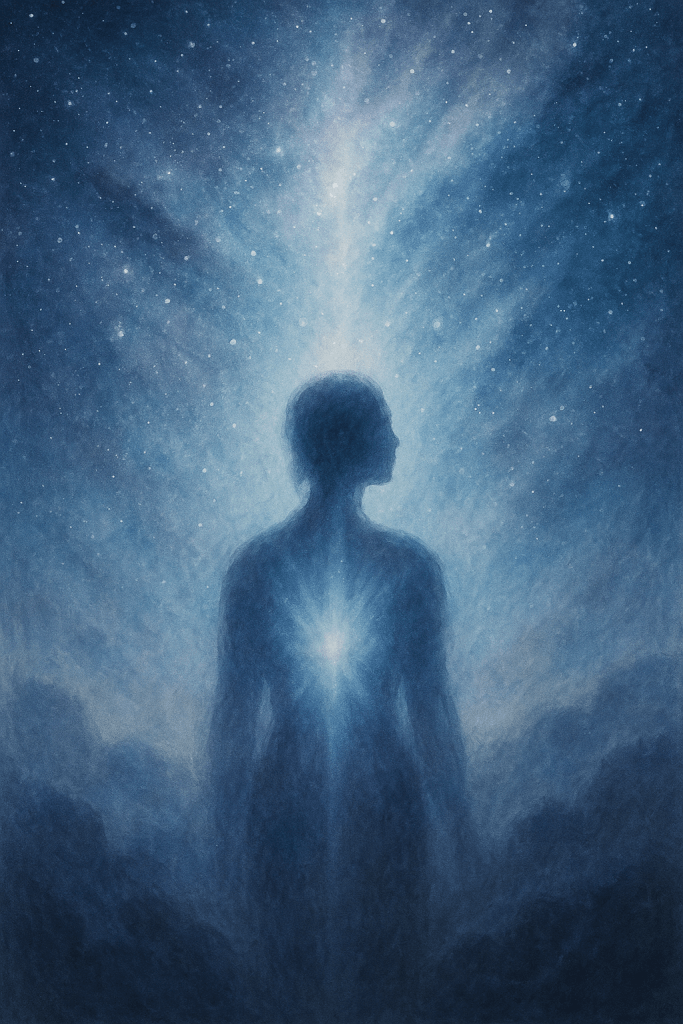
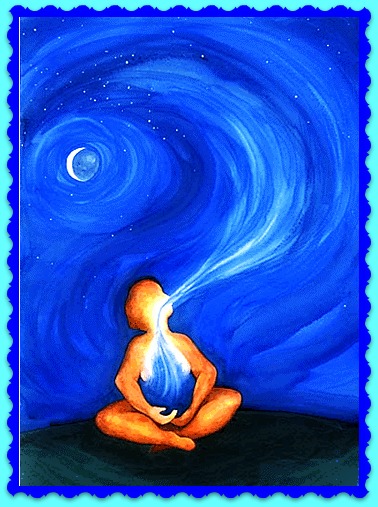
A serene figure outlined against a cosmic background, radiating light from the heart, symbolizing energy and spiritual healing.

One very profound thing my life has shown me is that all consists of energy vibrating at different frequencies — or what some may call “levels.” What appears to our logical, in-this-reality minds as solid and separate is, in truth, far from it. Basic science tells us that everything is made of atoms vibrating at different speeds. Quantum physics has gone even further, helping us understand that the solidity we perceive is not absolute. Consciousness is not limited by physical boundaries, nor by distance, nor by the illusion of the solid.

Where our attention and focus go, our energy flows. Music is a perfect example — its energy moves us, often literally. When sound is resonant and focused, it becomes a healing force. We feel it, and we dance.

Many of us have experienced how focusing on negativity seems to attract more of it, and the same goes for positivity. Our thoughts generate emotions, and our emotions generate energy. Change the thought, and you change the feeling. Feel the energy of an emotion, and it transforms. When released, it no longer holds power in the body — and in that transformation, we are no longer stuck. Blocked energy is a major contributor to illness and dis-ease. And dis-ease, at its root, is often simply the absence of ease within the Self.

Consciousness Beyond the Body

In conscious or active dreaming — sometimes called lucid dreaming, shamanic journeying, or astral travel — we become acutely aware that our consciousness is not confined to the body. In these states, we may fly, fall, or shape-shift. We may become animals, trees, mountains. We may walk through walls or explore “past” lives in bodies unfamiliar yet deeply known.

These experiences show us that we can merge with other energies, meet other beings — even interact with Souls who have passed on. In this space, time bends. Logic dissolves. And healing becomes possible on levels we often cannot reach in waking life.

I have found that when emotional resolution isn’t possible in physical reality, it can often be achieved through dreaming. Peace can be found. The nervous system can reset. The soul can breathe again.

Reiki and Seichim: A Personal Path

Most people are familiar with Reiki. Seichim, however, is less well known. I have received beautiful Reiki sessions that released energy gently or allowed me to drift into states of deep rest. But Reiki on its own, compared to the combined energy of Reiki and Seichim, is like comparing a torchlight to a spotlight. The combined energy is far more powerful.

Reiki is known as the wave of energy flowing in. Seichim is the wave flowing out.

Seichim is rooted in the teachings believed to have originated in Ancient Egypt (Sekhem), carried forward through Buddhist monks into India, and translated into Sanskrit. The hieroglyphic symbols for this energy are etched into pyramid walls and tombs. Sekhem is the domain of the lion-headed Goddess Sekhmet — both destroyer and healer. Kwan Yin, Goddess of Compassion, is associated with Seichim.

Like Reiki, Seichim can be practiced hands-on or from a distance. It is deeply feminine in nature — gentle, but direct. It addresses core patterns and beliefs, clears subtle body imprints, and helps restore physical, emotional, and spiritual health. As a tool for self-transformation, it accelerates personal evolution and brings us back into alignment with our fullest potential.

I have witnessed things during sessions that can only be described as miraculous. My hands often become hot, and I sometimes receive clear visions for the person I’m working with. These sessions are sacred. I never set an intention beyond asking that the session bring what is needed for the highest good.

My Story: Healing Through Energy

I once suffered for 18 years with a knee injury from a fatal car accident. I had seen specialists, done the rounds. Each told me I’d never regain full use of that knee. Then came my attunement to Reiki and Seichim. During that process, I released emotional trauma I hadn’t even realised I was carrying. And just like that — the pain lifted. I could walk without limping. I could bend my knee fully. It wasn’t subtle. It was transformational and miraculous.

My healing journey began with physical illness and dreams — profound, symbolic, and often startling experiences that reached far beyond ordinary sleep. As I began to work with them consciously, I realised they weren’t just stories; they were guides. They revealed emotional truth, soul memory, and future possibility, and they were the first threads in a much deeper transformation.

That unfolding, and everything it revealed about energy, healing, and connection, eventually led me to write The Promise: A Story of Love & Transformation. The book weaves together personal experience, soul connection, and the often invisible pathways that carry us toward wholeness. If my story speaks to something in you, you may find resonance within its pages too.

“Sometimes, we meet the ones who break us open—not to harm, but to awaken. Love doesn’t always look the way we thought it would, but it always arrives when the soul is ready. And when it does, there is no going back to sleep.”
The Promise: A Story of Love & Transformation

Healing isn’t always about fixing. Sometimes it’s about remembering. Returning to a truth you’ve always carried — that you are energy, that you are held, and that your inner world speaks in symbols, rhythms, and dreams. When you learn to listen, you start to come home.

If you’ve had a dream you can’t shake, a symbol that won’t let you go, or a feeling that something’s calling from beyond logic, follow it. That’s where the real work begins.

Working With Me

If you’re feeling drawn to experience distance healing or explore the symbolic language of your dreams, I offer personal and group sessions.

Session details, pricing, and the booking enquiry form can all be found on the Bookings and Payment page at www.cheoco.wordpress.com. Once your enquiry is received, I’ll be in touch with availability and next steps.

I’d be honoured to hold space for whatever is ready to move, release, or come home within you.

© Cheryl O’Connor 2025

Breathe, Feel, Heal: Remembering the Wisdom Within

“Dreamtime visions speak to me of the truth within,

Wisdom, Healing & Knowledge of Self to me they bring,

Helping me to know the true essence of my Soul,

enabling me to consciously experience

I AM …. One with the Whole.”

There is a life force running through all things. Some call it God, Spirit, Nature, Love, or Universal Energy. The name is less important than the feeling it brings and the healing it makes possible. When we remember this force, we begin to remember who we truly are.

For me, this energy first introduced itself through Reiki and later deepened with Seichim—two distinct yet connected frequencies of the same sacred current. Reiki is often associated with the Japanese lineage, while Seichim flows from Ancient Egypt, through the teachings of Sekhem and the energy of the fierce and compassionate goddesses Sekhmet and Kwan Yin.

Where Reiki is the wave flowing in, Seichim is the wave flowing out. Together, they form a complete cycle of energetic restoration.

A Multi-Layered Being

This healing work finds deep resonance with the Anthroposophical perspective of Rudolf Steiner, which sees the human being as a fourfold being:

  • Physical Body: The visible body, a map of our accumulated experiences and emotions.
  • Etheric Body (Energy Body): The life or breath body, responsible for vitality, healing, and rhythm. It thrives on sleep, air, water, nutrition, and nature.
  • Astral Body: The seat of memory and emotion. When the etheric is weakened, the astral can push through into the physical and cause dis-ease.
  • Core Self or “I AM”: The indwelling essence of who we truly are – divine, wise, and whole. This is not a “higher” self-perched on some pedestal, but the deepest truth of our being, right here, embodied. The notion of a “higher” self can often reinforce hierarchical thinking rooted in outdated paradigms. In truth, we are not reaching upward, we are remembering inward.

Further expanded by Barbara Brennan, this system includes seven energetic layers beyond the physical—each interpenetrating the other:

  1. Physical Body
  2. Etheric Body
  3. Emotional Body
  4. Mental Body
  5. Astral Body
  6. Etheric Template
  7. Celestial Body
  8. Ketheric Template

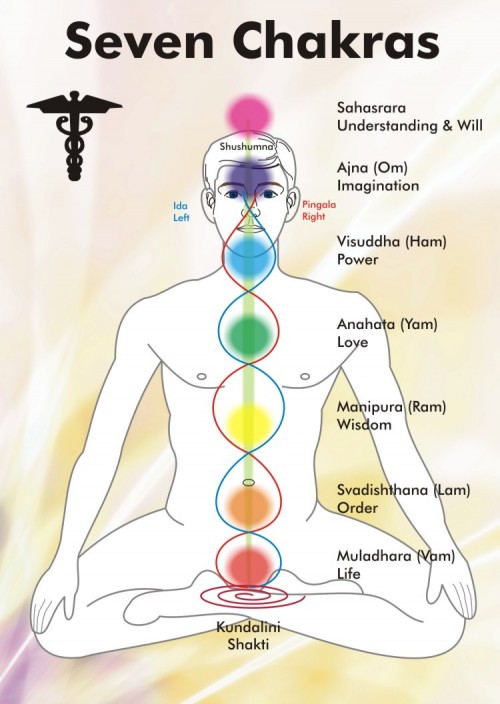
Each is linked to a chakra and vibrates at a unique frequency. Some healers also experience more than the standard seven chakras.

Blockages, Breath and the Map of the Body

In Reiki, Seichim, and Body-Based Counselling alike, imbalance and illness are seen to originate from energetic blockages—areas where life force energy cannot flow due to past trauma, grief, fear, suppressed emotions, or limiting beliefs. These imprints are stored in the subtle layers surrounding and entering the body.

When breath and awareness are consciously brought into these wounded areas, subconscious memories surface, and with them, release. In this process comes healing, insight, and a return to flow.

Brennan observed, “Illness is a result of imbalance, and imbalance is a result of forgetting who you are.” Others such as Baginski and Sharamon see symptoms as messages needing to be heard, accepted, and integrated before true healing can occur.

While approaches like CBT (Cognitive Behavioural Therapy) may assist some individuals in reframing thoughts and behaviours, they often stay in the mental realm. Deep transformation, however, often requires feeling, not just thinking. Jamie Sams says to feel is to heal. When emotion is acknowledged and expressed, the energy that has been held or suppressed is free to move again.

The Healing Power of Breath

When our bodies become stressed from pressure or anxiety, the adrenal glands release adrenaline. This hormone increases our heart rate to prepare for a fight-or-flight response. While this is a natural survival mechanism, it has side effects—particularly on the breath.

When we are anxious, our breathing becomes shallow. This reduces oxygen intake and can lead to fatigue, panic attacks, emotional distress, headaches, muscle tension, and even exacerbate conditions like PTSD.

Breath is life. It delivers oxygen to our cells and removes carbon dioxide, a key toxin. You can live without food or water for a time—but without oxygen, only minutes. Breath is also how we move life force energy. When pain is present, intentional breath can ease it. As infants and children, we naturally breathed into our bellies. But over time, many of us begin to breathe only into the upper chest, especially under stress.

Chest breathing results in irregular, rapid breaths. This reduces oxygen flow and limits the body’s ability to exhale toxins. The result? Fatigue, anxiety, and disconnection. The good news is: this pattern can be unlearned.

The Benefits of Cyclic Deep Breathing

  • Stimulates the lymphatic system, aiding detox and healing.
  • Strengthens immunity by supporting the body’s self-healing capacity.
  • Balances brain hemispheres and calms the nervous system.
  • Reduces anxiety and helps regulate emotional response.
  • Can be practiced anywhere, at any time, with no tools required.

A Gentle Word on Limitations

If you have asthma or another respiratory condition, cyclic breathing may not be appropriate. Please seek medical advice before practicing.

What Is Cyclic Breathing?

Cyclic breathing is a technique to calm the body and mind during times of stress, anxiety, or fear. One simple and accessible method is based on the Ho‘oponopono rhythm:

  1. Sit comfortably, feet on the ground. Place your hands on your lap or your belly.
  2. Notice your breath, just as it is.
  3. Then begin to breathe in for a count of seven.
  4. Hold for a count of seven.
  5. Exhale for a count of seven.
  6. Hold again for seven.

This is one round. Repeat it seven times.

You may also modify the count to suit your capacity. For example:

  • Inhale for 3, hold for 3, exhale for 3, hold for 3.
  • Or: Inhale for 3, hold for 3, exhale for 5, hold for 5.

Breathe slowly and gently, always staying within your comfort zone.

With consistent practice, abdominal breathing becomes natural again. You’ll notice your belly rising and falling as you breathe—just as it did when you were a child.

To support this, try practicing three times a day, or as needed. Repetition is key. Studies suggest it takes around 21 to 30 days to form a new habit. But the benefit is lasting: your body begins to remember the way home.


Enter, Exit, Behold: The Body Speaks

Body-Based Counselling draws on these same principles, using methods that access subconscious information directly through the body. Artistic therapies such as:

  • Clay work
  • Watercolour painting
  • Movement and gesture
  • Colour exploration

These tools bypass the analytical mind. Through simple yet profound methods like Enter, Exit, Behold, clients can step into a bodily sensation or pain, observe what wisdom it carries, and exit with the insight and resource needed for integration, without being overwhelmed or re-traumatised by the original emotion.

This process allows even unspoken or inexpressible emotions to be seen, shaped, and shifted. Pain takes form in clay. Breath is freed through movement. Colour returns to drawings that once looked lifeless. The intangible becomes tangible. Healing begins.

Real Lives, Real Healing

Here are a few examples that reflect the potency of these approaches:

  • A woman preparing for breast surgery received six sessions while also working with a naturopath. Just before the operation, scans revealed that the lumps had vanished.
  • A pregnant woman, leaking fluid after a medical procedure, came to me in a vision asking for help. I sent healing and saw the hole in the sac close. Two weeks later, she had stabilised.
  • A newborn boy with lung issues was hospitalised. After a brief hands-on healing session, he was released the next day. He later grew into a healthy twelve-year-old.
  • I lived with knee pain for seventeen years after a traumatic accident. Following my Reiki and Seichim attunement, I released grief I didn’t even know I was carrying. The pain disappeared.

The Counsellor’s Role

Just like with energy healing, true transformation in counselling comes when the client is ready and willing. The counsellor or practitioner simply creates a safe and sacred space, offers guidance, and teaches tools. But the work, the choice, the healing, comes from within.

Permission is essential. Unless a person asks, the energy cannot flow to them. Healing respects free will. When someone is ready and willing to receive, the field opens. Our role is to hold the space — not to push or fix, but to witness and support.

We do not fix. We empower. We do not impose. We invite.

Signs of Change

Change reveals itself in many ways: a client enters hunched, disconnected, anxious. After the session, they stand taller, breathe deeper, feel lighter. Art becomes more vibrant. Clay forms soften. Colour returns to the canvas. Their posture changes. So does their presence.

That is healing. That is remembering.

“The energy knows the way. All it needs is your yes.”


Video, Phone and Email Consultations Available
www.cheoco.wordpress.com
Email: cheoco99@yahoo.com.au
Microsoft Teams available by arrangement

© Cheryl O’Connor 2025

Images sourced from the internet – sources unknown.

Critical Social Policy Analysis and its Potential for Social Justice

Copyright A. Lathouras, C. O’Connor and G. Frawley. Peer reviewed Journal Article first published in New Community, Vol.21 (3)(83), pp. 26-31. 2023.

Abstract: If critical community development is committed to the pursuit of social justice and human rights, then a structural analysis of the root causes of oppression should be foregrounded. This then informs citizen advocacy to work towards social change. Moreover, practice in communities is shaped by social policy as it impacts the welfare of a nation’s citizens. The laws of the land comprise mechanisms for distributing society’s resources, and social policy is underpinned by values, driven by political objectives, and maintained by discursive practices. Drawing on Carol Bacchi’s (2009) critical approach to social policy analysis, this article presents two case study stories where social work students applied a structural analysis to examine the effects of social policy on First Nations communities. This analysis complements a critical approach to community development practice and guides progressive action. 

Introduction

At the University of the Sunshine Coast (UniSC), all social work students complete the courses: Community Development and Social Action and Critical Social Policy Analysis. The first author teaches both, and where theory intersects, critical approaches to both practices are foregrounded. The community development course draws from ideas in the critical tradition as articulated by Margaret Ledwith (2011). This is where practice seeks to build social solidarity and provide a lens through which existing societal structures are examined, enabling more egalitarian, supportive, and sustainable alternatives. Drawing from the Freirean tradition of community education (Freire, 1970 & Freire, 1974), and as radical educators, practitioners facilitate processes that empower people to analyse their lived experiences and collectively act in the hope of transforming those experiences.

For the context of social policy analysis, we gain inspiration from Saul Alinsky’s seminal text Rules for Radicals (1971). Alinsky called for a “reformation”, the process where masses of people reach a point of disillusionment with past ways and values and then, together, organise, build power, and change the system from within (Alinsky 1971:114). Discussing the importance of social democratic reform through citizenship, Alinsky (1971:115) was “desperately concerned” that masses of people, through lack of interest or opportunity, are resigned to live lives determined by others. He argued that, 

The spirit of democracy is the idea of importance and worth in the individual, and faith in the kind of world where the individual can achieve as much of his (sic) potential as possible…. Separation of the people from the routine daily functions of citizenship is heartbreak in a democracy (Alinsky 1971:115).  

Active citizenship can be traced back to the ancient Greek concept of agora, a site of political assembly, an interface between the public and private spheres of social life. In contemporary times, community development can be seen as an expression of “the political and politicized assembly of an active citizenry in civil society”, or a form of politics whereby citizens participate in civil society through communicative action to directly socialise policy issues (Geoghegan & Powell 2009:431).

Critical Social Policy Analysis

In the coursework at UniSC, we draw on Carol Bacchi’s (2009) theory to directly socialise policy issues. In her “What’s the problem represented to be?” approach to critical social policy analysis, Bacchi’s central thesis is that policies give shape to “problems” in society. Government cannot get to work without first problematising its territory, assuming the existence of problems that need to be ‘fixed’. Problematising is how something is represented as ‘a problem’, and social policy reflects what government thinks needs to change. Drawing on post-structural theories, where language or discourses are full of ideology and beliefs, these speak to and uphold one’s ‘truth’. Bacchi (2009) posits these are contested with taken-for-granted assumptions or presuppositions and can be interrogated with other possible standpoints. 

Bacchi’s six-question framework helps us with the interrogation:

  • Q1. What’s ‘the problem’ represented to be, or what’s the ‘problem representation’? Social policy students are encouraged to think from the policy writer’s perspective about the purpose of a policy, its vision, mission, and objectives.
  • Q2. What presuppositions or assumptions underlie this representation of the problem? Students are encouraged to put themselves in the shoes of the government and interrogate this question bothappreciatively and critically. For example, most social policies have strong social democratic and neoliberal underpinning ideology and language.
  • Q3. How has this representation of the problem come about?
  • Here students are encouraged to research the history of a chosen policy area, not from a ‘version control’ perspective, but from the perspective of how society’s attitudes and values have changed over time. For example, in a few short decades, we have gone from separating from society and institutionalising people with chronic disability; to deinstitutionalisation processes in the 1980s with block funding to NGOs; to the current National Disability Insurance Scheme where many people are in control of their own funding packages.
  • Q4. What is left unproblematic in this problem representation? This is where students are encouraged to draw from contemporary grey literature, including peak body reports and submissions to make arguments about what is silenced by the problem representation, or the way government has framed the issue.
  • Q5. What effects are produced by this representation of the problem?
  • Drawing on 500 hours of field education experience, students use their practice wisdom to name the effect on the people or end-users of the policy, both service users and fellow practitioners.
  • Q6. How could the problem representation be questioned, disrupted, and replaced? Here the tutors use a range of creative teaching techniques to help students think outside the box, and about how we can transcend the most deleterious effects of a policy on end-users or practitioners.  

Employing “authentic” assessment processes, which reaffirm the role of higher education in contributing to social justice (McArthur, 2023), students do a simulated policy advocacy presentation and write a simulated policy reform submission to government about the specific policy they’ve researched. The course this year has provided a sense of purpose and social work activism to final year social work students, Cheryl and Grace, co-authors of this paper. Below, each tells their story of applying Bacchi’s framework to social policy impacting on First Nations peoples. 

Cheryl’s Story – Close the Gap

With a legal background and a passion for community development work, recently I investigated an environmental issue impacting Indigenous inequality in Australia. I focused on the Close the Gap (CTG) Implementation Plan 2023, specifically Outcome 1, “Aboriginal and Torres Strait Islander People enjoy long and healthy lives” and 9b, “Safe and reliable water for remote and regional First Nations Communities”. Under the recently elected Labor government, the 2023 version of the Close the Gap social policy seems collaborative with First Nations people, which is a significant improvement over past efforts by various governments. Since writing the 2005 Social Justice Report, Professor Tom Calma AO, argues progress has been made toward achieving health and life expectancy equality for Aboriginal and Torres Strait Island peoples (Australian Indigenous Health Info Net, nd). However, the 2020 Close the Gap report highlighted that:

  • The Indigenous child mortality rate was 141 per 100,000 which is twice that of non-Indigenous children (Australian Government, 2020b).
  • Life expectancy at birth was 71.6 years for Indigenous males and 75.6 years for Indigenous females. In comparison, the non-Indigenous life expectancy at birth was 80.2 years for males and 83.4 years for females (Australian Government, 2020c).
  • During 2015 and 2017 the lowest life expectancy occurred in the Northern Territory (66.6 years for males and 83.4 years for females) (Australian Government, 2020c).

Concerning Outcome 1 of the policy, one of the current commitments is the funding of 30 four-chair haemodialysis units and two dialysis treatment buses throughout Australia. Because of a 2022 report by Water Services Association of Australia (WSAA) which identified 500 Indigenous communities lacking drinkable water due to elevated levels of uranium, arsenic, fluoride, and nitrate above Australian drinking water guidelines, CTG’s Outcome 9b allocates $150 million to the National Water Grid Fund for targeting clean drinking water access in Australian rural and remote communities. The report also found that regular water quality testing in these communities does not occur (WSAA, 2022). 

Initially conducting research for an environmental issue concerning Indigenous Australians, I was able to tie the two outcomes together (1 and 9b), which in the reading of CTG policy, did not appear to be connected.  Outcome 1 was only addressing symptoms by providing more dialysis units, not mentioning, or looking at the probable causes of increasing numbers of chronic kidney disease (CKD).

My preliminary research found evidence highlighting the lack of safe, clean water in the remote Aboriginal community of Laramba, Northern Territory and how despite community efforts to eliminate what they suspected was contaminated water via a court case, there were no laws requiring landlords to provide safe water (ABC News 2022a). Subsequently, the community lost the case. Ultimately, it took 15 years from when concerns were first raised by the Laramba community regarding their water supply before the Northern Territory government constructed and opened a water filtration plant for the community in April 2023 (Northern Territory Government and Information Services, 2023).

The present Australian Drinking Water Guideline level for uranium is 0.02mg/l and current testing reveals that the uranium level in the Laramba water supply has now dropped from between 0.029mg/l – 0.055mg/l to 0.01mg/l (Northern Territory Government and Information Services, 2023) because of the new filtration system.

In the remote Aboriginal community of Kiwirrkurra, Western Australia, the dialysis clinic had to be closed for two years due to contaminated water, and community members needing lifesaving haemodialysis had to travel 800 kilometres for treatment (Purple House, nd; ABC News, 2022b). The Kiwirrkurra article led me to Purple House, a non-profit Indigenous-run health organisation based in Alice Springs that provides haemodialysis treatments in clinics and services remote areas by bus. I spoke with Mr Michael Smith, bio-medical engineer at Purple House, who had invented and won an award for developing a reverse osmosis filtration system that had enabled the Kiwirrkurra clinic to re-open. Even though the clinic had re-opened, the community still did not have safe drinking water and it was reported that 700 bottles of water were being shipped in each week, creating a mountain of rubbish (ABC News, 2022b).

I had several conversations with Mr Smith concerning water quality in remote areas, the high volume of clean water required for haemodialysis treatments and the links between rancid tasting water, the substitution of drinking water for sugary drinks, diabetes, and subsequently CKD. Based on information provided by Mr Smith it is estimated that one patient requiring haemodialysis (3 treatments lasting between 3 to 5 hours per week), requires a total of 70,200 litres of clean, safe water per year. We also discussed the cost of commissioning and installing 20 reverse osmosis filtration systems in the remote communities that Purple House services, so that haemodialysis treatments could occur effectively within communities without community members needing to relocate or travel long distances.

Further research into chronic kidney disease (CKD), revealed that concerns have been growing among healthcare providers, affected community members and leaders regarding the increasing cases of diabetes and CKD in remote Aboriginal communities for quite some time (Rajapakse et. al., 2019; Pan, Owen & Oddy, 2021; Australian Bureau of Statistics, 2019). It was revealed that CKD has a probable cause associated with unpalatable or contaminated groundwater (Rajapakse et.al., 2019). Sugar-sweetened beverages, when substituted for water in communities where the water is rancid and undrinkable, have proven to create obesity which then leads to diabetes, renal failure, and other health issues (Gajjala, 2015; Hormones Australia Endocrine Society of Australia, 2018; Pan, Owen & Oddy, 2021).

Moreover, diabetic nephropathy is the most common type of kidney disease found in pregnant women (Fischer, 2007). A study in 2015 revealed that pregnancy in those with kidney disease had 52 per cent increased odds of preterm delivery and 33 per cent increased odds of caesarean delivery (Kendrick et. al., 2015). Infants whose mothers had kidney disease had 71 per cent increased odds of needing admission to neonatal intensive care units or death, and kidney disease in mothers created a 2-fold increased odds of low birth weight (Rajapakse et al 2019). Maternal kidney disease substantially increases the incidence of “death, foetal prematurity, and low birth rate” (Fischer 2007, p. 135). The Australian Institute of Health and Wellbeing also state that 57 per cent of Indigenous infant deaths that occurred between 2015 and 2019 were due to prenatal conditions (Australian Government Institute of Health and Welfare, 2023).

By using Bacchi’s (2009) framework, I found a situation of symptoms only being addressed in the policy and no evidence that the government was linking the connection I could see between the lack of safe, clean water and the high rates of CKD occurring in Western Australia, where it is endemic (Rajapakse et al., 2019), and in the Northern Territory. The lack of clean, safe water in the remote communities of the two jurisdictions is not news to federal or state governments as there has been an ongoing health crisis due to unsafe water that multiple reports have brought to their attention over the years. Yet it is only now that the State and Federal Governments are beginning to address the water issues.

Employing Bacchi’s question six about how the problem representation could be questioned, disrupted, and replaced, I made two recommendations. The first was to invest $1 million of the $150 million currently allocated in Outcome 9b of the CTG policy, to the National Water Grid Fund to install reverse osmosis filtration systems at the 20 sites Purple House services. If enacted, this would ensure safe and reliable water for those remote First Nations communities. The second recommendation was to immediately commence water quality testing in the 500 communities the WSAA has identified as having undrinkable water. If enacted, this would provide both the State and Federal Governments with a priority list of communities where water treatment processing plants need to be constructed.

Grace’s Story – Domestic and Family Violence Prevention

The social policy I analysed was the Queensland Domestic and Family Violence Prevention Strategy 2016-2026. This prevention strategy provides a framework for government to act against domestic and family violence and has four subsequent action plans, with the most recent action plan addressing coercive control (Queensland Government, 2016). The reason I chose to analyse this policy is because the Queensland Government plans to legislate coercive control by the end of this year, therefore highlighting the need for a current structural analysis of the problem. The Strategy has a vision of creating a Queensland free from domestic and family violence. Specifically, an objective is to legislate and criminalise coercive control by the end of 2023 with the overall aim of eliminating domestic and family violence.

My research found that compared to men, women are three times more likely to experience domestic and family violence, with one woman being murdered every week by a partner (Our Watch, 2023). Moreover, First Nations women are disproportionately more likely to experience domestic and family violence and are eleven times more likely to be killed due to family violence compared to non-Indigenous women (Commonwealth of Australia, 2022).  

A key characteristic of intimate partner homicide is a relationship in which coercive control is used to isolate and control the woman by a range of mechanisms, most of which are invisible to the public (Boxall et al., 2022). Drawing on Bacchi’s question three, I understand that historically, Australia has had a culture deeply engrained with normalising violence against women and maintaining silence about what happens in the private realm (of the home) (Piper, 2019). This culture has normalised domestic and family violence, so much so one can buy a singlet called the ‘wife beater’. Radical feminist discourse suggests the root cause of women’s oppression is in patriarchal gender relations (Pilcher & Whelehan, 2017; Damant et al., 2008), and this informs my belief that in the private realm a woman’s life is where the relationship itself is used as a mechanism of subordination. Furthermore, I now recognise Australia as a patriarchal society that supports this dominant ideology which is used to sustain the isolation of women to the private realm by limiting their ability to participate in the community. This has created a cultural norm in which women stay home and raise children while male partners go out and work (Baxter, 2018). In some households, this can turn a relationship into one of dependency and subservience creating ideal conditions for coercive control to take place (Stark, 2012).

However, I identified that this gendered structural analysis of domestic and family violence does not consider the detrimental socio-economic and cultural impacts of colonisation on First Nations women, impacts that contribute to their experiences of domestic and family violence. These include intergenerational trauma, economic exclusion and dispossession of land and family (Australia’s National Research Organisation for Women’s Safety [ANROWS], 2023). Evidence suggests that 70% to 90% of First Nations women in prison have experienced domestic and family violence either as a child or an adult (Commonwealth of Australia, 2022). First Nations women are overly represented in the criminal justice system and are often misidentified as the person who uses violence (Commonwealth of Australia, 2022). Furthermore, retaliation for their own protection or the protection of their children or misidentification due to racial stereotypes often leads to co-responding protection orders being placed against the victim-survivor (Commonwealth of Australia, 2022). Therefore, the intersection between gender inequality and racial inequality highlights that domestic and family violence can be much more than a cultural issue (ANROWS, 2016). 

Drawing on Bacchi’s question four about what is left problematic with government’s framing of a policy issue, I identified that consultation with First Nations women on this issue and the legislation of coercive control is imperative for Government to understand how this could create further harm to First Nations communities if not properly implemented. The discourse used within the prevention strategy suggests that the behaviours around coercive control need to change. Although this creates an assumption that the community has a comprehensive understanding of coercive control and are therefore capable to commit to change. Additionally, the 2021 National Community Attitudes Towards Violence Against Women Survey shows that 41% of respondents believed that domestic and family violence is committed equally by men and women (ANROWS, 2021). This suggests that the community is still unaware of unequal gender relations and how this influences domestic and family violence.

Additionally, there is an assumption that the criminalisation of coercive control will address the help seeking behaviours of women experiencing domestic and family violence, although the evidence suggests that rates of help seeking are higher for women who experience coercive control as well as physical and/or sexual abuse, rather than just coercive control (Boxall & Morgan, 2021). Furthermore, it is evident that the current systems we have in place are inadequate to support victim-survivors, with service organisations and law enforcement already overrun and struggling to keep up with rates of domestic and family violence (Burt & Iorio, 2023). Our systems that support victim-survivors of domestic and family violence have been structured as crisis responses that offer immediate safety planning, accommodation, and case management. This support is happening after the violence has already occurred with most services meeting woman who are at ‘rock bottom’ and already in grave danger.

After I researched similar social policy in other countries, I discovered that although England and Wales criminalised coercive control in 2015 the understanding of what constitutes coercive control and the ability to recognise it is still unclear. This impacts the practices and responses of service delivery. Additionally, missed or under reporting of coercive control has led to inadequate assessments of risk, resulting in victims being overlooked and murdered (Robinson, Myhill & Wire, 2018). I believe, therefore, a robust approach to re-structuring and re-defining domestic and family violence is needed.

During my policy advocacy presentation and review submission, I made a recommendation to governments to establish a nationwide definition of coercive control enabling a shared understanding and an unambiguous approach to responding to coercive control. Defining coercive control will encompass all forms of nonphysical violence, and will provide law enforcement, the community, and legal systems with a clear definition to respond effectively and lessen the deleterious impacts of this issue facing First Nations women.  

Conclusion

Bacchi’s critical questioning framework for policy analysis draws on social construction theory, about what we take to be ‘fixed’ reality is actually contextual, historical and changing. It also draws on feminist body theory and acts as a counterbalance to focus on people’s perceptions, ensuring that lived experience receives due recognition. Grace and Cheryl’s stories of social policy analysis provide an excellent example of how practitioners could use the framework and work with communities to develop their own structural analysis about the root causes of ongoing disadvantage. The issues raised by them paint a damning picture of a vulnerable population group whose voices are not yet being given space at the policy-making table. 

References

ABC News 2022a, NT Laramba residents consider further court action as absence of safe water laws problematic, viewed 28 May 2023, NT Laramba residents consider further court action as absence of safe water laws problematic – ABC News 

ABC News 2022b, Residents of remote Kiwirrkurra are worried about tap water, but a reverse osmosis water purifier could help, viewed 28 May 2023, Residents of remote Kiwirrkurra are worried about tap water, but a reverse osmosis water purifier could help – ABC News 

Alinsky, S 1971, Rules for Radicals, Random House, New York.

Australian Bureau of Statistics 2019, viewed 28 May 2023, National Aboriginal and Torres Strait Islander Health Survey, 2018-19 financial year, Australian Bureau of Statistics (abs.gov.au) 

Australian Government 2020a, Closing the Gap Report, viewed 27 May 2023, Closing the Gap 2020, Closing the Gap (niaa.gov.au)  

Australian Government 2020b, Child Mortality, viewed 27 May 2023, Child Mortality, Closing the Gap (niaa.gov.au)

Australian Government 2020c, Life Expectancy, viewed 27 May 2023, Life Expectancy, Closing the Gap (niaa.gov.au)  

Australian Government 2022, National Health and Medical Research Council, Australian Drinking Water Guidelines, viewed 28 May 2023, Australian_Drinking_Water_Guidelines_ADWG_V3-8_Sep2022.pdf

Australian Government 2023, Commonwealth Closing the Gap Implementation Plan, viewed 27 May 2023, 2023 Commonwealth Closing the Gap Implementation Plan, National Indigenous Agency (niaa.gov.au).  

Australian Government Institute of Health and Welfare 2023, Chronic Kidney Disease: Australian Facts, viewed 28 May 2023, Chronic kidney disease: Australian facts, Mortality-Australian Institute of Health and Welfare (aihw.gov.au).

Australian Government Ministers, Department of Health and Aged Care, viewed 31 May 2023, New renal dialysis units for remote First Nations patients, Health Portfolio Ministers and Aged Care. 

Australian Indigenous Health Info Net nd, viewed 27 May 2023, History of Closing the Gap – Closing the Gap – Australian Indigenous HealthInfoNet (ecu.edu.au)

Baxter J, 2018, ‘Fathers and Work: A statistical overview’, Australian Institute of Family Studies.

Australia’s National Research Organisation for Women’s Safety 2016, Existing knowledge, practice and responses to violence against women in Australian Indigenous communities: State of knowledge paper, Australia’s National Research Organisation for Women’s Safety, August 2, 2023, https://www.anrows.org.au/publication/existing-knowledge-practice-and-responses-to-violence-against-women-in-australian-indigenous-communities-state-of-knowledge-paper/.

Australia’s National Research Organisation for Women’s Safety 2021, The 2021 National Community Attitudes towards Violence against Women Survey, Australia’s National Research Organisation for Women’s Safety, August 2, 2023, https://www.anrows.org.au/publication/attitudes-matter-the-2021-national-community-attitudes-towards-violence-against-women-survey-ncas-findings-for-australia/.

Australia’s National Research Organisation for Women’s Safety Fast Facts- Indigenous Family Violence, Australia’s National Research Organisation for Women’s Safety, August 2, 2023, https://www.anrows.org.au/resources/fast-facts-indigenous-family-violence/#:~:text=This%20resource%20provides%20a%20brief,to%20inform%20their%20decision%2Dmaking.

Bacchi, C 2009, Analysing Policy: What’s the Problem Represented to be? Pearson, Frenchs Forest.

Boxall, H, Doherty, L, Lawler, S, Franks, C & Bricknell, S 2022, The “Pathways to intimate partner homicide” project: Key stages and events in male-perpetrated intimate partner homicide in Australia, Australia’s National Research Organisation for Women’s Safety, August 2, 2023, https://anrowsdev.wpenginepowered.com/wp-content/uploads/2020/04/Boxall-et-al_Pathways-to-intimate-partner-homicide.2.2.pdf.

Boxall & Morgan 2021, Experiences of coercive control among Australian women, Australian Government, August 2, 2023, https://www.aic.gov.au/sites/default/files/2021-03/sb30_experiences_of_coercive_control_among_australian_women_v2.pdf.

Burt, J & Iorio, K 2023, Domestic violence law reforms pass Queensland parliament, but consultation on criminalisation of coercive control continues, ABC News, August 2, 2023, https://www.abc.net.au/news/2023-02-23/coercive-control-queensland-parliament-domestic-violence-laws/102012376.

Commonwealth of Australia 2022, National Plan to End Violence against Women and Children 2022–2032, Department of Social Services, August 2, 2023, https://www.dss.gov.au/sites/default/files/documents/11_2022/national_plan_to_end_violence_against_women_and_children_2022-2032.pdf.

Damant, D, Lapierre, S, Kouraga, A, Fortin, A, Hamelin-Brabant, L, Lavergne, C & Lessard, G 2008, “Taking child abuse and mothering into account,” Affilia, 23(2):123–133, https://doi.org/10.1177/0886109908314321.

Freire, P 1970, Pedagogy of the oppressed. Penguin.

Freire, P 1974, Education for critical consciousness. Continuum.

Gajjala, Prathibha Reddy & Sanati, Maryam & Jankowski, Joachim 2015, Cellular and Molecular Mechanisms of Chronic Kidney Disease with Diabetes Mellitus and Cardiovascular Diseases as Its Comorbidities. Frontiers in immunology, Vol 6, p. 340. 10.3389/fimmu.2015.00340 

Geoghegan, M & Powell, F 2009, ‘Community Development and the Contested Politics of the Late Modern Agora: Of, Alongside or Against Neoliberalism?’, Community Development Journal, Vol. 44, No. 4, pp. 430-447.

Hormones Australia Endocrine Society of Australia 2018, Kidney Disease and Diabetes – What is the Link? Dr Nicolette Hodyl, viewed 26 May 2023, Kidney disease and diabetes – what is the link?, Hormones Australia (hormones-australia.org.au).

Kendrick J, Sharma S, Holmen J, Palit S, Nuccio E & Chonchol M 2015, Kidney disease and maternal and fetal outcomes in pregnancy, American Journal of Kidney Disease, Vol 66, no.1, pp.55-9. doi:10.1053/j.ajkd.2014.11.019. 

Ledwith, M 2011, Community development: A critical approach (2nd ed.). Policy Press.

McArthur, J 2023, ‘Rethinking authentic assessment: work, well-being, and society’, Higher Education, Vol. 85, pp. 85-101.

Northern Territory Government and Information Services 2023, viewed 28 May 2023, Laramba Water Treatment Plant officially opened | NT.GOV.AU 

Our Watch 2021, Quick facts Preventing violence against women, August 2, 2023, https://www,ourwatch.org.au/quick-facts/.

Pan F, Owen N and Oddy W 2021, Sugar sweetened beverages and increasing prevalence of type 2 diabetes in the Indigenous community of Australia, Nutrition, Metabolism and Cardiovascular Diseases, Vol 31, no. 10, Pages 2825-2830, https://doi.org/10.1016/j.numecd.2021.06.014

Our Watch 2021, Quick Facts Preventing Violence Against Women, August 2, 2023, https://www.ourwatch.org.au/quick-facts/.

Piper, A & Stevenson, A 2019, The long history of gender violence in Australia, and why it matters today, The Conversation, August 2, 2023, https://theconversation.com/the-long-history-of-gender-violence-in-australia-and-why-it-matters-today-119927.

Queensland Government 2016, Domestic and Family Violence Prevention Strategy 2016-2026, Queensland Government, August 2, 2023, https://www.publications.qld.gov.au/ckan-publications-attachments-prod/resources/008db60d-06e9-4702-bb87-48be367edf93/dfv-prevention-strategy.pdf?ETag=ef56a614ca32eedadca2acffc3f37578.

Robinson, AL, Myhill, A & Wire, J 2017, “Practitioner (mis)understandings of coercive control in England and Wales,” Criminology & Criminal Justice, 18(1):29–49, https://doi.org/10.1177/1748895817728381.

Stark, E 2012, “Looking beyond domestic violence: Policing coercive control,” Journal of Police Crisis Negotiations, 12(2):199–217, https://doi.org/10.1080/15332586.2012.725016.

The University of Queensland Australia 2022, viewed 3 August 2023, Countless reports show water is undrinkable in many Indigenous communities. Why has nothing changed? – Faculty of Medicine – University of Queensland (uq.edu.au) 

 Water Services Association of Australia 2022, viewed 28 May 2023,  Gaps to fill to ensure safe drinking water for First Nations communities | Water Services Association of Australia (wsaa.asn.au) 

Whelehan, I & Pilcher, J 2017, Key concepts in Gender Studies, https://doi.org/10.4135/9781473920224.