Articles

Nocturnal Communion:


When the Dream Lover Comes Bearing Fire

“Dreamtime lover comes to me,
helping me to clearly see
all I truly need to know—
your love for me you always show.

Guiding me to do what’s right,
giving me strength and insight.
Physically separate but living as One,
teaching me what needs to be done.

Knowing our love only grows and can never end,
as you assist me gradually to my Self mend.”

Have you ever woken with your body humming, breath quickened, heart strangely full? A dream so vivid, it left you aching—or glowing—with something you couldn’t quite name?

So many whisper it quietly:
“I had the most intense dream last night… but I can’t tell you. It’s too much.”

But I say, tell me everything. Because these dreams? They are sacred. They’re not just about sex. They are about energy. Integration. Memory. Reclamation.

We give this energy so many names: sexual energy, creative energy, Kundalini, God, Goddess, Great Spirit, Divine Union, Reiki, Seichim, Universal Life Force. But they are all rivers feeding the same source – the wild current of life itself. And its most ecstatic, alchemical expression? Orgasm. There’s a reason we cry out “Oh God” in those moments of deep pleasure. It’s not blasphemy. It’s a soul-deep remembering.

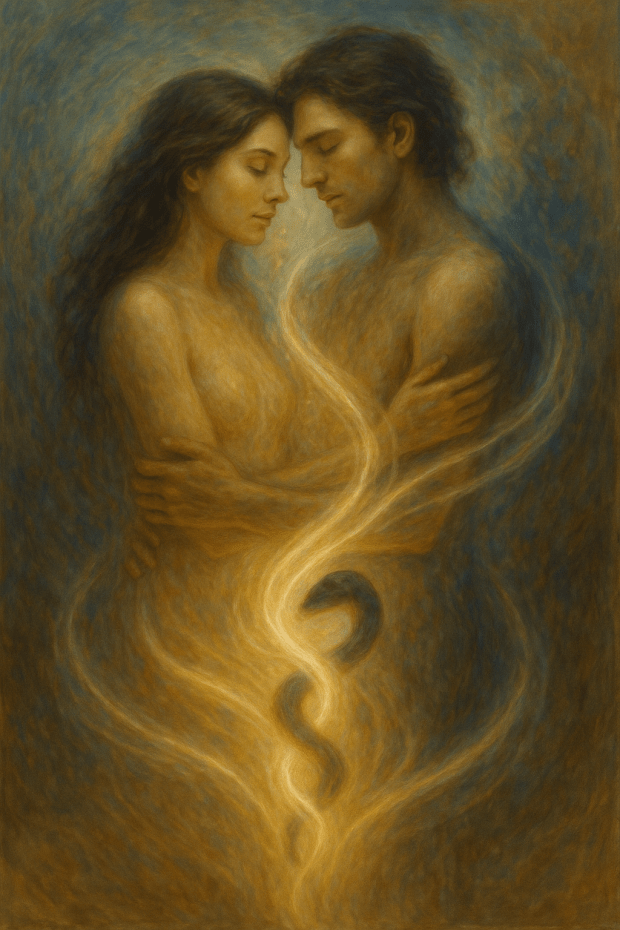
In dreams, anything becomes possible. We may find ourselves in the arms of a stranger, a past lover, someone we’ve never touched in waking life, but who feels as familiar as our own breath. Sometimes we merge with spirit beings, ancestors, archetypes. The forms may be surreal, symbolic, or shapeshifting, because dream lovers aren’t always literal, they’re invitations.

Invitations to reunite with soul threads. To embody the Lover, the Serpent, the Priestess, the Healer. To meet ourselves in forms we’ve long silenced or disowned. Often, it’s not about the person at all, but what they represent. Power. Passion. Tenderness. Permission. The dream body remembers what the waking mind forgets.

And let’s name the deeper truth now: soul-level communion is real. These dreams don’t always stay contained in the psyche. Sometimes, they’re shared experiences. If you’re thinking of someone with strong emotion, longing, desire, even grief, that thought becomes energy. It moves. It reaches. And if the other is attuned to you, they may feel it. Not as a conscious thought, but as a subtle frequency. A stirring in the night. A dream they can’t quite shake.

This is the intelligence of the soul field. Where time and space dissolve. Where lovers remember each other through the veil.

These dreams often arrive during times of emotional or energetic opening. When we’re grieving, creatively blocked, repressing desire, or navigating a threshold, these dreams come as messengers. They bring healing. They activate dormant parts of the body. They offer closure, clarity, confirmation. They reignite our connection to joy, to power, to the sacred yes of aliveness.

Even dream-orgasms, yes, they’re real, can be profoundly healing. Especially if touch, pleasure, or intimacy has been absent in waking life. And yet so many carry shame. They wake from these dreams wondering, “What’s wrong with me?” Especially if the imagery was strange, forbidden, or “inappropriate.” But erotic dreams don’t come to shame us, they come to liberate us.

We’ve all dreamt of partners we wouldn’t choose in the light of day, same-sex lovers, celebrities, even people from our past we’d rather forget. But dreams are symbolic. They’re the soul’s poetry. They speak in images, sensations, and metaphor. And they ask us not to judge, but to listen.

What part of me does this represent?
What wants to be felt, healed, or reintegrated?
What am I being invited to remember?

Erotic dreams are not just about sex. They’re about wholeness. They’re about power reclaimed. They’re about love, sometimes for another, often for the self. And sometimes, they are simply about joy. And that, too, is sacred. So next time your dream lover comes bearing fire, welcome them. Feel what wants to be felt. Honour what wants to be healed. And if you wake with tears, a sigh, or a sweet ache that lingers into the day, know this:

It wasn’t just a dream.
It was a remembering.


📚 Further Reading & Exploration

  1. Robert MossConscious Dreaming
    On dream travel, soul connection, and shared dreaming experiences.
  2. Barbara BrennanHands of Light
    A classic text on energy fields, cords, and how emotion/thought affects others.
  3. Anodea JudithWheels of Life
    A deep dive into chakras, creative/sexual energy, and inner integration.
  4. Toko-pa TurnerBelonging: Remembering Ourselves Home
    On the sacred art of dreamwork and returning to the soul’s truth.
  5. Clarissa Pinkola EstésWomen Who Run With the Wolves
    Archetypal stories that explore feminine psyche, longing, and reclamation.
  6. Mantak ChiaThe Multi-Orgasmic Man/Woman
    Taoist teachings on sexual energy as sacred and transformative force.
  7. Rupert SheldrakeMorphic Resonance
    A scientific view of non-local connection and shared fields of experience.

© Cheryl O’Connor, 2014 & 2025. All rights reserved.
Please do not reproduce without permission. Sharing with credit and a link is welcome.

•*´☾☆☽`*•

🌿 Explore more of my writing, creations, and soul-guided offerings at:

cheoco.net

📖 Read my book, The Promise: A Story of Love & Transformation
Download here

💫 Connect with me on Facebook:
facebook.com/cheococreates

🌕 Ever had a dream that left your soul stirred and your body buzzing?
I’d love to hear. Drop a note in the comments or share this with someone who dreams in symbols too.

FEAR BASED CONDITIONING

We all come with abundant courage, trust and love into this world. As infants, we trust our needs will be met. We’re fed, clothed, sheltered—and, ideally, loved. We play in nature, explore the world with awe, and live in the now. There’s no concept of lack or limitation.

So where does all that innate trust, courage and love go?

It gets smothered, slowly, by a blanket of fear-based conditioning.

“Don’t fall.” “Be careful.” “Don’t climb that.” “Don’t cry.” “Don’t speak to strangers.”

From the moment we begin exploring, we are bombarded with warnings. Many are well-meaning. But the message we receive is that the world is dangerous, our bodies are fragile, and our instincts can’t be trusted. Over time, our nervous systems internalise this. What starts as care becomes caution. What begins as protection becomes suppression. And what once was joy becomes fear.

This conditioning isn’t just psychological—it’s somatic. Repeated warnings trigger the body’s stress response, even when no real danger exists. Studies show that chronic activation of this response in childhood can lead to long-term dysregulation of the nervous system, laying the foundation for anxiety, depression, and autoimmune disorders. (See: Harvard Center on the Developing Child, 2010; Van der Kolk, 2014.)

We learn to mute our natural expressions. To cry quietly. To sit still. To put on masks.

We’re told to leave our feelings at the door. “Be professional.” “Leave your personal stuff at home.”

Yet humans aren’t machines. We carry our emotions, energy, stories and unprocessed grief into every space. Telling someone to leave their pain behind is like asking the ocean not to wave.

So, we cope. We numb. We perform.

We medicate ourselves with coffee, alcohol, sugar, nicotine, binge-watching, overworking—whatever dulls the ache. We long for weekends, dread Mondays, and confuse productivity with purpose. The more we ignore our inner world, the louder our bodies must speak—through illness, fatigue, or emotional outbursts.

This is not living. This is surviving.

And it’s no surprise that disconnection—internally and from others—leads to chronic stress, burnout, and a lack of meaning. As Gabor Maté writes, “When we have been prevented from learning how to say no, our bodies may end up saying it for us.”

Our systems reward burnout. We idolise busyness. We dismiss embodiment and emotional intelligence.

And yet, somewhere deep inside, we remember.

We remember the joy of dancing in the rain, the wonder of staring at clouds, the heartbeat of the earth beneath our bare feet. We remember what it feels like to trust ourselves.

What silences that voice?

Fear.

Fear, like all emotions, is energy. I see it as a contraction, a tightening of energy, whereas love is an expansion, a flow of energy.

When we sit with fear or anxiety, whether in our minds or bodies, it intensifies. We may feel stressed, unable to think clearly, or even slip into panic, neurosis, or paranoia. Fear can also paralyze us, or it may erupt as a reaction. Beneath anger, fear and pain often hide.

When we allow ourselves to fully experience and feel the anger, pain, regret, guilt, or shame that fear has been masking, the fear dissipates, and in its place, courage emerges. Often, this process also brings new insights and solutions that were previously hidden.

Our minds can amplify fear by spinning “what if” scenarios—often imagining outcomes that never come to pass. These imagined fears can cause unnecessary stress and anxiety, especially when they haven’t even materialized.

If we have a wound we’ve been protecting, and something triggers it, the “band-aid” comes off, exposing us to fear again. This can lead to a double layer of fear: the immediate reaction to the trigger and the deeper fear stemming from the original wound—or even multiple past wounds.

Shifting fear is no easy feat, and it can take time. But once we face it, and sit with the pain that lies beneath, fear melts away. In its place, we find love, peace, and clarity.

Fear of rejection. Of being judged. Of not being enough. Of failing. Of not fitting in. Of speaking our truth. Of losing love. Of death.

False Evidence Appearing Real.

Most of what we fear never actually happens. And the few things that do? We survive them. We grow through them. Sometimes, they become the very catalysts that awaken us.

So what if we re-learned how to trust ourselves? What if we began untangling the knots of fear-based conditioning, one thread at a time?

What if we let the grief rise instead of stuffing it down? What if we let our bodies dance when the music moved us? What if we started saying yes to what lights us up and no to what drains us?

This is not naive. It’s necessary.

Life isn’t meant to be a grind. It’s meant to be a creation.

If you’re ready to tear up the script of fear, I have scissors in my kit and a hand to hold. Together, we can unweave the tangle.

With love, C.


References for deeper reading:

  • Bessel van der Kolk, The Body Keeps the Score, 2014
  • Gabor Maté, When the Body Says No, 2003
  • Harvard Center on the Developing Child, “Toxic Stress and Brain Architecture”
  • Peter Levine, Waking the Tiger, 1997
  • Stephen Porges, The Polyvagal Theory, 2011

© Cheryl O’Connor, 2025. All rights reserved. Please do not reproduce without permission. Sharing with credit and a link is welcome.

Killer Stress: How Modern Life is Breaking Us

It seems fairly acceptable in our society these days to accept stress as “normal.” Technology designed to make life easier has, in fact, made life busier, with a constant flow of information, requests, and demands on our time. We live dictated by calendars, bank balances, and the ticking of the clock, numbers we react to as though they were threats.

More and more automated voice options on phones that fail to connect us to an actual human being add to our daily tension, offering less support and more frustration. Time for real food and deep connection shrinks as we all become… “so busy.”

Once, we wrote letters, posted them, and waited. Now, emails ping, and we feel a pressure to respond instantly. It’s not just a pace; it’s a mindset of urgency. Productivity is the new idol, and the pressure to outperform for profit isn’t just found in the workplace, it’s embedded in our nervous systems (Rosen, 2020).

We’re saturated with disasters, grief, and horror from every corner of the globe. Not only is this overwhelming, but our stress response is being constantly triggered by situations we can’t control (Sahakian et al., 2015). Gratitude for safety is real but so is the burden of helplessness. And the truth is: we can always turn it off. But often, we don’t.

The deeper issue is that when we do need to hibernate, retreat, rest, withdraw, we’re told we’re lazy, self-indulgent, or not resilient enough (Biron et al., 2012).

Even our own government has proposed raising the age at which people become eligible for support—further extending the years we’re expected to stay in the workforce. The message is clear: keep working, keep producing, keep pushing. And burnout? That’s just the cost of survival, apparently a cruel irony when burnout is already rampant.

Snappy voices, reactive outbursts, and social disengagement often stem from chronic stress. People aren’t present. They’re time-travelling, replaying the past or pre-living future disasters. And that lack of presence? That’s the real cost (Kabat-Zinn, 2005).

We are not machines. Yet we expect ourselves to operate like them. Even computers need a reboot. When was your last one?

The Myth of Multitasking

One of the greatest myths of modern life is that multitasking makes us more efficient. In reality, the human brain cannot focus on multiple complex tasks at once. We are constantly context-switching, splitting our attention and taxing our cognitive resources (Rosen, 2020). This increases errors, reduces memory recall, and heightens stress.

Multitasking is not mastery. It’s a nervous system constantly being yanked in different directions. No wonder we feel scattered.

Rest as Resistance

There is a growing movement that names rest not as a luxury, but as a form of resistance. Tricia Hersey, founder of The Nap Ministry, reminds us: “Rest is a spiritual practice. Rest is a form of resistance because it disrupts and pushes back against capitalism and white supremacy.”

We are not designed to be endlessly productive. We are cyclical beings, wired to ebb and flow, to rise and retreat. The feminine principle, whether expressed in any gendered body, calls for restoration, reflection, and radical slowness (Hersey, 2022).

Returning to Rhythm

There was a time when our rhythms followed the sun. When life was made, not consumed. When tribe, rest, music, growing, laughing, and storytelling were at the heart of our days.

What we now call “stress” was once a short-term survival response. Adrenaline kicks in when we’re under threat, giving us power to run or fight. It was never meant to be a way of life (McEwen, 2007). Fifteen minutes. That’s the optimal duration of a stress response before the body starts to take damage (Selye, 1976).

But when stress becomes constant? The effects show up in every system of the body: high blood pressure, anxiety, insomnia, digestive disorders, muscle pain, and emotional exhaustion. Stress is not just uncomfortable—it’s biologically destructive. And yet we carry on, until our bodies force us to stop (Sapolsky, 2004; van der Kolk, 2014).

Language That Triggers Stress

Even the language we use is steeped in nervous system activation. We’re “alarmed” out of bed. We hit “panic buttons.” We race to meet “deadlines.” We juggle tasks and “crash” by evening.

Words matter. They shape our perception and perception creates our reality. A slower, kinder vocabulary begins the rewiring process.

Pause Practices

To reclaim the present moment is an act of healing. Here are a few gentle ways to begin:

  1. Hand on Heart – Pause. Breathe. Feel the warmth of your own touch. You’re here.
  2. Barefoot Grounding – Stand on earth. Feel your soles reconnect with soil, sand, stone.
  3. Three Deep Breaths – Inhale through the nose. Exhale through the mouth. Let it go.
  4. Digital Sabbath – Choose one hour, one afternoon, or one day to unplug.

A Story Worth Remembering

There is a story in Women Who Run With the Wolves. You can find it on page 328. The story is called The Three Gold Hairs. It fits extremely well into the scenario of stress in our modern world. We become the old and withered dying man, lost in the dark forest of overwork. Until, finally, we remember. We are human beings, not human doings.

To nurture, to rest, to dream is not laziness. It’s medicine.

And like a steaming apple pie, fresh from the oven, everyone will want a piece of you. Just remember—leave some for yourself. And bake a new one before you run out.

With care,

Cheryl
© Cheryl O’Connor 2025. All rights reserved.

Please do not reproduce without permission. Sharing with credit and a link is welcome.


References

Biron, C., Brun, J. P., & Ivers, H. (2012). Extent and sources of occupational stress in university staff. Work, 42(4), 739–750. https://doi.org/10.3233/WOR-2012-1427

Ellis, A. (1994). Reason and emotion in psychotherapy. Carol Publishing Group.

Estés, C. P. (1992). Women who run with the wolves: Myths and stories of the wild woman archetype. Ballantine Books.

Hersey, T. (2022). Rest is resistance: A manifesto. Little, Brown Spark.

Kabat-Zinn, J. (2005). Coming to our senses: Healing ourselves and the world through mindfulness. Hyperion.

McEwen, B. S. (2007). Physiology and neurobiology of stress and adaptation: Central role of the brain. Physiological Reviews, 87(3), 873–904.

Rosen, L. D. (2020). The distracted mind: Ancient brains in a high-tech world. MIT Press.

Sahakian, B. J., et al. (2015). The impact of neuroscience on society: Cognitive enhancement in neuropsychiatric disorders and in healthy people. Philosophical Transactions of the Royal Society B, 370(1677), 20140214.

Sapolsky, R. M. (2004). Why zebras don’t get ulcers: The acclaimed guide to stress, stress-related diseases, and coping. Holt Paperbacks.

Selye, H. (1976). The stress of life (Rev. ed.). McGraw-Hill.

van der Kolk, B. (2014). The body keeps the score: Brain, mind, and body in the healing of trauma. Viking.

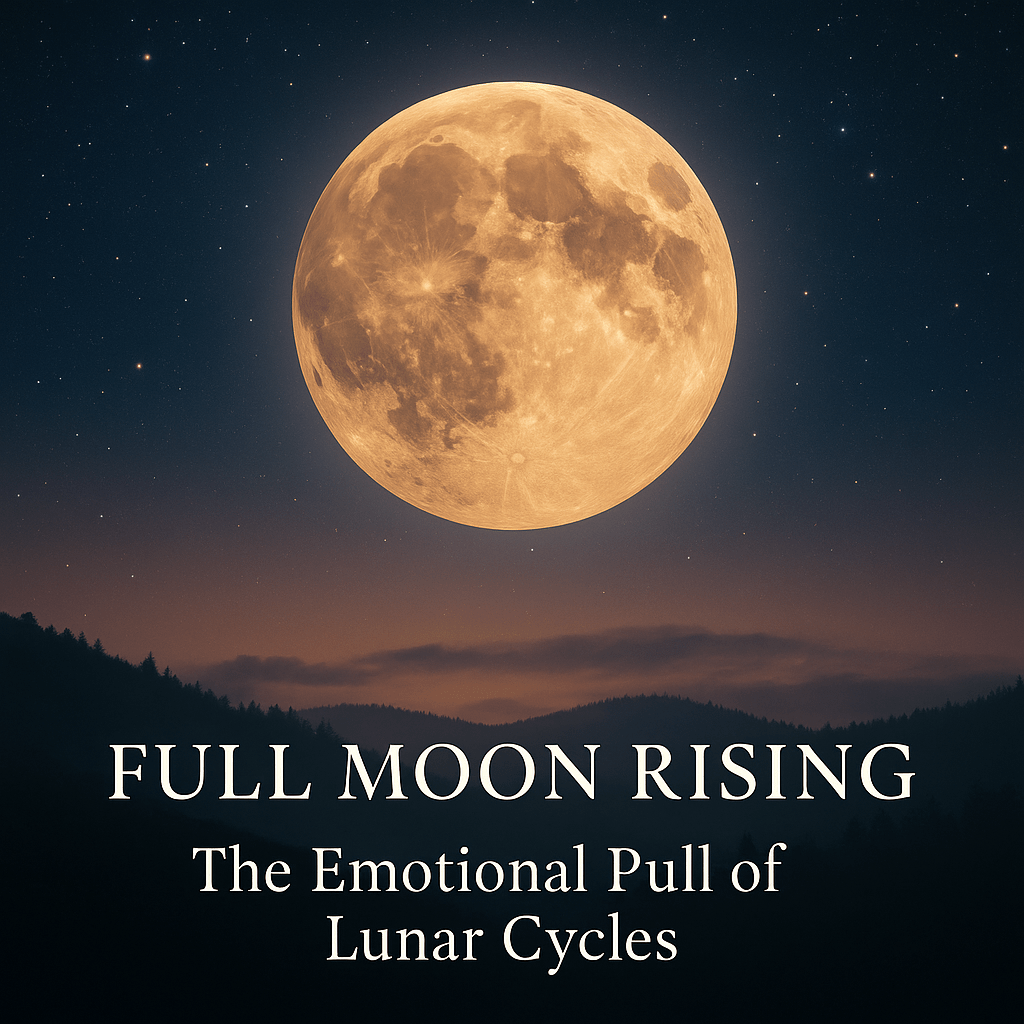
THERE’S A FULL MOON RISING


🌕 Full Moon Rising: The Emotional Pull of Lunar Cycles

By Cheryl O’Connor · 10 June 2025

A Moment with the Strawberry Moon

On June 11, the full moon will rise over Australia — known in the Northern Hemisphere as the Strawberry Moon, named not for its colour, but for the ripening of fruit that traditionally occurs at this time.

While the name may not reflect our Southern seasons, the energy of this moon still speaks. It carries a frequency of ripening, readiness, and sweet release — a time when what’s been quietly growing beneath the surface reaches its moment of fullness.

Astrologically, this full moon rises in Sagittarius — the seeker, the truth-teller, the horizon-walker. It invites us to look honestly at what’s come to completion, what beliefs or burdens are ready to be shed, and where our deeper alignment is calling us next.

This isn’t a moon for force or striving.
It’s a moon for tuning in.
For honouring what is quietly asking to be released.

What truth is ripening in you?
What’s ready to fall from the branch, and nourish something new?

This full moon, I’ll be tending the fire of stillness. Dream-listening. Letting the symbols speak.


The Moon, the Body, and the Emotional Landscape

Have you ever noticed your emotions rising to the surface, your sleep thinning, or your dreams becoming more vivid as the full moon draws near?

You’re not alone.

The moon governs the tides. And just as the ocean swells under her pull, so too, many of us feel subtle — or not-so-subtle — waves rising within. Our emotional waters stir. Our subconscious speaks more loudly. Our nervous systems become more sensitive.

Across cultures, the moon has long been associated with the Divine Feminine — intuitive, cyclical, nurturing. In some Indigenous traditions, a woman’s menstrual cycle was known as her “moon time,” often syncing with the full moon. During this phase, women would retreat to Moon Lodges to rest, to dream, and to replenish — a space of reverence, not retreat.

Today, many of us have lost that rhythm. We’re encouraged to override our cycles — to push through, to stay productive, to disconnect from the body’s quiet wisdom.

Yet the body, like the Earth, keeps time. And the moon still speaks.

“There is a tide in the affairs of men…”
Shakespeare wrote — and perhaps he was more literal than we’ve realised.


Science Catches Up with the Moon

Modern studies are beginning to validate what ancient cultures always knew.

A 2021 study in Science Advances found that people — even in urban settings — tend to fall asleep later and sleep less in the days leading up to the full moon, suggesting our circadian rhythms are still sensitive to lunar light and gravitational cycles (Casiraghi et al., 2021).

And in Frontiers in Endocrinology, researchers observed that menstrual cycles longer than 27 days may occasionally sync with lunar phases — particularly in women under 35 and in those less exposed to artificial light at night (Helfrich-Förster et al., 2021).

This may explain why, even in our hyper-lit, hyper-busy modern lives, so many of us feel the tug of the moon. It’s not superstition. It’s biological. Emotional. Rhythmic. Real.


A Gentle Invitation

If your sleep has been strange…
If your dreams have been louder…
If your heart feels like it’s carrying more than usual…

You’re not broken. You’re in rhythm.

This full moon, I’m choosing rest over resistance. Listening over logic. Letting the wave move through.
If something has been stirring in your sleep or spirit, I’d love to hear what’s rising for you, too.

– Cheryl O’Connor
Author | Artist | Holistic Counsellor | Social Worker
Exploring where structure meets soul — through law, healing, and symbolic art.

🔍 References

Casiraghi, L., Spiousas, I., Dunster, G. P., McGlothlen, K., Fernandez-Duque, E., Valeggia, C., & de la Iglesia, H. O. (2021). Moonstruck sleep: Synchronization of human sleep with the moon cycle under natural conditions. Science Advances, 7(5), eabe1358. https://doi.org/10.1126/sciadv.abe1358

Helfrich-Förster, C., Monecke, S., Spiousas, I., Hovestadt, T., Mitesser, O., & Wehr, T. A. (2021). Women temporarily synchronize their menstrual cycles with the luminance and gravimetric cycles of the Moon. Science Advances, 7(5), eabe1358. https://doi.org/10.1126/sciadv.abe1358

Note: These two studies were published under the same issue and DOI grouping in Science Advances due to their related chronobiological focus.

© Cheryl O’Connor, 2025. All rights reserved.
Please do not reproduce without permission. Sharing with credit and a link is welcome.

#FullMoon #StrawberryMoon #Dreaming #LunarEnergy #DivineFeminine #Symbolism #MoonWisdom #MoonCycles #ConsciousLiving #Cheoco

Beyond the To-Do List

For many of us, simply being present, fully here, right now, is one of the greatest challenges we face. In Western culture especially, we’re conditioned to think in linear terms: past, present, future. We track what has been, plan what’s next, and often measure our lives by where we’re going and what we hope to achieve. We make lists, set goals, and feel comforted by having a plan. But underneath it all, we may be reacting not to what’s real, but to a story we’ve told ourselves about how things should go.

My mum, bless her, was the Queen of Organisation. With four children and a job, she had to be. Each of us had assigned chores, and our weeks were structured down to the minute. I grew up knowing exactly what I’d be doing, and when. While life still threw curveballs, I found the predictability comforting. When I became a mother myself, I quickly saw how being organised helped ease stress, and that habit carried over into my work life.

Over three decades in the legal industry only reinforced that rhythm. Planning ahead, meeting deadlines, staying in routine, all of it created a sense of order in what was often a stressful environment. But over time, the rhythm became a rut. I began to feel stuck, drained of joy, and quietly suffocated by the very structure that once kept me afloat. I also realised that when organisation becomes too rigid, it stops being helpful. It becomes control.

As I deepened in awareness, I started to sense that time, at least as we know it, might not actually exist. That all time is now. That things unfold not when we want them to, but when the energy aligns. And from that perspective, life became gentler. I stopped expecting things to go a certain way, and with that, emotional reactions softened. I found myself detaching, from outcomes, from expectations, from old habits of control.

I made fewer plans. “Going with the flow” evolved into being the flow. I became more spontaneous. I let things go if they weren’t working, and trusted that something better might be waiting to fall into place. The most I now plan is a basic outline, one day at a time. As for those job interview questions like, “Where do you see yourself in five years?”, I’ve come to see them as part of a cultural story that often robs us of presence, creativity, and possibility. How can we know what five years will bring? Sometimes, we don’t even know what the next five minutes will bring.

I learned the hard way: plans rarely go according to plan.

Now, if something I want to do just isn’t flowing, I don’t push it. If the energy is not aligned, I let it be. I’ve noticed how stressed people get when things don’t go “according to plan”, the frustration, the disappointment, the tension it can cause in relationships. But often, those delays or disruptions are gifts. Protection. Rearrangements. Or just not the right time yet. The puzzle pieces aren’t in place. And when they are, everything clicks.

I thought I had this all sorted. Skeletal plan? Check. Present moment awareness? Check. Calendar reminders so I didn’t forget the essentials?  Check. It was working beautifully, until one day when I found myself in a situation where communication had been unclear, and I didn’t know what I was “meant” to be doing next. I’d been told one thing, then it suddenly changed. I felt confused, unprepared, and frustrated.

Old habits kicked in: irritation, storytelling, the mental narrative of how it should have been communicated differently. And underneath it all, discomfort. My little comfort zone, small as it was, had been nudged.

Then came the gentle wisdom of another: Does it really matter what you are doing next?

In that moment, I had to laugh. Who was creating the confusion? The person who hadn’t communicated clearly? Or me, reacting to a story in my head, projecting into the future, and leaving the present moment behind?

It was such a simple lesson, offered in such an effective way: Just show up. Be present. Do what’s needed in the moment of now. Let go of the rest.

© Cheryl O’Connor, 2025. All rights reserved.
Please do not reproduce without permission. Sharing with credit and a link is welcome.

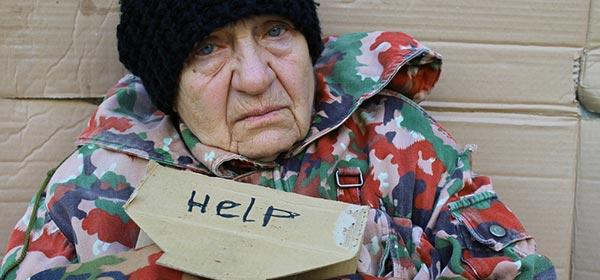
Australia’s Homeless Crisis: Detrimental Impacts on Older Women

Older single women in Australia are at high risk of facing a crisis. One brought on by neoliberal ideologies and policies which intersect with gender and wage bias, along with the historical marginalisation of women in a patriarchal society. This crisis is homelessness and why it is exponentially growing can be understood through the lens of feminist standpoint theory and neoliberalism.

Like all theories, feminist standpoint theory has its limitations and uses. It assists with analysing and understanding this particular social justice issue because feminist standpoint theory considers the individual experiences of the women involved. It also takes into consideration women’s historical roles in society. Standpoint theory emerged from Marxism wherein it was seen that members of society who were oppressed were privy to knowledge the privileged class were not aware of (Borland 2020). In 1983 when Nancy Hartsock published her book “Money, Sex and Power” she provided a theoretical method which took into consideration women’s unique perspectives within society (Hekman 1997, p. 341). This theory also justified feminist claims regarding women being oppressed members of society and feminist standpoint theory as a methodology began (Hekman 1997). During the 80s and 90s other contributors to this theory included Sandra Harding, Merrill Hintikka, Patricia Hill Collins and Dorothy Smith (Hekman 1997; Borland 2020). Harding was of the view that even though scientific researchers claimed to be neutral, their research methods and results were sexist (Borland 2020, p.1).

Harding saw that by implementing standpoint theory, it would reveal the power held within ‘scientific authority’ and would create ‘knowledge that is embodied, self-critical and coherent’ (Borland 2020, p.1). Patricia Hill Collins contributed an African American feminist perspective arguing that race, gender, class oppression and lack of privilege for African American women also provided a unique perspective to the feminist landscape which needed to be seen (Borland 2020). Whilst standpoint theory can be seen as essentialist due to the implied belief that a universal female standpoint exists, theorists utilising feminist standpoint theory have chosen to focus on the ‘political aspects of social position’ from a feminist view rather than speaking for all women (Borland 2020, p.1). Use of feminist standpoint theory and practice, however, has come under scrutiny as it appears to challenge the more recent feminist theories which have emerged from ‘postmodernism and poststructuralism’ (Hekman 1997, p.342).

Nonetheless, Hekman (1997, p.342) argues that feminist standpoint theory is based on the understanding that “knowledge is situated and perspectival, and that there are multiple standpoints from which knowledge is produced.” Hawkesworth (1999) sees feminist standpoint theory not as an epistemology but as an analytical tool. Both Hawkesworth (1999) and Hekman (1997) posit there are various types of competing feminist standpoints and that by critically examining those, problems can be illuminated which Hawkesworth (1997, p.152) states …’empirical research must engage’.

When looking at the issue of older single homeless women in Australia some of the specific gender-based factors for this cohort are that their earlier lives have been shaped by the societal norm they would marry and their husband would provide for them in their roles as homemakers, child-bearers and predominantly mothers (Darab & Hartman 2013; Hartman & Darab 2017). According to McFerren & Laverty (2010),a high percentage of older single homeless women have suffered domestic violence or experienced adverse tragedy in their earlier lives. Common themes found in various studies concerning lack of housing security available to these women both now and into the foreseeable future, are cited as being systemic issues; domestic violence; age, wage, employment and gender discrimination; and relationship breakups (McFerren & Laverty 2010;Darab & Hartman 2013; Hartman & Darab 2017; Irwin & Leeson 2016; Sharman 2017; Faulkner & Lestner 2020). Invisibility via research and media representation of this group of women, which results in a lack of service provision specifically tailored for them, along with housing unaffordability, are also cited as being factors which are contributing to the increasing number of older women who are, or are becoming, homeless (McFerren & Laverty 2010; Darab & Hartman 2013; Hartman & Darab 2017; Irwin & Leeson 2016; Sharman 2017; Faulkner & Lestner 2020).

In 2017 Hartman & Darab conducted a qualitative research project using feminist standpoint theory regarding older homeless women and pathways to housing in the rural area of the Northern Rivers, New South Wales. They found intersectionality was occurring between gender, relationship status, aging and lack of home ownership (Hartman & Darab 2017). The absence of employment opportunities combined with minimal public transport were also cited as factors contributing to older single women becoming homeless in the region (Hartman & Darab 2017). Reasons Sharman (2017) gives for the rise in numbers of older single homeless women in her Victorian study are that these women, due to the roles they played earlier in their lives were locked out of the labour market and as such were prevented from accumulating superannuation and savings. Sharman (2017, p.51) also cites ‘adverse critical life experiences’ which are ‘non-normative’, as being a factor. For example, the unexpected death of a partner, ill health, sick children, unemployment or disability all can impact on an individual’s ability to function as they would normally expect to (Sharman 2017).

Other critical life events which Sharman (2017) states have impacted on older single women have been rental increases, mortgagee repossessions, evictions and housing stress brought on by increasing costs where 30 per cent or more of household income is required to secure housing. In addition to the aforementioned factors women’s work is often undervalued, unpaid or underpaid (Sharman 2017; Healy & Kidd 2013). Many women’s working lives are interrupted by children and they are often pushed into the dominant female industries of health, teaching and retail (Sharman 2017). Mostly relying on less pay than male counterparts along with part-time or casual work to meet family responsibilities results in less savings and less superannuation being accumulated by the time they retire (Sharman 2017; Healy & Kidd 2013). Recent research by Faulkner and Lestner (2020) estimated “240,000 women aged 55 or older and another 165,000 women aged 45-54 are at risk of homelessness” in Australia.

Whilst no government is responsible for exceptional individual life experiences, under the United Nations agreements Australia is privy to, the State is responsible for the provision of certain basic human rights to all citizens, which it does not appear to be adhering to. In 1976 Australia ratified the United Nations International Covenant on Economic, Social and Cultural Rights. At Article 11, 1., it states that adequate housing is a fundamental human right (Marston, McDonald & Bryson 2014; Australian Legal Information Institute 1976; Australian Human Rights Commission 1976; Human Rights and Equal Opportunity Commission 1996). The Universal Declaration of Human Rights, which Australia was a founding contributor to in 1948 and signatory of, at Article 25, states, “Everyone has the right to a standard of living adequate for the health and well-being of himself and his family, including … housing” (United Nations 1948).Despite these signed agreements, according to the Australian Bureau of Statistics 2016 Census, there were an estimated “6,866” homeless older women and “5,820” older women who were “living in marginal housing” and “may be at risk of homelessness” (Australian Bureau of Statistics 2017; Australian Human Rights Commission 2019a).

Further, older women are seen to be “the fastest-growing cohort of homeless Australians” evidenced by a 31 per cent increase occurring between 2011 and 2016. (Australian Human Rights Commission 2019a; Australian Human Rights Commission 2019b). Dominant neo-liberal ideology and practices which have been occurring in Westernised countries for the past 30 years are a major factor which impacts on homelessness (Bullen 2015; Hartman & Darab 2017). Neo-liberalism is a mode of governing which emphasises free markets, individuals being solely responsible for themselves and market like modes of service provision (Bullen 2015; Hartman & Darab 2017).

As a consequence of neoliberalism, there has been a shift away from discourses of homelessness being a social issue brought about by unemployment, poverty, domestic violence and disadvantage, to being one of a personal issue (Bullen 2015; Sharman 2017). This has consequently had a detrimental impact on service provision and created negative feelings of self-worth, blame and exclusion for homeless persons (Bullen 2015).  Policies implemented, which included the reduction of capital gains tax in 1999 and negative gearing in the late 1980s, have resulted in decreased housing affordability as house prices, compared to available income during the past 15 years, has increased sharply (Hartman & Darab 2017). Further, there has been a decline in public housing availability since the 1990s as the State’s focus has been on offering financial support for low-income earners via rent assistance within the private rental market, as well as implementing the first home owner’s grant, rather than providing public housing (Hartman & Darab 2017).

These policies have resulted in a rental market which favours investors and landlords (Hartman & Darab 2017). Media representation based on neo-liberal principles presents a perspective of homelessness, generally speaking, that some are deserving and undeserving of State assistance (Lyons & Smedley 2020). Those who are considered deserving are those who through no personal fault suddenly find themselves homeless and those who are classed as undeserving are often stereotyped as being slack due to the perception that they are incompetent (Lyons & Smedley 2020). What is missing from media representation regarding homelessness in Australia is a discussion concerning the growing number of single older women who are unable to secure a home (Lyons & Smedley 2020).

Whilst there is not a lot of research available regarding this sector of homelessness specifically, research does validate that a looming crisis is pending. Many factors are contributing to single older women becoming homeless in Australia, not the least of which are neoliberal ideology and practices that are proving to not only be detrimental to a whole generation of women currently but potentially also for women in the future.

Copyright C. O’Connor, November 2021.

References

Australian Bureau of Statistics 2017, 2016 Census, viewed 23 August 2020 https://www.abs.gov.au/websitedbs/censushome.nsf/home/2016 

Australian Human Rights Commission 2019a, Older Women’s Risk of Homelessness: Background Paper, viewed 20 August 2020,  https://humanrights.gov.au/sites/default/files/document/publication/ahrc_ow_homelessness2019.pdf

Australian Human Rights Commission 2019b, Risks of Homelessness in older women, viewed 20 August 2020, https://humanrights.gov.au/our-work/age-discrimination/projects/risk-homelessness-older-women  

Australian Human Rights Commission 1976, International Covenant on Economic, Social and Cultural Rights, viewed 20 August 2020, https://humanrights.gov.au/our-work/commission-general/international-covenant-economic-social-and-cultural-rights-human-rights 

Australian Legal Information Institute, Australian Treaty Series 1976, No 5, Department of Foreign Affairs, International Covenant on Economic, Social and Cultural Rights, United Nations, New York, viewed http://www.austlii.edu.au/au/other/dfat/treaties/1976/5.html  

Borland E 2020, Standpoint theory, viewed 20 August 2020, https://www.britannica.com/topic/standpoint-theory

Bullen J 2015, ‘Governing Homelessness: The Discursive and Institutional

Construction of Homelessness in Australia’, Housing, Theory and Society, 32:2, 218-239, doi:10.1080/14036096.2015.1024886

Darab, S & Hartman Y 2013, ‘Understanding Single Older Women’s Invisibility in Housing Issues in Australia’, Housing, Theory and Society, vol. 30, no. 4, pp. 1–20, doi:10.1080/14036096.2012.746944

Faulkner D & Lester L 2020, ‘400,000 women over 45 are at risk of homelessness in Australia The Conversation, viewed 23 August 2020https://theconversation.com/400-000-women-over-45-are-at-risk-of-homelessness-in-australia-142906

Hartman, Y & Darab, S 2017, ‘The housing pathways of single older non-home owning women in a rural region of Australia’, Journal of Rural Studies, vol. 54, pp. 234–243, doi:10.1016/j.jrurstud.2017.07.003.

Hawkesworth, M 1999, ‘Analyzing backlash: Feminist standpoint theory as analytical tool’, Women’s Studies International Forum, vol. 22, no. 2, pp. 135–155, doi:10.1016/S0277-5395(99)00003-5.

Healy, J & Kidd, M 2013, ‘Gender-based undervaluation and the equal remuneration powers of Fair Work Australia’, Journal of Industrial Relations, vol. 55, no. 5, pp. 760–782, doi: 10.1177/0022185613491683.

Hekman, S 1997, ‘Truth and Method: Feminist Standpoint Theory Revisited’, Signs, vol. 22, no. 2, pp. 341–365, doi:10.1086/495159.

Human Rights and Equal Opportunity Commission 1996, Housing as a human right, viewed 20 August 2020 https://humanrights.gov.au/sites/default/files/content/pdf/human_rights/housing.pdf

Irwin P & Leeson G 2016, ‘Late Middle-Aged Single Women and The Risk of Homelessness in Rural Australia’, The Gerontologist, vol. 56, no. Suppl3, pp. 719–719, doi:10.1093/geront/gnw162.2932.

Lyons G & Smedley C (2020) ‘The new face of homelessness? Examining media representations of women’s homelessness in five Australian news sources’, Journal of Social Distress and Homelessness, doi:10.1080/10530789.2019.1709269

McFerran, L & Laverty, S 2010, ‘It could be you: female, single, older and homeless’, Parity, vol. 23, no. 7, ISSN:1032-6170

Marston, G, McDonald, C & Bryson, L 2014, The Australian welfare state: who benefits now?, Palgrave Macmillan, South Yarra. 

Petersen, M 2015, ‘Addressing older women’s homelessness: service and housing models’ Australian Journal of Social Issues, vol. 50, no. 4, pp. 419–438,458, doi:10.1002/j.1839-4655.2015.tb00358.x.

Sharman A 2017, The Voices of Midlife Women Facing Housing Insecurity in Victoria, Australia, Social Policy & Society, Vol 16, No. 1, pp.49-63, doi:10.1017/S1474746415000603

United Nations 1948, Universal Declaration of Human Rights, viewed 23 August 2020, https://www.un.org/en/universal-declaration-human-rights/index.html
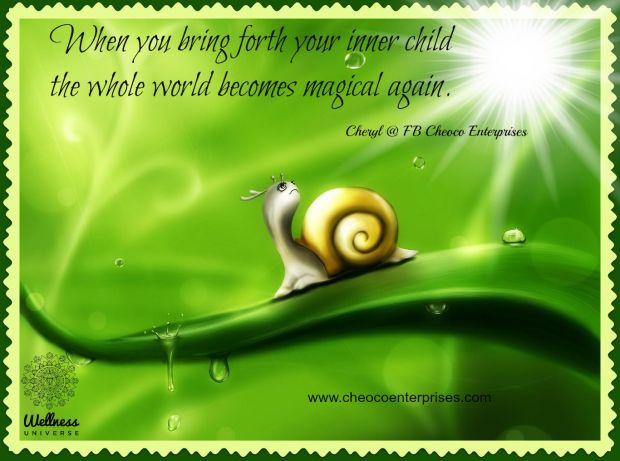
RECONNECTING WITH OUR INNER CHILD

Within the confines of being told we have to “grow up,” we lose ever so much. Our conditioning is such that as children we begin to learn to fear the world and just about everything and everyone in it, hearing more often “don’t,” than “do.”

The inner child begins to shut down and off to a world that was once magical, full of adventure, imagination, play, fun, beauty, excitement and sheer delight. Just watch any child as they start to explore the world – all is new and exciting. The feel of grass underfoot, the raindrops dripping, the love of singing, dance, water play, mud, creativity and laughter just because they are happy and want to have fun.

When expressing anger or frustration they are often told don’t behave like that and are these days sent to the naughty corner. When parents fear they will fall from the tree they are climbing or fear whatever else they do, or tell them what they experience is not “real,” when they are taught to seek approval from others at such a young age, are told things about themselves and the world by adults they fully believe because the adults said so, are yelled at, hit, abused and so it goes on, all that joy, excitement and sheer delight with just the pure magic of being alive seems to disappear. Lost and seemingly gone forever as life becomes nothing more than a “job” full of adult responsibilities, concerns, worries, anxiety, conformity and fear which then leads to illness, addiction, depression, reckless behaviour, more abuse and sadly in some situations the taking of one’s own life.

I was once told as a child, only children can enter “The Kingdom of Heaven.” This terrified me at that time because I figured once I became an adult – straight to “Hell” I would go, forever. In many ways, we do go to Hell though because due to the adult behaviour around us and the beliefs and projections which shape us we lose conscious awareness of all that is childlike.  Yet we are also told we need to be childlike to enter the Kingdom of Heaven.

The ability to make friends easily, to trust, to have fun unless we are drunk, stoned or participating in other activities that bring momentary pleasure from outside ourselves all goes. If we were feeling joyous and broke out in song on the morning train commute, for example, we would be given strange looks like something was “wrong” with us. So we conform, we play the game the adults around us play and we do indeed lose a huge part of ourselves along the way.  Many become miserable and bitter, negative, resentful, spiteful, manipulative, greedy, needy, liars and haters who try to desperately control others around them. Each day becomes a chore to drag oneself through and many literally start looking like robotic walking dead.

For myself I had to “grow up” very quickly, leaving home at only 14, and life for me became a matter of survival for many decades. Survive I did, ever so much, but it was just that – surviving, not thriving.

We speak of “The Journey Home” and how we are all on the same journey back to conscious awareness of all we once knew before it was shut down because of fear and conformity.  For myself, it took decades of Self work and inner child work to reach where I am at within myself now, which feels like “home” to me

Some of the tools I used along the way which can help are:

  • Pay attention to what your dreams and daily synchronicity are telling you.   If you don’t know – learn.
  • Spend time alone in nature.
  • Use your dominant writing hand to ask your inner child a question, swap hands and wait for the answer to be written.  Go with the very first thing that comes, do NOT think oooh that’s just nonsense.
  • Do not doubt what others told you was “just your imagination” – whatever you experience is real for you because it is YOUR experience.
  • Try to remember things you used to LOVE to do as a child and MAKE time to do them on a regular basis.
  • Run with your gut feelings about anything and everything – don’t pay attention to your logical doubts and fears which have been instilled in you by others.
  • Pay attention to any memories or feelings that come – especially those which create an emotional reaction and ask yourself “Where is this TRULY coming from?”  Wait patiently for the answer to come to you.
  • Parent your own inner child.  Most of our inner children are scared, lost, angry, hurt and confused and often feel like they have been abandoned, which they have been. Mine was SO angry and hurt it took months of solid work for her to even feel safe enough again to just start dialoguing with me.
  • Don’t blame, hate or punish your parents for the damage done – they did the best they could with the awareness they had, they still are and at some stage we all have to actually accept responsibility for ourselves and start to parent our own inner child.

As a child, I wanted desperately to live “Somewhere over the Rainbow.” It was however quite literally a journey into,  through and out the other side of Hell to follow my own yellow brick road, but it was worth every single step to reach “home” and the “Kingdom of Heaven.” That isn’t some place in the sky as so many of us were told it was, but is within each of us and fully accessible to all of us by reconnecting with our own inner child.

Cheers, Cheryl.

© Cheryl O’Connor 2014.

•*´☾☆☽`*•

Get your free Dreamwork Booklet at bit.ly/CheocoNews when you sign up for my monthly Newsletter. Cheers, Cheryl.

#Cheryl O’Connor. #Cheoco
#Holistic #Counsellor, #Author & #Writer.

* #Cognitive & Body Based #Counselling.
* #Creative & #Artistic #Therapies.
* Specialising in #Dream #Analysis, #Conscious #Dreaming & #Shamanic #Journeying.
* #Reiki #Seichim #Treatments & #Attunements.
* #Isis #Meditation.

http://bit.ly/FBCheoco – Facebook.
http://bit.ly/CreationsbyCheoco – Etsy
http://bit.ly/CheocoNews – Newsletter Subscription.
http://bit.ly/pinterestcheryloconnor – Pinterest.
http://bit.ly/Googlepluscheryloconnor – Google Plus.
http://bit.ly/linkedincheryloconnor – LinkedIn.
http://bit.ly/wordpresscheryloconnor – WordPress.
http://bit.ly/cheocoenterprises – Website.

Twitter:  @cheoco99

Proud Member of The Wellness Universe www.TheWellnessUniverse.com
#WUVIP

Visit www.TheWellnessUniverse.com for people supporting

Emotional Wellness http://goo.gl/Z3EQcy
Environmental Wellness http://goo.gl/BO6qLP
Intellectual Wellness http://goo.gl/R1v1dc
Occupational Wellness http://goo.gl/QFF2xM
Physical Wellness http://goo.gl/aGfYU6
Social Wellness http://goo.gl/oYZALZ
Spiritual Wellness http://goo.gl/TyXSbQ

Join Us if you contribute to a Better World! http://goo.gl/PQyzFA

Are we truly busy?

“The most common thing I hear folk say these days when asked how they are is “Busy”.

Today’s technology was essentially designed to make things easier, give us all more “time” and yet it appears to me it has failed to do that.  If anything we all seem to be way busier than we were a couple of decades ago, with seemingly never-ending to-do lists, copious emails that flood our inboxes, umpteen “notifications” by way of social media, errands to run and so it goes on. This influx of things to be attended to is often overwhelming and creates stress, for we are now living in a time where we think we need to attend to ever so much immediately.
I’ve been pondering this standard comment we all seem to be giving these days of I’m busy or you are busy.  I have a huge variety of activities in my life simply because I do not do boring and mundane well at all and abhor being stuck in any sort of rut.  Variety is indeed my spice in life and to have any two days spent doing exactly the same thing is my worst case scenario.  Many interpret that as me being busy.
I spoke in my last article about living in NOW.  Such a hard thing for so many of us to achieve and yet, once you do get the hang of it, it is very easy.  As I looked back on all my years of being unconsciously busy, rushing here and there, achieving this and that, the stress that comes with always being busy and the many comments I hear of “busy” I had an epiphany of sorts.  When we are fully present in right here and now “busy” is totally eliminated.  How so?
Well, I saw that busyness lives in our heads and only occurs when we move out of now and think “a head” too far.  Often we become overwhelmed with how much we think we need to do or must do, which in fact, we are all choosing to do for no-one is making us do anything.  When we are so busy we miss the moment of now for always we are thinking I need to do this, then that, then that and on it goes, usually ticking things off either in our heads or lists as we go. Often not even fully focussed on whatever it is we are doing right now, due to thoughts of once this is done then the next thing needs to be done.
I also saw that much stress lies in the busyness of our minds and the things we choose to do that we perceive “make” us all so busy.  I saw that being in the moment of now with absolutely no thought of what is next until I got to what is next, does indeed and quite miraculously not create a feeling of being busy at all.   As I was pondering this whole busy aspect of life, another crossed my path who shared that we create busy to avoid being in now.  Synchronicity?  Well of course.
When we live in each moment of now, fully, we are just being and we are all essentially, beings, not doings. Many think we have to go and have a vacation and do absolutely nothing to avoid the stress of being busy, to wind down and “get away from it all”.
Personally I find life far more interesting, way less stress full and not at all busy, to just do the things I feel I want and need to do, when I want and need to do them. I also find that things don’t go “wrong”, I don’t hit brick walls nor do I experience any of the elements that once brought frustration, stress, major muck-ups, accidents or rushing around like a lunatic when I am just focussed on and fully present in NOW.   Another miraculous aspect of living in NOW – I have more “time”.
Try it, you may just be very surprised by what happens when you stop thinking “a head” and actually become one with the flow of life.
Cheers, C.

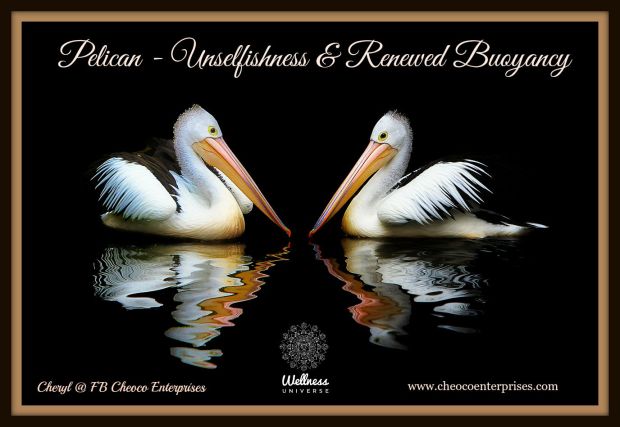
PELICAN – UNSELFISHNESS & RENEWED BUOYANCY

Pelicans were once considered to be very magical and powerful birds. Contrary to some beliefs they do not store fish in their bills, they simply use their bills to scoop fish up. Should Pelican be a bird that is crossing your path it may be prudent to reflect on how that may provide you with some insight into your own behaviour. Are you one who stores anything you do not really need to be storing? Are you using what you already have? Are you digesting that which you are given or are you storing it? There was once a story told of how a Pelican harmed its own breast with its bill in order to feed its own blood to its young. This is where the unselfish self-sacrifice symbolised in this bird has come from and it also contains a Christian connotation.

Pelicans always make room for others of their kind and will nest in such a way that there is room for all. They also work together when fishing. As a team they manoeuvre fish into shallower water so all may enjoy a meal.

Pelicans are very large birds and whilst they appear heavy due to their size they float exceptionally well and are buoyant. Often they will descend into the water from a great height at speed and then magically pop up on the surface of the water. Air sacs which are located under their skin assist them to do this and they are totally unsinkable due to those air sacs.

These birds speak to us of the ability to bounce back, become buoyant ourselves and to rest regardless of what may appear to be the weight of life circumstances. Pelican teaches us that no matter how heavy or difficult some situations may be in our lives and no matter how deeply we plunge or fall we are all able to rise to the surface again. Their medicine is that of knowing how to rise above life’s trials and tribulations.   Another story about Pelican speaks of how they once lived in the desert and they adapted by feeding upon Snakes.   Whilst they may appear to have difficulty taking off at times from the water they succeed and this relates to us having the ability to free ourselves from emotions that might otherwise weigh us down. Pelican medicine is also showing us how we can avoid being overcome by our emotions to the point they debilitate us.

Grab your free copy of my Dreamwork Booklet at http://bit.ly/CheocoNews when you sign up for my monthly Newsletter.

*´☾☆☽`*•

#Cheryl O’Connor.
#Holistic #Counsellor, Author & Writer.

* Cognitive & Body Based Counselling.
* Creative & Artistic Therapies.
* Specialising in #Dream #Analysis/#Conscious #Dreaming & #Shamanic Journeying.
* #Reiki/#Seichim Treatments & Attunements.
* Isis #Meditation.

Website @ http://www.cheocoenterprises.com

My book The Promise, Skype & Email Consultations Available – bit.ly/Cheocoshop

Facebook: http://bit.ly/FBCheoco
Online Shop: http://bit.ly/Cheocoshop
LinkedIn: http://bit.ly/linkedincheryloconnor
Pinterest: http://bit.ly/pinterestcheryloconnor
Google+: http://bit.ly/Googlepluscheryloconnor

Proud member of The Wellness Universe: www.thewellnessuniverse.com #WUVIP

Image credit: Pixabay.

© C. O’Connor 5 August 2015.

BADGER MEDICINE

Someone recently asked me about the symbolism of Badger. As many will know I don’t partake in the this definitely means that scenario like Dream Dictionaries and the like do. There is however very generalised information floating around based on other’s perceptions of what a particular symbol means which, if you are experiencing that particular animal or thing crossing your path you can have a read of. The danger with Dream Dictionaries and the like is that NOTHING will mean exactly the same thing for every single person on the planet.

The information I share in relation to the “Symbolism of Animals” comes from personal experience either in ordinary or non-ordinary reality, or, if that particular symbol/animal/energy/medicine has not yet crossed my path sources I use for info that I share with you, which I write in my own words, having read all the info I have access to, come from people like Jamie Sams and Ted Andrews.

It is not enough to just look at the symbolism of one particular thing or animal, it is about actually integrating the qualities of that symbol – for all that exists is energy and to “carry medicine” of an animal it HAS to consciously become part of who you are.

We are all, at the core, connected to all that exists but there is a massive difference between knowing something theoretically/symbolically and actually experiencing and also bringing the energy of particular traits or your own personal “medicine” by way of your totem animal/s or Spirit animals, into being by way of literally becoming one with that animal’s particular medicine.

If anyone has questions about all that, if it is not making sense to you, I am more than happy to answer your questions as best I can.

Today’s animal is Badger. Enjoy the read – Cheers, C.

BADGER – AGGRESSIVENESS.
Badgers may look cute but they are far from being meek and mild. Notoriously vicious animals they will attack with powerful aggression. They are easy and quick to anger and will pounce with great speed. Their “medicine” is of being aggressive and the ability, along with the willingness, to fight for whatever it is they want.

They have been known to tear their opponents to shreds if that opponent doesn’t have an equal amount of aggressiveness. Many powerful Medicine Women contain Badger Medicine as Badger is also the one who has the responsibility to be the caretaker/keeper of medicine roots for in Badger’s home burrows they are aware of all the roots which are Mother Earth’s healing herbs.

Roots ground “negative” energy by way of allowing and transforming illness to pass through the physical body into the earth as neutral energy, thereby healing the body. Folk who contain Badger medicine are very apt and quick to act should a crisis occur as they are not prone to panic.

Those who contain Badger medicine very easily and quickly express their feelings not caring what the consequences may be for doing so. They may also be aggressive healers due to the courage they contain to facilitate healing by unconventional methods for it is the result that matters, not the process. They will use whatever means necessary to ensure healing occurs, even in relation to the critically ill.

They can be vicious gossips and they may also appear to others to have a chip on their shoulder when they are out of balance. They contain perseverance and will not give up in relation to what they want to achieve. They are often the “boss” as they get the job done and they are certain of what they are doing.

Badger’s appearance could indicate that you are not being confident/aggressive enough but it is a balanced aggressiveness that is required. It is not necessary to rip other folk to shreds. It could be an indicator that you need to aggressively assert yourself in relation to your own healing by removing any and all barriers that are impeding your progress. Further it may be a sign that you need to cut the dead wood out of your life. Badger appearing may also be an indicator that you need to become more grounded and centred in your body/in your life.

Badger could also be relating to expressing your anger in an unhealthy way. It can be a reminder that all anger directed at you from other folk is really anger towards Self which is being dumped onto others. Anger also stems from fear and usually behind fear is pain and so if you are angry it is prudent to ask yourself why am I angry and what am I afraid of. It could be necessary for you to engage in reflection and uncover any feelings or thoughts of helplessness as well.

Badger medicine can be about a need to heal the physical body with roots and herbs. It speaks of a need to find proper balance, to be more aggressive if you have been too shy and have been letting others walk all over you.

It can, generally speaking, be about you needing to take control of your life and to take action as inaction usually leads to pain being experienced. If you are feeling angry it calls for a time for you to do whatever is needed, without harming others or self, to release your angry feelings. These feelings can also relate to jealousy and envy.

Essentially contrary Badger is trying to teach you about some of the holes you can fall into in relation to shyness or insecurity as well as projected and vicious aggressiveness towards others which you really need to stop projecting onto others and deal with, within yourself. Badger medicine always calls for action to be taken, whatever the present situation is you are dealing with.

Copyright. C. O’Connor. 1 August 2015.

Grab your free copy of my Dreamwork Booklet at http://bit.ly/CheocoNews when you sign up for my monthly Newsletter.

*´☾☆☽`*•

#Cheryl O’Connor.
#Holistic #Counsellor, Author & Writer.

* Cognitive & Body Based Counselling.
* Creative & Artistic Therapies.
* Specialising in #Dream #Analysis/#Conscious #Dreaming & #Shamanic Journeying.
* #Reiki/#Seichim Treatments & Attunements.
* Isis #Meditation.

Website @ http://www.cheocoenterprises.com

My book The Promise, Skype & Email Consultations Available – bit.ly/Cheocoshop

Facebook: http://bit.ly/FBCheoco
Online Shop: http://bit.ly/Cheocoshop
LinkedIn: http://bit.ly/linkedincheryloconnor
Pinterest: http://bit.ly/pinterestcheryloconnor
Google+: http://bit.ly/Googlepluscheryloconnor

Proud member of The Wellness Universe: www.thewellnessuniverse.com #WUVIP

Image credit: Pixabay.