Australia

FEAR BASED CONDITIONING

We all come with abundant courage, trust and love into this world. As infants, we trust our needs will be met. We’re fed, clothed, sheltered—and, ideally, loved. We play in nature, explore the world with awe, and live in the now. There’s no concept of lack or limitation.

So where does all that innate trust, courage and love go?

It gets smothered, slowly, by a blanket of fear-based conditioning.

“Don’t fall.” “Be careful.” “Don’t climb that.” “Don’t cry.” “Don’t speak to strangers.”

From the moment we begin exploring, we are bombarded with warnings. Many are well-meaning. But the message we receive is that the world is dangerous, our bodies are fragile, and our instincts can’t be trusted. Over time, our nervous systems internalise this. What starts as care becomes caution. What begins as protection becomes suppression. And what once was joy becomes fear.

This conditioning isn’t just psychological—it’s somatic. Repeated warnings trigger the body’s stress response, even when no real danger exists. Studies show that chronic activation of this response in childhood can lead to long-term dysregulation of the nervous system, laying the foundation for anxiety, depression, and autoimmune disorders. (See: Harvard Center on the Developing Child, 2010; Van der Kolk, 2014.)

We learn to mute our natural expressions. To cry quietly. To sit still. To put on masks.

We’re told to leave our feelings at the door. “Be professional.” “Leave your personal stuff at home.”

Yet humans aren’t machines. We carry our emotions, energy, stories and unprocessed grief into every space. Telling someone to leave their pain behind is like asking the ocean not to wave.

So, we cope. We numb. We perform.

We medicate ourselves with coffee, alcohol, sugar, nicotine, binge-watching, overworking—whatever dulls the ache. We long for weekends, dread Mondays, and confuse productivity with purpose. The more we ignore our inner world, the louder our bodies must speak—through illness, fatigue, or emotional outbursts.

This is not living. This is surviving.

And it’s no surprise that disconnection—internally and from others—leads to chronic stress, burnout, and a lack of meaning. As Gabor Maté writes, “When we have been prevented from learning how to say no, our bodies may end up saying it for us.”

Our systems reward burnout. We idolise busyness. We dismiss embodiment and emotional intelligence.

And yet, somewhere deep inside, we remember.

We remember the joy of dancing in the rain, the wonder of staring at clouds, the heartbeat of the earth beneath our bare feet. We remember what it feels like to trust ourselves.

What silences that voice?

Fear.

Fear, like all emotions, is energy. I see it as a contraction, a tightening of energy, whereas love is an expansion, a flow of energy.

When we sit with fear or anxiety, whether in our minds or bodies, it intensifies. We may feel stressed, unable to think clearly, or even slip into panic, neurosis, or paranoia. Fear can also paralyze us, or it may erupt as a reaction. Beneath anger, fear and pain often hide.

When we allow ourselves to fully experience and feel the anger, pain, regret, guilt, or shame that fear has been masking, the fear dissipates, and in its place, courage emerges. Often, this process also brings new insights and solutions that were previously hidden.

Our minds can amplify fear by spinning “what if” scenarios—often imagining outcomes that never come to pass. These imagined fears can cause unnecessary stress and anxiety, especially when they haven’t even materialized.

If we have a wound we’ve been protecting, and something triggers it, the “band-aid” comes off, exposing us to fear again. This can lead to a double layer of fear: the immediate reaction to the trigger and the deeper fear stemming from the original wound—or even multiple past wounds.

Shifting fear is no easy feat, and it can take time. But once we face it, and sit with the pain that lies beneath, fear melts away. In its place, we find love, peace, and clarity.

Fear of rejection. Of being judged. Of not being enough. Of failing. Of not fitting in. Of speaking our truth. Of losing love. Of death.

False Evidence Appearing Real.

Most of what we fear never actually happens. And the few things that do? We survive them. We grow through them. Sometimes, they become the very catalysts that awaken us.

So what if we re-learned how to trust ourselves? What if we began untangling the knots of fear-based conditioning, one thread at a time?

What if we let the grief rise instead of stuffing it down? What if we let our bodies dance when the music moved us? What if we started saying yes to what lights us up and no to what drains us?

This is not naive. It’s necessary.

Life isn’t meant to be a grind. It’s meant to be a creation.

If you’re ready to tear up the script of fear, I have scissors in my kit and a hand to hold. Together, we can unweave the tangle.

With love, C.


References for deeper reading:

  • Bessel van der Kolk, The Body Keeps the Score, 2014
  • Gabor Maté, When the Body Says No, 2003
  • Harvard Center on the Developing Child, “Toxic Stress and Brain Architecture”
  • Peter Levine, Waking the Tiger, 1997
  • Stephen Porges, The Polyvagal Theory, 2011

© Cheryl O’Connor, 2025. All rights reserved. Please do not reproduce without permission. Sharing with credit and a link is welcome.

Killer Stress: How Modern Life is Breaking Us

It seems fairly acceptable in our society these days to accept stress as “normal.” Technology designed to make life easier has, in fact, made life busier, with a constant flow of information, requests, and demands on our time. We live dictated by calendars, bank balances, and the ticking of the clock, numbers we react to as though they were threats.

More and more automated voice options on phones that fail to connect us to an actual human being add to our daily tension, offering less support and more frustration. Time for real food and deep connection shrinks as we all become… “so busy.”

Once, we wrote letters, posted them, and waited. Now, emails ping, and we feel a pressure to respond instantly. It’s not just a pace; it’s a mindset of urgency. Productivity is the new idol, and the pressure to outperform for profit isn’t just found in the workplace, it’s embedded in our nervous systems (Rosen, 2020).

We’re saturated with disasters, grief, and horror from every corner of the globe. Not only is this overwhelming, but our stress response is being constantly triggered by situations we can’t control (Sahakian et al., 2015). Gratitude for safety is real but so is the burden of helplessness. And the truth is: we can always turn it off. But often, we don’t.

The deeper issue is that when we do need to hibernate, retreat, rest, withdraw, we’re told we’re lazy, self-indulgent, or not resilient enough (Biron et al., 2012).

Even our own government has proposed raising the age at which people become eligible for support—further extending the years we’re expected to stay in the workforce. The message is clear: keep working, keep producing, keep pushing. And burnout? That’s just the cost of survival, apparently a cruel irony when burnout is already rampant.

Snappy voices, reactive outbursts, and social disengagement often stem from chronic stress. People aren’t present. They’re time-travelling, replaying the past or pre-living future disasters. And that lack of presence? That’s the real cost (Kabat-Zinn, 2005).

We are not machines. Yet we expect ourselves to operate like them. Even computers need a reboot. When was your last one?

The Myth of Multitasking

One of the greatest myths of modern life is that multitasking makes us more efficient. In reality, the human brain cannot focus on multiple complex tasks at once. We are constantly context-switching, splitting our attention and taxing our cognitive resources (Rosen, 2020). This increases errors, reduces memory recall, and heightens stress.

Multitasking is not mastery. It’s a nervous system constantly being yanked in different directions. No wonder we feel scattered.

Rest as Resistance

There is a growing movement that names rest not as a luxury, but as a form of resistance. Tricia Hersey, founder of The Nap Ministry, reminds us: “Rest is a spiritual practice. Rest is a form of resistance because it disrupts and pushes back against capitalism and white supremacy.”

We are not designed to be endlessly productive. We are cyclical beings, wired to ebb and flow, to rise and retreat. The feminine principle, whether expressed in any gendered body, calls for restoration, reflection, and radical slowness (Hersey, 2022).

Returning to Rhythm

There was a time when our rhythms followed the sun. When life was made, not consumed. When tribe, rest, music, growing, laughing, and storytelling were at the heart of our days.

What we now call “stress” was once a short-term survival response. Adrenaline kicks in when we’re under threat, giving us power to run or fight. It was never meant to be a way of life (McEwen, 2007). Fifteen minutes. That’s the optimal duration of a stress response before the body starts to take damage (Selye, 1976).

But when stress becomes constant? The effects show up in every system of the body: high blood pressure, anxiety, insomnia, digestive disorders, muscle pain, and emotional exhaustion. Stress is not just uncomfortable—it’s biologically destructive. And yet we carry on, until our bodies force us to stop (Sapolsky, 2004; van der Kolk, 2014).

Language That Triggers Stress

Even the language we use is steeped in nervous system activation. We’re “alarmed” out of bed. We hit “panic buttons.” We race to meet “deadlines.” We juggle tasks and “crash” by evening.

Words matter. They shape our perception and perception creates our reality. A slower, kinder vocabulary begins the rewiring process.

Pause Practices

To reclaim the present moment is an act of healing. Here are a few gentle ways to begin:

  1. Hand on Heart – Pause. Breathe. Feel the warmth of your own touch. You’re here.
  2. Barefoot Grounding – Stand on earth. Feel your soles reconnect with soil, sand, stone.
  3. Three Deep Breaths – Inhale through the nose. Exhale through the mouth. Let it go.
  4. Digital Sabbath – Choose one hour, one afternoon, or one day to unplug.

A Story Worth Remembering

There is a story in Women Who Run With the Wolves. You can find it on page 328. The story is called The Three Gold Hairs. It fits extremely well into the scenario of stress in our modern world. We become the old and withered dying man, lost in the dark forest of overwork. Until, finally, we remember. We are human beings, not human doings.

To nurture, to rest, to dream is not laziness. It’s medicine.

And like a steaming apple pie, fresh from the oven, everyone will want a piece of you. Just remember—leave some for yourself. And bake a new one before you run out.

With care,

Cheryl
© Cheryl O’Connor 2025. All rights reserved.

Please do not reproduce without permission. Sharing with credit and a link is welcome.


References

Biron, C., Brun, J. P., & Ivers, H. (2012). Extent and sources of occupational stress in university staff. Work, 42(4), 739–750. https://doi.org/10.3233/WOR-2012-1427

Ellis, A. (1994). Reason and emotion in psychotherapy. Carol Publishing Group.

Estés, C. P. (1992). Women who run with the wolves: Myths and stories of the wild woman archetype. Ballantine Books.

Hersey, T. (2022). Rest is resistance: A manifesto. Little, Brown Spark.

Kabat-Zinn, J. (2005). Coming to our senses: Healing ourselves and the world through mindfulness. Hyperion.

McEwen, B. S. (2007). Physiology and neurobiology of stress and adaptation: Central role of the brain. Physiological Reviews, 87(3), 873–904.

Rosen, L. D. (2020). The distracted mind: Ancient brains in a high-tech world. MIT Press.

Sahakian, B. J., et al. (2015). The impact of neuroscience on society: Cognitive enhancement in neuropsychiatric disorders and in healthy people. Philosophical Transactions of the Royal Society B, 370(1677), 20140214.

Sapolsky, R. M. (2004). Why zebras don’t get ulcers: The acclaimed guide to stress, stress-related diseases, and coping. Holt Paperbacks.

Selye, H. (1976). The stress of life (Rev. ed.). McGraw-Hill.

van der Kolk, B. (2014). The body keeps the score: Brain, mind, and body in the healing of trauma. Viking.

THERE’S A FULL MOON RISING


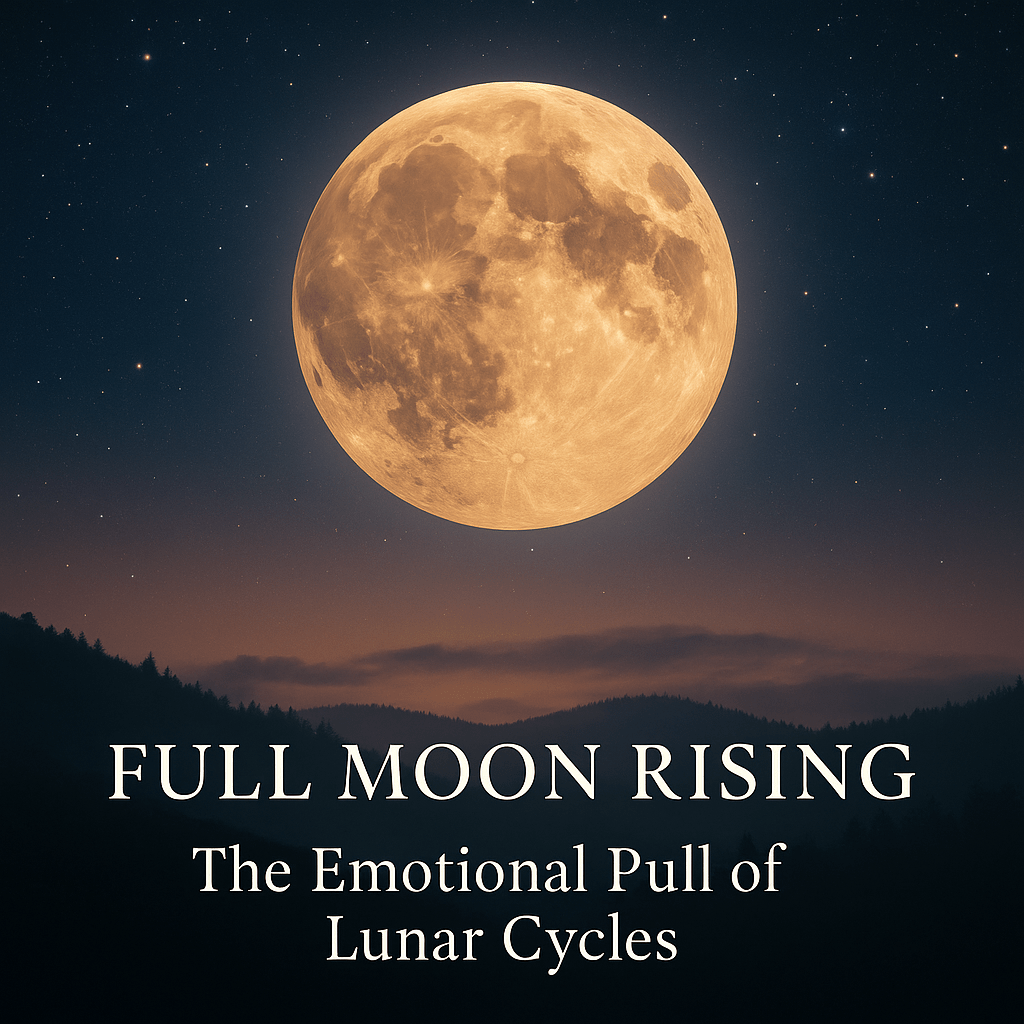
🌕 Full Moon Rising: The Emotional Pull of Lunar Cycles

By Cheryl O’Connor · 10 June 2025

A Moment with the Strawberry Moon

On June 11, the full moon will rise over Australia — known in the Northern Hemisphere as the Strawberry Moon, named not for its colour, but for the ripening of fruit that traditionally occurs at this time.

While the name may not reflect our Southern seasons, the energy of this moon still speaks. It carries a frequency of ripening, readiness, and sweet release — a time when what’s been quietly growing beneath the surface reaches its moment of fullness.

Astrologically, this full moon rises in Sagittarius — the seeker, the truth-teller, the horizon-walker. It invites us to look honestly at what’s come to completion, what beliefs or burdens are ready to be shed, and where our deeper alignment is calling us next.

This isn’t a moon for force or striving.
It’s a moon for tuning in.
For honouring what is quietly asking to be released.

What truth is ripening in you?
What’s ready to fall from the branch, and nourish something new?

This full moon, I’ll be tending the fire of stillness. Dream-listening. Letting the symbols speak.


The Moon, the Body, and the Emotional Landscape

Have you ever noticed your emotions rising to the surface, your sleep thinning, or your dreams becoming more vivid as the full moon draws near?

You’re not alone.

The moon governs the tides. And just as the ocean swells under her pull, so too, many of us feel subtle — or not-so-subtle — waves rising within. Our emotional waters stir. Our subconscious speaks more loudly. Our nervous systems become more sensitive.

Across cultures, the moon has long been associated with the Divine Feminine — intuitive, cyclical, nurturing. In some Indigenous traditions, a woman’s menstrual cycle was known as her “moon time,” often syncing with the full moon. During this phase, women would retreat to Moon Lodges to rest, to dream, and to replenish — a space of reverence, not retreat.

Today, many of us have lost that rhythm. We’re encouraged to override our cycles — to push through, to stay productive, to disconnect from the body’s quiet wisdom.

Yet the body, like the Earth, keeps time. And the moon still speaks.

“There is a tide in the affairs of men…”
Shakespeare wrote — and perhaps he was more literal than we’ve realised.


Science Catches Up with the Moon

Modern studies are beginning to validate what ancient cultures always knew.

A 2021 study in Science Advances found that people — even in urban settings — tend to fall asleep later and sleep less in the days leading up to the full moon, suggesting our circadian rhythms are still sensitive to lunar light and gravitational cycles (Casiraghi et al., 2021).

And in Frontiers in Endocrinology, researchers observed that menstrual cycles longer than 27 days may occasionally sync with lunar phases — particularly in women under 35 and in those less exposed to artificial light at night (Helfrich-Förster et al., 2021).

This may explain why, even in our hyper-lit, hyper-busy modern lives, so many of us feel the tug of the moon. It’s not superstition. It’s biological. Emotional. Rhythmic. Real.


A Gentle Invitation

If your sleep has been strange…
If your dreams have been louder…
If your heart feels like it’s carrying more than usual…

You’re not broken. You’re in rhythm.

This full moon, I’m choosing rest over resistance. Listening over logic. Letting the wave move through.
If something has been stirring in your sleep or spirit, I’d love to hear what’s rising for you, too.

– Cheryl O’Connor
Author | Artist | Holistic Counsellor | Social Worker
Exploring where structure meets soul — through law, healing, and symbolic art.

🔍 References

Casiraghi, L., Spiousas, I., Dunster, G. P., McGlothlen, K., Fernandez-Duque, E., Valeggia, C., & de la Iglesia, H. O. (2021). Moonstruck sleep: Synchronization of human sleep with the moon cycle under natural conditions. Science Advances, 7(5), eabe1358. https://doi.org/10.1126/sciadv.abe1358

Helfrich-Förster, C., Monecke, S., Spiousas, I., Hovestadt, T., Mitesser, O., & Wehr, T. A. (2021). Women temporarily synchronize their menstrual cycles with the luminance and gravimetric cycles of the Moon. Science Advances, 7(5), eabe1358. https://doi.org/10.1126/sciadv.abe1358

Note: These two studies were published under the same issue and DOI grouping in Science Advances due to their related chronobiological focus.

© Cheryl O’Connor, 2025. All rights reserved.
Please do not reproduce without permission. Sharing with credit and a link is welcome.

#FullMoon #StrawberryMoon #Dreaming #LunarEnergy #DivineFeminine #Symbolism #MoonWisdom #MoonCycles #ConsciousLiving #Cheoco

Beyond the To-Do List

For many of us, simply being present, fully here, right now, is one of the greatest challenges we face. In Western culture especially, we’re conditioned to think in linear terms: past, present, future. We track what has been, plan what’s next, and often measure our lives by where we’re going and what we hope to achieve. We make lists, set goals, and feel comforted by having a plan. But underneath it all, we may be reacting not to what’s real, but to a story we’ve told ourselves about how things should go.

My mum, bless her, was the Queen of Organisation. With four children and a job, she had to be. Each of us had assigned chores, and our weeks were structured down to the minute. I grew up knowing exactly what I’d be doing, and when. While life still threw curveballs, I found the predictability comforting. When I became a mother myself, I quickly saw how being organised helped ease stress, and that habit carried over into my work life.

Over three decades in the legal industry only reinforced that rhythm. Planning ahead, meeting deadlines, staying in routine, all of it created a sense of order in what was often a stressful environment. But over time, the rhythm became a rut. I began to feel stuck, drained of joy, and quietly suffocated by the very structure that once kept me afloat. I also realised that when organisation becomes too rigid, it stops being helpful. It becomes control.

As I deepened in awareness, I started to sense that time, at least as we know it, might not actually exist. That all time is now. That things unfold not when we want them to, but when the energy aligns. And from that perspective, life became gentler. I stopped expecting things to go a certain way, and with that, emotional reactions softened. I found myself detaching, from outcomes, from expectations, from old habits of control.

I made fewer plans. “Going with the flow” evolved into being the flow. I became more spontaneous. I let things go if they weren’t working, and trusted that something better might be waiting to fall into place. The most I now plan is a basic outline, one day at a time. As for those job interview questions like, “Where do you see yourself in five years?”, I’ve come to see them as part of a cultural story that often robs us of presence, creativity, and possibility. How can we know what five years will bring? Sometimes, we don’t even know what the next five minutes will bring.

I learned the hard way: plans rarely go according to plan.

Now, if something I want to do just isn’t flowing, I don’t push it. If the energy is not aligned, I let it be. I’ve noticed how stressed people get when things don’t go “according to plan”, the frustration, the disappointment, the tension it can cause in relationships. But often, those delays or disruptions are gifts. Protection. Rearrangements. Or just not the right time yet. The puzzle pieces aren’t in place. And when they are, everything clicks.

I thought I had this all sorted. Skeletal plan? Check. Present moment awareness? Check. Calendar reminders so I didn’t forget the essentials?  Check. It was working beautifully, until one day when I found myself in a situation where communication had been unclear, and I didn’t know what I was “meant” to be doing next. I’d been told one thing, then it suddenly changed. I felt confused, unprepared, and frustrated.

Old habits kicked in: irritation, storytelling, the mental narrative of how it should have been communicated differently. And underneath it all, discomfort. My little comfort zone, small as it was, had been nudged.

Then came the gentle wisdom of another: Does it really matter what you are doing next?

In that moment, I had to laugh. Who was creating the confusion? The person who hadn’t communicated clearly? Or me, reacting to a story in my head, projecting into the future, and leaving the present moment behind?

It was such a simple lesson, offered in such an effective way: Just show up. Be present. Do what’s needed in the moment of now. Let go of the rest.

© Cheryl O’Connor, 2025. All rights reserved.
Please do not reproduce without permission. Sharing with credit and a link is welcome.

Critical Social Policy Analysis and its Potential for Social Justice

Copyright A. Lathouras, C. O’Connor and G. Frawley. Peer reviewed Journal Article first published in New Community, Vol.21 (3)(83), pp. 26-31. 2023.

Abstract: If critical community development is committed to the pursuit of social justice and human rights, then a structural analysis of the root causes of oppression should be foregrounded. This then informs citizen advocacy to work towards social change. Moreover, practice in communities is shaped by social policy as it impacts the welfare of a nation’s citizens. The laws of the land comprise mechanisms for distributing society’s resources, and social policy is underpinned by values, driven by political objectives, and maintained by discursive practices. Drawing on Carol Bacchi’s (2009) critical approach to social policy analysis, this article presents two case study stories where social work students applied a structural analysis to examine the effects of social policy on First Nations communities. This analysis complements a critical approach to community development practice and guides progressive action. 

Introduction

At the University of the Sunshine Coast (UniSC), all social work students complete the courses: Community Development and Social Action and Critical Social Policy Analysis. The first author teaches both, and where theory intersects, critical approaches to both practices are foregrounded. The community development course draws from ideas in the critical tradition as articulated by Margaret Ledwith (2011). This is where practice seeks to build social solidarity and provide a lens through which existing societal structures are examined, enabling more egalitarian, supportive, and sustainable alternatives. Drawing from the Freirean tradition of community education (Freire, 1970 & Freire, 1974), and as radical educators, practitioners facilitate processes that empower people to analyse their lived experiences and collectively act in the hope of transforming those experiences.

For the context of social policy analysis, we gain inspiration from Saul Alinsky’s seminal text Rules for Radicals (1971). Alinsky called for a “reformation”, the process where masses of people reach a point of disillusionment with past ways and values and then, together, organise, build power, and change the system from within (Alinsky 1971:114). Discussing the importance of social democratic reform through citizenship, Alinsky (1971:115) was “desperately concerned” that masses of people, through lack of interest or opportunity, are resigned to live lives determined by others. He argued that, 

The spirit of democracy is the idea of importance and worth in the individual, and faith in the kind of world where the individual can achieve as much of his (sic) potential as possible…. Separation of the people from the routine daily functions of citizenship is heartbreak in a democracy (Alinsky 1971:115).  

Active citizenship can be traced back to the ancient Greek concept of agora, a site of political assembly, an interface between the public and private spheres of social life. In contemporary times, community development can be seen as an expression of “the political and politicized assembly of an active citizenry in civil society”, or a form of politics whereby citizens participate in civil society through communicative action to directly socialise policy issues (Geoghegan & Powell 2009:431).

Critical Social Policy Analysis

In the coursework at UniSC, we draw on Carol Bacchi’s (2009) theory to directly socialise policy issues. In her “What’s the problem represented to be?” approach to critical social policy analysis, Bacchi’s central thesis is that policies give shape to “problems” in society. Government cannot get to work without first problematising its territory, assuming the existence of problems that need to be ‘fixed’. Problematising is how something is represented as ‘a problem’, and social policy reflects what government thinks needs to change. Drawing on post-structural theories, where language or discourses are full of ideology and beliefs, these speak to and uphold one’s ‘truth’. Bacchi (2009) posits these are contested with taken-for-granted assumptions or presuppositions and can be interrogated with other possible standpoints. 

Bacchi’s six-question framework helps us with the interrogation:

  • Q1. What’s ‘the problem’ represented to be, or what’s the ‘problem representation’? Social policy students are encouraged to think from the policy writer’s perspective about the purpose of a policy, its vision, mission, and objectives.
  • Q2. What presuppositions or assumptions underlie this representation of the problem? Students are encouraged to put themselves in the shoes of the government and interrogate this question bothappreciatively and critically. For example, most social policies have strong social democratic and neoliberal underpinning ideology and language.
  • Q3. How has this representation of the problem come about?
  • Here students are encouraged to research the history of a chosen policy area, not from a ‘version control’ perspective, but from the perspective of how society’s attitudes and values have changed over time. For example, in a few short decades, we have gone from separating from society and institutionalising people with chronic disability; to deinstitutionalisation processes in the 1980s with block funding to NGOs; to the current National Disability Insurance Scheme where many people are in control of their own funding packages.
  • Q4. What is left unproblematic in this problem representation? This is where students are encouraged to draw from contemporary grey literature, including peak body reports and submissions to make arguments about what is silenced by the problem representation, or the way government has framed the issue.
  • Q5. What effects are produced by this representation of the problem?
  • Drawing on 500 hours of field education experience, students use their practice wisdom to name the effect on the people or end-users of the policy, both service users and fellow practitioners.
  • Q6. How could the problem representation be questioned, disrupted, and replaced? Here the tutors use a range of creative teaching techniques to help students think outside the box, and about how we can transcend the most deleterious effects of a policy on end-users or practitioners.  

Employing “authentic” assessment processes, which reaffirm the role of higher education in contributing to social justice (McArthur, 2023), students do a simulated policy advocacy presentation and write a simulated policy reform submission to government about the specific policy they’ve researched. The course this year has provided a sense of purpose and social work activism to final year social work students, Cheryl and Grace, co-authors of this paper. Below, each tells their story of applying Bacchi’s framework to social policy impacting on First Nations peoples. 

Cheryl’s Story – Close the Gap

With a legal background and a passion for community development work, recently I investigated an environmental issue impacting Indigenous inequality in Australia. I focused on the Close the Gap (CTG) Implementation Plan 2023, specifically Outcome 1, “Aboriginal and Torres Strait Islander People enjoy long and healthy lives” and 9b, “Safe and reliable water for remote and regional First Nations Communities”. Under the recently elected Labor government, the 2023 version of the Close the Gap social policy seems collaborative with First Nations people, which is a significant improvement over past efforts by various governments. Since writing the 2005 Social Justice Report, Professor Tom Calma AO, argues progress has been made toward achieving health and life expectancy equality for Aboriginal and Torres Strait Island peoples (Australian Indigenous Health Info Net, nd). However, the 2020 Close the Gap report highlighted that:

  • The Indigenous child mortality rate was 141 per 100,000 which is twice that of non-Indigenous children (Australian Government, 2020b).
  • Life expectancy at birth was 71.6 years for Indigenous males and 75.6 years for Indigenous females. In comparison, the non-Indigenous life expectancy at birth was 80.2 years for males and 83.4 years for females (Australian Government, 2020c).
  • During 2015 and 2017 the lowest life expectancy occurred in the Northern Territory (66.6 years for males and 83.4 years for females) (Australian Government, 2020c).

Concerning Outcome 1 of the policy, one of the current commitments is the funding of 30 four-chair haemodialysis units and two dialysis treatment buses throughout Australia. Because of a 2022 report by Water Services Association of Australia (WSAA) which identified 500 Indigenous communities lacking drinkable water due to elevated levels of uranium, arsenic, fluoride, and nitrate above Australian drinking water guidelines, CTG’s Outcome 9b allocates $150 million to the National Water Grid Fund for targeting clean drinking water access in Australian rural and remote communities. The report also found that regular water quality testing in these communities does not occur (WSAA, 2022). 

Initially conducting research for an environmental issue concerning Indigenous Australians, I was able to tie the two outcomes together (1 and 9b), which in the reading of CTG policy, did not appear to be connected.  Outcome 1 was only addressing symptoms by providing more dialysis units, not mentioning, or looking at the probable causes of increasing numbers of chronic kidney disease (CKD).

My preliminary research found evidence highlighting the lack of safe, clean water in the remote Aboriginal community of Laramba, Northern Territory and how despite community efforts to eliminate what they suspected was contaminated water via a court case, there were no laws requiring landlords to provide safe water (ABC News 2022a). Subsequently, the community lost the case. Ultimately, it took 15 years from when concerns were first raised by the Laramba community regarding their water supply before the Northern Territory government constructed and opened a water filtration plant for the community in April 2023 (Northern Territory Government and Information Services, 2023).

The present Australian Drinking Water Guideline level for uranium is 0.02mg/l and current testing reveals that the uranium level in the Laramba water supply has now dropped from between 0.029mg/l – 0.055mg/l to 0.01mg/l (Northern Territory Government and Information Services, 2023) because of the new filtration system.

In the remote Aboriginal community of Kiwirrkurra, Western Australia, the dialysis clinic had to be closed for two years due to contaminated water, and community members needing lifesaving haemodialysis had to travel 800 kilometres for treatment (Purple House, nd; ABC News, 2022b). The Kiwirrkurra article led me to Purple House, a non-profit Indigenous-run health organisation based in Alice Springs that provides haemodialysis treatments in clinics and services remote areas by bus. I spoke with Mr Michael Smith, bio-medical engineer at Purple House, who had invented and won an award for developing a reverse osmosis filtration system that had enabled the Kiwirrkurra clinic to re-open. Even though the clinic had re-opened, the community still did not have safe drinking water and it was reported that 700 bottles of water were being shipped in each week, creating a mountain of rubbish (ABC News, 2022b).

I had several conversations with Mr Smith concerning water quality in remote areas, the high volume of clean water required for haemodialysis treatments and the links between rancid tasting water, the substitution of drinking water for sugary drinks, diabetes, and subsequently CKD. Based on information provided by Mr Smith it is estimated that one patient requiring haemodialysis (3 treatments lasting between 3 to 5 hours per week), requires a total of 70,200 litres of clean, safe water per year. We also discussed the cost of commissioning and installing 20 reverse osmosis filtration systems in the remote communities that Purple House services, so that haemodialysis treatments could occur effectively within communities without community members needing to relocate or travel long distances.

Further research into chronic kidney disease (CKD), revealed that concerns have been growing among healthcare providers, affected community members and leaders regarding the increasing cases of diabetes and CKD in remote Aboriginal communities for quite some time (Rajapakse et. al., 2019; Pan, Owen & Oddy, 2021; Australian Bureau of Statistics, 2019). It was revealed that CKD has a probable cause associated with unpalatable or contaminated groundwater (Rajapakse et.al., 2019). Sugar-sweetened beverages, when substituted for water in communities where the water is rancid and undrinkable, have proven to create obesity which then leads to diabetes, renal failure, and other health issues (Gajjala, 2015; Hormones Australia Endocrine Society of Australia, 2018; Pan, Owen & Oddy, 2021).

Moreover, diabetic nephropathy is the most common type of kidney disease found in pregnant women (Fischer, 2007). A study in 2015 revealed that pregnancy in those with kidney disease had 52 per cent increased odds of preterm delivery and 33 per cent increased odds of caesarean delivery (Kendrick et. al., 2015). Infants whose mothers had kidney disease had 71 per cent increased odds of needing admission to neonatal intensive care units or death, and kidney disease in mothers created a 2-fold increased odds of low birth weight (Rajapakse et al 2019). Maternal kidney disease substantially increases the incidence of “death, foetal prematurity, and low birth rate” (Fischer 2007, p. 135). The Australian Institute of Health and Wellbeing also state that 57 per cent of Indigenous infant deaths that occurred between 2015 and 2019 were due to prenatal conditions (Australian Government Institute of Health and Welfare, 2023).

By using Bacchi’s (2009) framework, I found a situation of symptoms only being addressed in the policy and no evidence that the government was linking the connection I could see between the lack of safe, clean water and the high rates of CKD occurring in Western Australia, where it is endemic (Rajapakse et al., 2019), and in the Northern Territory. The lack of clean, safe water in the remote communities of the two jurisdictions is not news to federal or state governments as there has been an ongoing health crisis due to unsafe water that multiple reports have brought to their attention over the years. Yet it is only now that the State and Federal Governments are beginning to address the water issues.

Employing Bacchi’s question six about how the problem representation could be questioned, disrupted, and replaced, I made two recommendations. The first was to invest $1 million of the $150 million currently allocated in Outcome 9b of the CTG policy, to the National Water Grid Fund to install reverse osmosis filtration systems at the 20 sites Purple House services. If enacted, this would ensure safe and reliable water for those remote First Nations communities. The second recommendation was to immediately commence water quality testing in the 500 communities the WSAA has identified as having undrinkable water. If enacted, this would provide both the State and Federal Governments with a priority list of communities where water treatment processing plants need to be constructed.

Grace’s Story – Domestic and Family Violence Prevention

The social policy I analysed was the Queensland Domestic and Family Violence Prevention Strategy 2016-2026. This prevention strategy provides a framework for government to act against domestic and family violence and has four subsequent action plans, with the most recent action plan addressing coercive control (Queensland Government, 2016). The reason I chose to analyse this policy is because the Queensland Government plans to legislate coercive control by the end of this year, therefore highlighting the need for a current structural analysis of the problem. The Strategy has a vision of creating a Queensland free from domestic and family violence. Specifically, an objective is to legislate and criminalise coercive control by the end of 2023 with the overall aim of eliminating domestic and family violence.

My research found that compared to men, women are three times more likely to experience domestic and family violence, with one woman being murdered every week by a partner (Our Watch, 2023). Moreover, First Nations women are disproportionately more likely to experience domestic and family violence and are eleven times more likely to be killed due to family violence compared to non-Indigenous women (Commonwealth of Australia, 2022).  

A key characteristic of intimate partner homicide is a relationship in which coercive control is used to isolate and control the woman by a range of mechanisms, most of which are invisible to the public (Boxall et al., 2022). Drawing on Bacchi’s question three, I understand that historically, Australia has had a culture deeply engrained with normalising violence against women and maintaining silence about what happens in the private realm (of the home) (Piper, 2019). This culture has normalised domestic and family violence, so much so one can buy a singlet called the ‘wife beater’. Radical feminist discourse suggests the root cause of women’s oppression is in patriarchal gender relations (Pilcher & Whelehan, 2017; Damant et al., 2008), and this informs my belief that in the private realm a woman’s life is where the relationship itself is used as a mechanism of subordination. Furthermore, I now recognise Australia as a patriarchal society that supports this dominant ideology which is used to sustain the isolation of women to the private realm by limiting their ability to participate in the community. This has created a cultural norm in which women stay home and raise children while male partners go out and work (Baxter, 2018). In some households, this can turn a relationship into one of dependency and subservience creating ideal conditions for coercive control to take place (Stark, 2012).

However, I identified that this gendered structural analysis of domestic and family violence does not consider the detrimental socio-economic and cultural impacts of colonisation on First Nations women, impacts that contribute to their experiences of domestic and family violence. These include intergenerational trauma, economic exclusion and dispossession of land and family (Australia’s National Research Organisation for Women’s Safety [ANROWS], 2023). Evidence suggests that 70% to 90% of First Nations women in prison have experienced domestic and family violence either as a child or an adult (Commonwealth of Australia, 2022). First Nations women are overly represented in the criminal justice system and are often misidentified as the person who uses violence (Commonwealth of Australia, 2022). Furthermore, retaliation for their own protection or the protection of their children or misidentification due to racial stereotypes often leads to co-responding protection orders being placed against the victim-survivor (Commonwealth of Australia, 2022). Therefore, the intersection between gender inequality and racial inequality highlights that domestic and family violence can be much more than a cultural issue (ANROWS, 2016). 

Drawing on Bacchi’s question four about what is left problematic with government’s framing of a policy issue, I identified that consultation with First Nations women on this issue and the legislation of coercive control is imperative for Government to understand how this could create further harm to First Nations communities if not properly implemented. The discourse used within the prevention strategy suggests that the behaviours around coercive control need to change. Although this creates an assumption that the community has a comprehensive understanding of coercive control and are therefore capable to commit to change. Additionally, the 2021 National Community Attitudes Towards Violence Against Women Survey shows that 41% of respondents believed that domestic and family violence is committed equally by men and women (ANROWS, 2021). This suggests that the community is still unaware of unequal gender relations and how this influences domestic and family violence.

Additionally, there is an assumption that the criminalisation of coercive control will address the help seeking behaviours of women experiencing domestic and family violence, although the evidence suggests that rates of help seeking are higher for women who experience coercive control as well as physical and/or sexual abuse, rather than just coercive control (Boxall & Morgan, 2021). Furthermore, it is evident that the current systems we have in place are inadequate to support victim-survivors, with service organisations and law enforcement already overrun and struggling to keep up with rates of domestic and family violence (Burt & Iorio, 2023). Our systems that support victim-survivors of domestic and family violence have been structured as crisis responses that offer immediate safety planning, accommodation, and case management. This support is happening after the violence has already occurred with most services meeting woman who are at ‘rock bottom’ and already in grave danger.

After I researched similar social policy in other countries, I discovered that although England and Wales criminalised coercive control in 2015 the understanding of what constitutes coercive control and the ability to recognise it is still unclear. This impacts the practices and responses of service delivery. Additionally, missed or under reporting of coercive control has led to inadequate assessments of risk, resulting in victims being overlooked and murdered (Robinson, Myhill & Wire, 2018). I believe, therefore, a robust approach to re-structuring and re-defining domestic and family violence is needed.

During my policy advocacy presentation and review submission, I made a recommendation to governments to establish a nationwide definition of coercive control enabling a shared understanding and an unambiguous approach to responding to coercive control. Defining coercive control will encompass all forms of nonphysical violence, and will provide law enforcement, the community, and legal systems with a clear definition to respond effectively and lessen the deleterious impacts of this issue facing First Nations women.  

Conclusion

Bacchi’s critical questioning framework for policy analysis draws on social construction theory, about what we take to be ‘fixed’ reality is actually contextual, historical and changing. It also draws on feminist body theory and acts as a counterbalance to focus on people’s perceptions, ensuring that lived experience receives due recognition. Grace and Cheryl’s stories of social policy analysis provide an excellent example of how practitioners could use the framework and work with communities to develop their own structural analysis about the root causes of ongoing disadvantage. The issues raised by them paint a damning picture of a vulnerable population group whose voices are not yet being given space at the policy-making table. 

References

ABC News 2022a, NT Laramba residents consider further court action as absence of safe water laws problematic, viewed 28 May 2023, NT Laramba residents consider further court action as absence of safe water laws problematic – ABC News 

ABC News 2022b, Residents of remote Kiwirrkurra are worried about tap water, but a reverse osmosis water purifier could help, viewed 28 May 2023, Residents of remote Kiwirrkurra are worried about tap water, but a reverse osmosis water purifier could help – ABC News 

Alinsky, S 1971, Rules for Radicals, Random House, New York.

Australian Bureau of Statistics 2019, viewed 28 May 2023, National Aboriginal and Torres Strait Islander Health Survey, 2018-19 financial year, Australian Bureau of Statistics (abs.gov.au) 

Australian Government 2020a, Closing the Gap Report, viewed 27 May 2023, Closing the Gap 2020, Closing the Gap (niaa.gov.au)  

Australian Government 2020b, Child Mortality, viewed 27 May 2023, Child Mortality, Closing the Gap (niaa.gov.au)

Australian Government 2020c, Life Expectancy, viewed 27 May 2023, Life Expectancy, Closing the Gap (niaa.gov.au)  

Australian Government 2022, National Health and Medical Research Council, Australian Drinking Water Guidelines, viewed 28 May 2023, Australian_Drinking_Water_Guidelines_ADWG_V3-8_Sep2022.pdf

Australian Government 2023, Commonwealth Closing the Gap Implementation Plan, viewed 27 May 2023, 2023 Commonwealth Closing the Gap Implementation Plan, National Indigenous Agency (niaa.gov.au).  

Australian Government Institute of Health and Welfare 2023, Chronic Kidney Disease: Australian Facts, viewed 28 May 2023, Chronic kidney disease: Australian facts, Mortality-Australian Institute of Health and Welfare (aihw.gov.au).

Australian Government Ministers, Department of Health and Aged Care, viewed 31 May 2023, New renal dialysis units for remote First Nations patients, Health Portfolio Ministers and Aged Care. 

Australian Indigenous Health Info Net nd, viewed 27 May 2023, History of Closing the Gap – Closing the Gap – Australian Indigenous HealthInfoNet (ecu.edu.au)

Baxter J, 2018, ‘Fathers and Work: A statistical overview’, Australian Institute of Family Studies.

Australia’s National Research Organisation for Women’s Safety 2016, Existing knowledge, practice and responses to violence against women in Australian Indigenous communities: State of knowledge paper, Australia’s National Research Organisation for Women’s Safety, August 2, 2023, https://www.anrows.org.au/publication/existing-knowledge-practice-and-responses-to-violence-against-women-in-australian-indigenous-communities-state-of-knowledge-paper/.

Australia’s National Research Organisation for Women’s Safety 2021, The 2021 National Community Attitudes towards Violence against Women Survey, Australia’s National Research Organisation for Women’s Safety, August 2, 2023, https://www.anrows.org.au/publication/attitudes-matter-the-2021-national-community-attitudes-towards-violence-against-women-survey-ncas-findings-for-australia/.

Australia’s National Research Organisation for Women’s Safety Fast Facts- Indigenous Family Violence, Australia’s National Research Organisation for Women’s Safety, August 2, 2023, https://www.anrows.org.au/resources/fast-facts-indigenous-family-violence/#:~:text=This%20resource%20provides%20a%20brief,to%20inform%20their%20decision%2Dmaking.

Bacchi, C 2009, Analysing Policy: What’s the Problem Represented to be? Pearson, Frenchs Forest.

Boxall, H, Doherty, L, Lawler, S, Franks, C & Bricknell, S 2022, The “Pathways to intimate partner homicide” project: Key stages and events in male-perpetrated intimate partner homicide in Australia, Australia’s National Research Organisation for Women’s Safety, August 2, 2023, https://anrowsdev.wpenginepowered.com/wp-content/uploads/2020/04/Boxall-et-al_Pathways-to-intimate-partner-homicide.2.2.pdf.

Boxall & Morgan 2021, Experiences of coercive control among Australian women, Australian Government, August 2, 2023, https://www.aic.gov.au/sites/default/files/2021-03/sb30_experiences_of_coercive_control_among_australian_women_v2.pdf.

Burt, J & Iorio, K 2023, Domestic violence law reforms pass Queensland parliament, but consultation on criminalisation of coercive control continues, ABC News, August 2, 2023, https://www.abc.net.au/news/2023-02-23/coercive-control-queensland-parliament-domestic-violence-laws/102012376.

Commonwealth of Australia 2022, National Plan to End Violence against Women and Children 2022–2032, Department of Social Services, August 2, 2023, https://www.dss.gov.au/sites/default/files/documents/11_2022/national_plan_to_end_violence_against_women_and_children_2022-2032.pdf.

Damant, D, Lapierre, S, Kouraga, A, Fortin, A, Hamelin-Brabant, L, Lavergne, C & Lessard, G 2008, “Taking child abuse and mothering into account,” Affilia, 23(2):123–133, https://doi.org/10.1177/0886109908314321.

Freire, P 1970, Pedagogy of the oppressed. Penguin.

Freire, P 1974, Education for critical consciousness. Continuum.

Gajjala, Prathibha Reddy & Sanati, Maryam & Jankowski, Joachim 2015, Cellular and Molecular Mechanisms of Chronic Kidney Disease with Diabetes Mellitus and Cardiovascular Diseases as Its Comorbidities. Frontiers in immunology, Vol 6, p. 340. 10.3389/fimmu.2015.00340 

Geoghegan, M & Powell, F 2009, ‘Community Development and the Contested Politics of the Late Modern Agora: Of, Alongside or Against Neoliberalism?’, Community Development Journal, Vol. 44, No. 4, pp. 430-447.

Hormones Australia Endocrine Society of Australia 2018, Kidney Disease and Diabetes – What is the Link? Dr Nicolette Hodyl, viewed 26 May 2023, Kidney disease and diabetes – what is the link?, Hormones Australia (hormones-australia.org.au).

Kendrick J, Sharma S, Holmen J, Palit S, Nuccio E & Chonchol M 2015, Kidney disease and maternal and fetal outcomes in pregnancy, American Journal of Kidney Disease, Vol 66, no.1, pp.55-9. doi:10.1053/j.ajkd.2014.11.019. 

Ledwith, M 2011, Community development: A critical approach (2nd ed.). Policy Press.

McArthur, J 2023, ‘Rethinking authentic assessment: work, well-being, and society’, Higher Education, Vol. 85, pp. 85-101.

Northern Territory Government and Information Services 2023, viewed 28 May 2023, Laramba Water Treatment Plant officially opened | NT.GOV.AU 

Our Watch 2021, Quick facts Preventing violence against women, August 2, 2023, https://www,ourwatch.org.au/quick-facts/.

Pan F, Owen N and Oddy W 2021, Sugar sweetened beverages and increasing prevalence of type 2 diabetes in the Indigenous community of Australia, Nutrition, Metabolism and Cardiovascular Diseases, Vol 31, no. 10, Pages 2825-2830, https://doi.org/10.1016/j.numecd.2021.06.014

Our Watch 2021, Quick Facts Preventing Violence Against Women, August 2, 2023, https://www.ourwatch.org.au/quick-facts/.

Piper, A & Stevenson, A 2019, The long history of gender violence in Australia, and why it matters today, The Conversation, August 2, 2023, https://theconversation.com/the-long-history-of-gender-violence-in-australia-and-why-it-matters-today-119927.

Queensland Government 2016, Domestic and Family Violence Prevention Strategy 2016-2026, Queensland Government, August 2, 2023, https://www.publications.qld.gov.au/ckan-publications-attachments-prod/resources/008db60d-06e9-4702-bb87-48be367edf93/dfv-prevention-strategy.pdf?ETag=ef56a614ca32eedadca2acffc3f37578.

Robinson, AL, Myhill, A & Wire, J 2017, “Practitioner (mis)understandings of coercive control in England and Wales,” Criminology & Criminal Justice, 18(1):29–49, https://doi.org/10.1177/1748895817728381.

Stark, E 2012, “Looking beyond domestic violence: Policing coercive control,” Journal of Police Crisis Negotiations, 12(2):199–217, https://doi.org/10.1080/15332586.2012.725016.

The University of Queensland Australia 2022, viewed 3 August 2023, Countless reports show water is undrinkable in many Indigenous communities. Why has nothing changed? – Faculty of Medicine – University of Queensland (uq.edu.au) 

 Water Services Association of Australia 2022, viewed 28 May 2023,  Gaps to fill to ensure safe drinking water for First Nations communities | Water Services Association of Australia (wsaa.asn.au) 

Whelehan, I & Pilcher, J 2017, Key concepts in Gender Studies, https://doi.org/10.4135/9781473920224.

Australia’s Homeless Crisis: Detrimental Impacts on Older Women

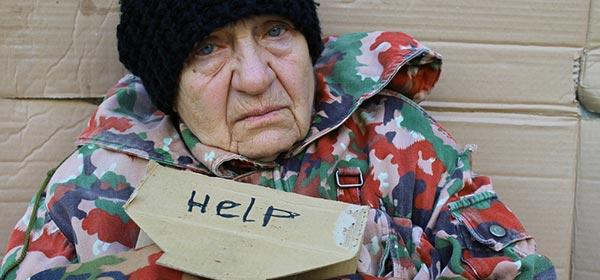
Older single women in Australia are at high risk of facing a crisis. One brought on by neoliberal ideologies and policies which intersect with gender and wage bias, along with the historical marginalisation of women in a patriarchal society. This crisis is homelessness and why it is exponentially growing can be understood through the lens of feminist standpoint theory and neoliberalism.

Like all theories, feminist standpoint theory has its limitations and uses. It assists with analysing and understanding this particular social justice issue because feminist standpoint theory considers the individual experiences of the women involved. It also takes into consideration women’s historical roles in society. Standpoint theory emerged from Marxism wherein it was seen that members of society who were oppressed were privy to knowledge the privileged class were not aware of (Borland 2020). In 1983 when Nancy Hartsock published her book “Money, Sex and Power” she provided a theoretical method which took into consideration women’s unique perspectives within society (Hekman 1997, p. 341). This theory also justified feminist claims regarding women being oppressed members of society and feminist standpoint theory as a methodology began (Hekman 1997). During the 80s and 90s other contributors to this theory included Sandra Harding, Merrill Hintikka, Patricia Hill Collins and Dorothy Smith (Hekman 1997; Borland 2020). Harding was of the view that even though scientific researchers claimed to be neutral, their research methods and results were sexist (Borland 2020, p.1).

Harding saw that by implementing standpoint theory, it would reveal the power held within ‘scientific authority’ and would create ‘knowledge that is embodied, self-critical and coherent’ (Borland 2020, p.1). Patricia Hill Collins contributed an African American feminist perspective arguing that race, gender, class oppression and lack of privilege for African American women also provided a unique perspective to the feminist landscape which needed to be seen (Borland 2020). Whilst standpoint theory can be seen as essentialist due to the implied belief that a universal female standpoint exists, theorists utilising feminist standpoint theory have chosen to focus on the ‘political aspects of social position’ from a feminist view rather than speaking for all women (Borland 2020, p.1). Use of feminist standpoint theory and practice, however, has come under scrutiny as it appears to challenge the more recent feminist theories which have emerged from ‘postmodernism and poststructuralism’ (Hekman 1997, p.342).

Nonetheless, Hekman (1997, p.342) argues that feminist standpoint theory is based on the understanding that “knowledge is situated and perspectival, and that there are multiple standpoints from which knowledge is produced.” Hawkesworth (1999) sees feminist standpoint theory not as an epistemology but as an analytical tool. Both Hawkesworth (1999) and Hekman (1997) posit there are various types of competing feminist standpoints and that by critically examining those, problems can be illuminated which Hawkesworth (1997, p.152) states …’empirical research must engage’.

When looking at the issue of older single homeless women in Australia some of the specific gender-based factors for this cohort are that their earlier lives have been shaped by the societal norm they would marry and their husband would provide for them in their roles as homemakers, child-bearers and predominantly mothers (Darab & Hartman 2013; Hartman & Darab 2017). According to McFerren & Laverty (2010),a high percentage of older single homeless women have suffered domestic violence or experienced adverse tragedy in their earlier lives. Common themes found in various studies concerning lack of housing security available to these women both now and into the foreseeable future, are cited as being systemic issues; domestic violence; age, wage, employment and gender discrimination; and relationship breakups (McFerren & Laverty 2010;Darab & Hartman 2013; Hartman & Darab 2017; Irwin & Leeson 2016; Sharman 2017; Faulkner & Lestner 2020). Invisibility via research and media representation of this group of women, which results in a lack of service provision specifically tailored for them, along with housing unaffordability, are also cited as being factors which are contributing to the increasing number of older women who are, or are becoming, homeless (McFerren & Laverty 2010; Darab & Hartman 2013; Hartman & Darab 2017; Irwin & Leeson 2016; Sharman 2017; Faulkner & Lestner 2020).

In 2017 Hartman & Darab conducted a qualitative research project using feminist standpoint theory regarding older homeless women and pathways to housing in the rural area of the Northern Rivers, New South Wales. They found intersectionality was occurring between gender, relationship status, aging and lack of home ownership (Hartman & Darab 2017). The absence of employment opportunities combined with minimal public transport were also cited as factors contributing to older single women becoming homeless in the region (Hartman & Darab 2017). Reasons Sharman (2017) gives for the rise in numbers of older single homeless women in her Victorian study are that these women, due to the roles they played earlier in their lives were locked out of the labour market and as such were prevented from accumulating superannuation and savings. Sharman (2017, p.51) also cites ‘adverse critical life experiences’ which are ‘non-normative’, as being a factor. For example, the unexpected death of a partner, ill health, sick children, unemployment or disability all can impact on an individual’s ability to function as they would normally expect to (Sharman 2017).

Other critical life events which Sharman (2017) states have impacted on older single women have been rental increases, mortgagee repossessions, evictions and housing stress brought on by increasing costs where 30 per cent or more of household income is required to secure housing. In addition to the aforementioned factors women’s work is often undervalued, unpaid or underpaid (Sharman 2017; Healy & Kidd 2013). Many women’s working lives are interrupted by children and they are often pushed into the dominant female industries of health, teaching and retail (Sharman 2017). Mostly relying on less pay than male counterparts along with part-time or casual work to meet family responsibilities results in less savings and less superannuation being accumulated by the time they retire (Sharman 2017; Healy & Kidd 2013). Recent research by Faulkner and Lestner (2020) estimated “240,000 women aged 55 or older and another 165,000 women aged 45-54 are at risk of homelessness” in Australia.

Whilst no government is responsible for exceptional individual life experiences, under the United Nations agreements Australia is privy to, the State is responsible for the provision of certain basic human rights to all citizens, which it does not appear to be adhering to. In 1976 Australia ratified the United Nations International Covenant on Economic, Social and Cultural Rights. At Article 11, 1., it states that adequate housing is a fundamental human right (Marston, McDonald & Bryson 2014; Australian Legal Information Institute 1976; Australian Human Rights Commission 1976; Human Rights and Equal Opportunity Commission 1996). The Universal Declaration of Human Rights, which Australia was a founding contributor to in 1948 and signatory of, at Article 25, states, “Everyone has the right to a standard of living adequate for the health and well-being of himself and his family, including … housing” (United Nations 1948).Despite these signed agreements, according to the Australian Bureau of Statistics 2016 Census, there were an estimated “6,866” homeless older women and “5,820” older women who were “living in marginal housing” and “may be at risk of homelessness” (Australian Bureau of Statistics 2017; Australian Human Rights Commission 2019a).

Further, older women are seen to be “the fastest-growing cohort of homeless Australians” evidenced by a 31 per cent increase occurring between 2011 and 2016. (Australian Human Rights Commission 2019a; Australian Human Rights Commission 2019b). Dominant neo-liberal ideology and practices which have been occurring in Westernised countries for the past 30 years are a major factor which impacts on homelessness (Bullen 2015; Hartman & Darab 2017). Neo-liberalism is a mode of governing which emphasises free markets, individuals being solely responsible for themselves and market like modes of service provision (Bullen 2015; Hartman & Darab 2017).

As a consequence of neoliberalism, there has been a shift away from discourses of homelessness being a social issue brought about by unemployment, poverty, domestic violence and disadvantage, to being one of a personal issue (Bullen 2015; Sharman 2017). This has consequently had a detrimental impact on service provision and created negative feelings of self-worth, blame and exclusion for homeless persons (Bullen 2015).  Policies implemented, which included the reduction of capital gains tax in 1999 and negative gearing in the late 1980s, have resulted in decreased housing affordability as house prices, compared to available income during the past 15 years, has increased sharply (Hartman & Darab 2017). Further, there has been a decline in public housing availability since the 1990s as the State’s focus has been on offering financial support for low-income earners via rent assistance within the private rental market, as well as implementing the first home owner’s grant, rather than providing public housing (Hartman & Darab 2017).

These policies have resulted in a rental market which favours investors and landlords (Hartman & Darab 2017). Media representation based on neo-liberal principles presents a perspective of homelessness, generally speaking, that some are deserving and undeserving of State assistance (Lyons & Smedley 2020). Those who are considered deserving are those who through no personal fault suddenly find themselves homeless and those who are classed as undeserving are often stereotyped as being slack due to the perception that they are incompetent (Lyons & Smedley 2020). What is missing from media representation regarding homelessness in Australia is a discussion concerning the growing number of single older women who are unable to secure a home (Lyons & Smedley 2020).

Whilst there is not a lot of research available regarding this sector of homelessness specifically, research does validate that a looming crisis is pending. Many factors are contributing to single older women becoming homeless in Australia, not the least of which are neoliberal ideology and practices that are proving to not only be detrimental to a whole generation of women currently but potentially also for women in the future.

Copyright C. O’Connor, November 2021.

References

Australian Bureau of Statistics 2017, 2016 Census, viewed 23 August 2020 https://www.abs.gov.au/websitedbs/censushome.nsf/home/2016 

Australian Human Rights Commission 2019a, Older Women’s Risk of Homelessness: Background Paper, viewed 20 August 2020,  https://humanrights.gov.au/sites/default/files/document/publication/ahrc_ow_homelessness2019.pdf

Australian Human Rights Commission 2019b, Risks of Homelessness in older women, viewed 20 August 2020, https://humanrights.gov.au/our-work/age-discrimination/projects/risk-homelessness-older-women  

Australian Human Rights Commission 1976, International Covenant on Economic, Social and Cultural Rights, viewed 20 August 2020, https://humanrights.gov.au/our-work/commission-general/international-covenant-economic-social-and-cultural-rights-human-rights 

Australian Legal Information Institute, Australian Treaty Series 1976, No 5, Department of Foreign Affairs, International Covenant on Economic, Social and Cultural Rights, United Nations, New York, viewed http://www.austlii.edu.au/au/other/dfat/treaties/1976/5.html  

Borland E 2020, Standpoint theory, viewed 20 August 2020, https://www.britannica.com/topic/standpoint-theory

Bullen J 2015, ‘Governing Homelessness: The Discursive and Institutional

Construction of Homelessness in Australia’, Housing, Theory and Society, 32:2, 218-239, doi:10.1080/14036096.2015.1024886

Darab, S & Hartman Y 2013, ‘Understanding Single Older Women’s Invisibility in Housing Issues in Australia’, Housing, Theory and Society, vol. 30, no. 4, pp. 1–20, doi:10.1080/14036096.2012.746944

Faulkner D & Lester L 2020, ‘400,000 women over 45 are at risk of homelessness in Australia The Conversation, viewed 23 August 2020https://theconversation.com/400-000-women-over-45-are-at-risk-of-homelessness-in-australia-142906

Hartman, Y & Darab, S 2017, ‘The housing pathways of single older non-home owning women in a rural region of Australia’, Journal of Rural Studies, vol. 54, pp. 234–243, doi:10.1016/j.jrurstud.2017.07.003.

Hawkesworth, M 1999, ‘Analyzing backlash: Feminist standpoint theory as analytical tool’, Women’s Studies International Forum, vol. 22, no. 2, pp. 135–155, doi:10.1016/S0277-5395(99)00003-5.

Healy, J & Kidd, M 2013, ‘Gender-based undervaluation and the equal remuneration powers of Fair Work Australia’, Journal of Industrial Relations, vol. 55, no. 5, pp. 760–782, doi: 10.1177/0022185613491683.

Hekman, S 1997, ‘Truth and Method: Feminist Standpoint Theory Revisited’, Signs, vol. 22, no. 2, pp. 341–365, doi:10.1086/495159.

Human Rights and Equal Opportunity Commission 1996, Housing as a human right, viewed 20 August 2020 https://humanrights.gov.au/sites/default/files/content/pdf/human_rights/housing.pdf

Irwin P & Leeson G 2016, ‘Late Middle-Aged Single Women and The Risk of Homelessness in Rural Australia’, The Gerontologist, vol. 56, no. Suppl3, pp. 719–719, doi:10.1093/geront/gnw162.2932.

Lyons G & Smedley C (2020) ‘The new face of homelessness? Examining media representations of women’s homelessness in five Australian news sources’, Journal of Social Distress and Homelessness, doi:10.1080/10530789.2019.1709269

McFerran, L & Laverty, S 2010, ‘It could be you: female, single, older and homeless’, Parity, vol. 23, no. 7, ISSN:1032-6170

Marston, G, McDonald, C & Bryson, L 2014, The Australian welfare state: who benefits now?, Palgrave Macmillan, South Yarra. 

Petersen, M 2015, ‘Addressing older women’s homelessness: service and housing models’ Australian Journal of Social Issues, vol. 50, no. 4, pp. 419–438,458, doi:10.1002/j.1839-4655.2015.tb00358.x.

Sharman A 2017, The Voices of Midlife Women Facing Housing Insecurity in Victoria, Australia, Social Policy & Society, Vol 16, No. 1, pp.49-63, doi:10.1017/S1474746415000603

United Nations 1948, Universal Declaration of Human Rights, viewed 23 August 2020, https://www.un.org/en/universal-declaration-human-rights/index.html

Race and Racism in Australia.

Race as a social construct came into being alongside capitalism.  When European colonists arrived in Australian with their ethnocentric ideology, racist foundations became the building blocks upon which inequity and institutions were built. As a result, the trauma and inequality created for Aboriginal and Torres Strait Islanders by colonialism has, and continues to, impact detrimentally on their health and well-being despite Governments expending large sums of money on programs and services to close the gap between Indigenous and non-Indigenous outcomes in relation to health. The colonialist mentality of racism in Australia towards Aboriginal and Torres Strait Islander people is maintained by three main forms of racism; institutionalised, interpersonal and internalised. Institutionalised racism, particularly within the health system, is creating a plethora of inequity issues which are resulting in high mortality rates amongst Aboriginal and Torres Strait Islander communities.

The publication of The Origin of Species, written by biologist and philosopher Charles Darwin in 1859, led to eugenics, phrenology, ethnocentricity and Social Darwinism, and subsequently race and racism began.  Darwin’s theory of evolution and natural selection proposed that differences between human beings, such as skin colour, equated to different races of human beings existing and therefore those who did not have the same attributes as Europeans were classified as being of a different species, or race (Hollinsworth 2006, p.32). His theory added scientific credence to, and fueled the fire of, the political, social and medical discourses being espoused by Herbert Spencer, an English sociologist, biologist and prominent liberal political theorist (Hollinsworth 2006, p.32). Darwin’s theory led to Social Darwinism being established within European society (Hollinsworth 2006, p.32). Race and racism was therefore founded on the politics of eugenics and the medical and political discourses which spread globally during the end of the nineteenth century and into the twentieth century (Bastos, Harnois & Paradies 2016, p.209). Eugenics is the science of controlling breeding within populations so there is an increasing manifestation of the required genetic characteristics (Galton 1904, p.1). Indigenous Australians were seen by European colonists to be situated at the very bottom of a hierarchical ladder which Europeans existed at the summit of (Germov & Poole 2007, p. 284). This mentality was known as ethnocentricity which is when a belief exists that your own culture or ethnic group is superior to another (Bizumic & Duckitt 2012, p.887). It was also seen by Europeans that Indigenous people were inferior biologically due to the pseudo-scientific theory of phrenology which equated skull size and shape as being able to determine a person’s character (Germov & Poole 2007, p. 284).  With eugenics, phrenology and ethnocentricity firmly implanted in the minds of the colonists who invaded Australia, it takes little sociological imagination to understand why European colonists behaved as they did towards Aboriginal and Torres Strait Islander people.

When the invasion of Australia by the British occurred in 1770 they brought with them fixed mindsets of capitalism and Social Darwinism and the colonisation of Australia began. Colonialism relates to a system being implemented whereby an individual or group of individuals seek to dominate others (Horvath 1972, p.46). Sociological theorist Pierre Bourdieu referred to colonialism as a forceful system of oppression based on racist beliefs which seeks to reorganise social kinships and at the same time establish a crossbred society (Go 2013, p. 49).Colonialism is also a powerful and aggressive action taken by people to possess land and exploit it, along with the Indigenous people who occupy that land, with no regard to the original inhabitants, their culture or their existing laws (Horvath 1972, p. 46). Karl Marx believed this type of domination occurs out of an economic basis and is a symptom of capitalism (Horvath 1972, p.46). Horvath states colonisation creates and perpetuates social injustice (Horvath 1972, p.46). Colonists were of the fear-based view that Aboriginal and Torres Strait Islander people were savages who were dangerous, yet childlike (Hollinsworth 2006, p.33).As such, great measures to establish and maintain superior paternalistic power and control over Indigenous Australians began because of unconsciously based scientific racist beliefs (Hollinsworth 2006, p. 34). This fear-based power and control continued to have a stronghold in Australia into the later part of last century (Hollinsworth 2006, p. 34). Because of Darwin’s theory of natural selection, Indigenous Australians were seen to be a separate race of people who colonists believed were destined to die out anyway (Hollinsworth 2006, p. 35).It was often the situation that anyone who protested the horrendous treatment Indigenous people received whilst colonisation was occurring, were met with rebuttal (Hollinsworth 2006, p. 35).It was also seen to be worthy of celebration by colonists, not lamentation, that the extinction of an inferior race was occurring, with their help (Hollinsworth 2006, p. 35).  The attempted assimilation which occurred of trying to change the genetics of Indigenous Australians was a direct result of eugenics. It was these underlying beliefs colonisers held which established Australia’s institutions and created the systemic racism which still exists within those institutions today.

Institutionalised racism lays at the core of all of Australia’s systems and is closely linked with capitalism. Race and racism in Australia can be understood as being maintained institutionally when looked at through the sociological lens of Foucault’s theory that governmental control occurs via the power maintained in institutional systems, which then becomes internalised normality within society (Germov & Poole 2007, p. 287).From a Marxists perspective Governments would not want to change the existing institutionalised racism because to do so would alter the balance of power which would no longer serve the interests of capitalism (Germov & Poole 2007, p. 287).  Racism is defined as a discriminatory dispersal of chances, assistance or capital implemented by the dominant culture over minority groups of different race or ethnicity (Paradies, 2018, 0.42 – 1.44). Institutionalised racism has been defined as having its basis in historical social scenarios which continues due to frameworks that preserve prior discriminations (Jones 2001, p.1212). Institutionalised racism is often seen to be legalised and lays within the policies and practices of institutions, whilst also being apparent when procrastination occurs, instead of action, in relation to needs not being met (Jones 2001, p.1212). Evidence shows that racism, whilst not a set target in the Close the Gap Report 2008 (Parliament of Australia undated, p. n/a), has been recognised by the Federal Government in the Close the Gap Report Review 2018 (Australian Human Rights Commission 2018, p.3) and in the National Aboriginal and Torres Strait Islander Health Plan 2013-2023 (Australian Government Department of Health 2013, p.8). Due to institutionalised racism, which has become the societal norm, many Australians do not see their unconsciously conditioned biases perpetuate not only the racism the country’s systems were built on, but also that they serve to maintain the inequality between Indigenous and non-Indigenous Australians which began over two hundred years ago.

Interpersonal racism, along with institutionalised racism and deficit discourses within politics and the media are having an adverse effect on the mental and physical health of Indigenous Australians. Interpersonal racism can be conscious or unconscious and appears in society by way of stereotyping, lack of service, ignoring, lack of respect and devaluation (Jones 2001, p.1213).Institutionalised racism, combined with interpersonal racism lead to internalised racism, which involves taking on the limiting beliefs about oneself which have been projected by the dominant culture onto the minority group (Jones 2001, p. 1213).Internalised racism can also lead to a lack of self-worth, lack of belief in peers and in one’s self (Jones 2001, p. 1213).  The general dominant political and media discourse in Australia is increasing the inequality many minority groups encounter from the dominant culture (Hollinsworth 2006, p. 246). Since 1996, when the Howard Government came into power, there has been a steadily growing manufactured erosion of social justice and equal rights occurring in Australia via an official discourse being implemented through laws based on fear and envy (Hollinsworth 2006, p 246). This stance will only lead to increasing inequality, endangering existing social structures and possibly result in an increase in violence occurring (Hollinsworth 2006, p. 246). Combined with these deficit discourses created by non-indigenous media and politicians in Australia towards Indigenous Australians, racism has been found to be detrimental to Aboriginal and Torres Strait Islanders health as they all impact adversely psychologically, emotionally and in relation to their overall social wellbeing.

Perceptions of race and racism within Australian have been shown, through a variety of micro and macro level methods, to reveal health care barriers exist for Indigenous Australians which do not exist for non-Indigenous Australians. Systemic racism not only has detrimental outcomes such as depression, suicide, anxiety and post-traumatic stress disorder for Indigenous Australians, but it also creates significant economic impacts on society (Paradies 2016, p.1). In 2016 it was estimated that racial discrimination cost the Australian economy approximately 37.9 billion dollars per annum (Paradies 2016, p.1). A study conducted during 2012 and 2013 revealed thirty percent of Aboriginal and Torres Strait Islander people suffer from extreme psychological and emotional occurrences of depression or anxiety (Australian Institute of Health and Welfare 2015, p. 71). This figure is extraordinarily high when one considers that Indigenous Australians make up only three percent of the national population (Bastos, Harnois & Paradies 2016, p.211). Further, it was revealed in 2012 that Indigenous Australians experience higher rates of suicide than non-Indigenous Australians with deaths being predominantly higher for males between the ages of twenty-five and twenty-nine (Australian Bureau of Statistics 2012, p. n/a). The statistics of deaths based on a scale of one hundred thousand per population for this age group show that non-Indigenous male deaths by suicide peak at twenty percent and Indigenous males peak at ninety percent (Australian Bureau of Statistics 2012, p. n/a). In 2014 a General Social Survey was conducted to determine the degree racial discrimination intersects with other areas of discrimination such as, gender, sexuality, class and age within Australia, in creating access barriers to health care (Bastos, Harnois & Paradies 2016, p.209). The results concluded perceived racism was a major factor creating a barrier in accessing health care, particularly mental health (Bastos, Harnois & Paradies 2016, p.216). There is ample available research which indicates that the social construct of race is responsible for the ongoing high mortality rates occurring within Aboriginal and Torres Strait Islander communities. Racism in its various forms is not only creating barriers to accessing health care but creating ongoing psychological and emotional distress for a large percentage of Indigenous Australians.

According to sociologists, Australia has moved into a time of post-modernity and post-colonialism, but the evidence clearly shows the social construct of race and the racism which stems from it continues to be maintained by way of institutionalised racism. Post-colonialism came into being late in the twentieth century (Eagleton 2011, p. 222).It is defined as a time when physical violence is no longer being perpetrated to take land (Hollinsworth 2006, p.246). This may be the situation; however, it appears that a new form of racism has taken the place of the past brutal dispossession, assimilation and genocide. Known as new racism, this form revolves around the structure and appearance of racism in relation to pecuniary and socio-traditional variances which exist between the overriding and minority cultures within a country (Germov & Poole 2007, p. 287).Post-colonialism studies look at the relationships between oppressors and oppressed existing in countries that have been colonised (Germov & Poole 2007, p. 287).Indigenous identity, which post-colonialism also concerns itself with, has been revealed via various institutional policies to have been manipulated to implement and validate dominant policies (Germov & Poole 2007, p. 288).Colonialism was rooted in racism and whilst many perceive both exist historically and are no longer apparent, both still exist within capitalism as the Western thinking of those in power continues to be based on the taking of other people’s land who are not in positions to stop them (Jureidini & Poole 2003, p.246). It is in the continuation of institutionalised racism and subsequent racist policies and practices, by those in power within the Westernised political system, that inequity continues to grow and create an ever-widening gap between capitalist politicians and those who they deem to be inferior.

Race and racism are social constructs designed by the political upper class in Europe in the late 1800s based on ethnocentricity. Institutionalised racism has created discrimination, exploitation, distress and inter-generational trauma which is still impacting on Aboriginal and Torres Strait Islander people. Whilst State and Federal Governments have spent voluminous sums of money on programs and services to bring about more equality between non-Indigenous and Indigenous Australians in relation to health, they have failed. Up until 2013 they did not recognise that systemic racism within Australian institutions is responsible for the lack of equity, agency, health issues, self-governance and self-determination Aboriginal and Torres Strait Islanders have been and still are experiencing.

Copyright: C. O’Connor, November 2018.

Reference List

Australian Bureau of Statistics 2012, Aboriginal and Torres Strait Islander suicide deaths overview, viewed 21 October 2018, http://www.abs.gov.au/ausstats/abs@.nsf/Products/40080452773CE5D5CA257A4500045E5F?opendocument

Australian Government Department of Health 2013, National Aboriginal and Torres Strait Islander Health Plan 2013-2023, p. 8, viewed 18 October 2018 http://www.health.gov.au/natsihp

Australian Human Rights Commission 2018, A ten-year review: The Closing the Gap Strategy and Recommendations for Reset: Close the Gap 2018 – Human Rights, p. 3 viewed 16 October 2018 https://www.humanrights.gov.au/sites/default/files/document/publication/CTG%202018_FINAL-WEB.pdf

Australian Institute of Health and Welfare 2015, The health and welfare of Australia’s Aboriginal and Torres Strait Islander people’s, viewed 22 October 2018, https://www.aihw.gov.au/getmedia/584073f7-041e-4818-9419-39f5a060b1aa/18175.pdf.aspx?inline=true\

Bastos, J, Harnois, C & Paradies, Y 2018, ‘Health care barriers, racism, and intersectionality in Australia’, Social Science & Medicine, vol. 199, pp. 209 – 218. doi: 10.1016/j.socscimed.2017.05.010

Bizumic, B & Duckitt, J 2012, ‘What Is and Is Not Ethnocentrism? A Conceptual Analysis and Political Implications’, Political Psychology, vol. 33, no. 6, pp.887–909. doi:10.1111/j.1467-9221.2012.00907

Eagleton, T 2011, Why Marx was right, Yale University Press, New Haven.

Elias, A & Paradies, Y 2016, ‘Estimating the mental health costs of racial discrimination’ BMC Public Health, vol.16, no. 1(1), p.n/a, doi: 10.1186/s12889-016-3868-1

Galton, F 1904, ‘Eugenics: Its Definition, Scope, and Aims’, American Journal of Sociology, vol. 10, no. 1, pp.1–25. doi: 10.1086/211280

Germov, J & Poole, M 2007, Public sociology: an introduction to Australian society, Allen & Unwin, Crows Nest, N.S.W..

Go, J, 2013, ‘Decolonizing Bourdieu: Colonial and Postcolonial Theory in Pierre Bourdieu’s Early Work’, Sociological Theory, vol. 31, no. 1, pp.49–74. doi: 10.1177/0735275113477082.

Hollinsworth, D 2006, Race & racism in Australia 3rd ed., Thomson Social Science Press, South Melbourne.

Horvath, R 1972, ‘A Definition of Colonialism’, Current Anthropology, vol. 13, no. 1, pp.45–57. doi:10.1086/201248

Jones, C 2000, ‘Levels of racism: A theoretic framework and a gardener’s tale’, American Journal of Public Health, vol. 90, no. 8, pp.1212–1215. Doi:10.2105/AJPH.90.8.1212

Jureidini, R. & Poole, M 2003. Sociology: Australian connections, 3rd edn, Allen & Unwin, Crows Nest, N.S.W.

Paradies, Y 2013. ‘A Culturally Respectful and Non-Discriminatory Health System’, Viewed 26 August 2018, https://vimeo.com/11864669

Parliament of Australia, Social Policy, undated, viewed 20 October 2018, https://www.aph.gov.au/About_Parliament/Parliamentary_Departments/Parliamentary_Library/pubs/BriefingBook44p/ClosingGap

(more…)

Are we truly busy?

“The most common thing I hear folk say these days when asked how they are is “Busy”.

Today’s technology was essentially designed to make things easier, give us all more “time” and yet it appears to me it has failed to do that.  If anything we all seem to be way busier than we were a couple of decades ago, with seemingly never-ending to-do lists, copious emails that flood our inboxes, umpteen “notifications” by way of social media, errands to run and so it goes on. This influx of things to be attended to is often overwhelming and creates stress, for we are now living in a time where we think we need to attend to ever so much immediately.
I’ve been pondering this standard comment we all seem to be giving these days of I’m busy or you are busy.  I have a huge variety of activities in my life simply because I do not do boring and mundane well at all and abhor being stuck in any sort of rut.  Variety is indeed my spice in life and to have any two days spent doing exactly the same thing is my worst case scenario.  Many interpret that as me being busy.
I spoke in my last article about living in NOW.  Such a hard thing for so many of us to achieve and yet, once you do get the hang of it, it is very easy.  As I looked back on all my years of being unconsciously busy, rushing here and there, achieving this and that, the stress that comes with always being busy and the many comments I hear of “busy” I had an epiphany of sorts.  When we are fully present in right here and now “busy” is totally eliminated.  How so?
Well, I saw that busyness lives in our heads and only occurs when we move out of now and think “a head” too far.  Often we become overwhelmed with how much we think we need to do or must do, which in fact, we are all choosing to do for no-one is making us do anything.  When we are so busy we miss the moment of now for always we are thinking I need to do this, then that, then that and on it goes, usually ticking things off either in our heads or lists as we go. Often not even fully focussed on whatever it is we are doing right now, due to thoughts of once this is done then the next thing needs to be done.
I also saw that much stress lies in the busyness of our minds and the things we choose to do that we perceive “make” us all so busy.  I saw that being in the moment of now with absolutely no thought of what is next until I got to what is next, does indeed and quite miraculously not create a feeling of being busy at all.   As I was pondering this whole busy aspect of life, another crossed my path who shared that we create busy to avoid being in now.  Synchronicity?  Well of course.
When we live in each moment of now, fully, we are just being and we are all essentially, beings, not doings. Many think we have to go and have a vacation and do absolutely nothing to avoid the stress of being busy, to wind down and “get away from it all”.
Personally I find life far more interesting, way less stress full and not at all busy, to just do the things I feel I want and need to do, when I want and need to do them. I also find that things don’t go “wrong”, I don’t hit brick walls nor do I experience any of the elements that once brought frustration, stress, major muck-ups, accidents or rushing around like a lunatic when I am just focussed on and fully present in NOW.   Another miraculous aspect of living in NOW – I have more “time”.
Try it, you may just be very surprised by what happens when you stop thinking “a head” and actually become one with the flow of life.
Cheers, C.

PELICAN – UNSELFISHNESS & RENEWED BUOYANCY

Pelicans were once considered to be very magical and powerful birds. Contrary to some beliefs they do not store fish in their bills, they simply use their bills to scoop fish up. Should Pelican be a bird that is crossing your path it may be prudent to reflect on how that may provide you with some insight into your own behaviour. Are you one who stores anything you do not really need to be storing? Are you using what you already have? Are you digesting that which you are given or are you storing it? There was once a story told of how a Pelican harmed its own breast with its bill in order to feed its own blood to its young. This is where the unselfish self-sacrifice symbolised in this bird has come from and it also contains a Christian connotation.

Pelicans always make room for others of their kind and will nest in such a way that there is room for all. They also work together when fishing. As a team they manoeuvre fish into shallower water so all may enjoy a meal.

Pelicans are very large birds and whilst they appear heavy due to their size they float exceptionally well and are buoyant. Often they will descend into the water from a great height at speed and then magically pop up on the surface of the water. Air sacs which are located under their skin assist them to do this and they are totally unsinkable due to those air sacs.

These birds speak to us of the ability to bounce back, become buoyant ourselves and to rest regardless of what may appear to be the weight of life circumstances. Pelican teaches us that no matter how heavy or difficult some situations may be in our lives and no matter how deeply we plunge or fall we are all able to rise to the surface again. Their medicine is that of knowing how to rise above life’s trials and tribulations.   Another story about Pelican speaks of how they once lived in the desert and they adapted by feeding upon Snakes.   Whilst they may appear to have difficulty taking off at times from the water they succeed and this relates to us having the ability to free ourselves from emotions that might otherwise weigh us down. Pelican medicine is also showing us how we can avoid being overcome by our emotions to the point they debilitate us.

Grab your free copy of my Dreamwork Booklet at http://bit.ly/CheocoNews when you sign up for my monthly Newsletter.

*´☾☆☽`*•

#Cheryl O’Connor.
#Holistic #Counsellor, Author & Writer.

* Cognitive & Body Based Counselling.
* Creative & Artistic Therapies.
* Specialising in #Dream #Analysis/#Conscious #Dreaming & #Shamanic Journeying.
* #Reiki/#Seichim Treatments & Attunements.
* Isis #Meditation.

Website @ http://www.cheocoenterprises.com

My book The Promise, Skype & Email Consultations Available – bit.ly/Cheocoshop

Facebook: http://bit.ly/FBCheoco
Online Shop: http://bit.ly/Cheocoshop
LinkedIn: http://bit.ly/linkedincheryloconnor
Pinterest: http://bit.ly/pinterestcheryloconnor
Google+: http://bit.ly/Googlepluscheryloconnor

Proud member of The Wellness Universe: www.thewellnessuniverse.com #WUVIP

Image credit: Pixabay.

© C. O’Connor 5 August 2015.

BADGER MEDICINE

Someone recently asked me about the symbolism of Badger. As many will know I don’t partake in the this definitely means that scenario like Dream Dictionaries and the like do. There is however very generalised information floating around based on other’s perceptions of what a particular symbol means which, if you are experiencing that particular animal or thing crossing your path you can have a read of. The danger with Dream Dictionaries and the like is that NOTHING will mean exactly the same thing for every single person on the planet.

The information I share in relation to the “Symbolism of Animals” comes from personal experience either in ordinary or non-ordinary reality, or, if that particular symbol/animal/energy/medicine has not yet crossed my path sources I use for info that I share with you, which I write in my own words, having read all the info I have access to, come from people like Jamie Sams and Ted Andrews.

It is not enough to just look at the symbolism of one particular thing or animal, it is about actually integrating the qualities of that symbol – for all that exists is energy and to “carry medicine” of an animal it HAS to consciously become part of who you are.

We are all, at the core, connected to all that exists but there is a massive difference between knowing something theoretically/symbolically and actually experiencing and also bringing the energy of particular traits or your own personal “medicine” by way of your totem animal/s or Spirit animals, into being by way of literally becoming one with that animal’s particular medicine.

If anyone has questions about all that, if it is not making sense to you, I am more than happy to answer your questions as best I can.

Today’s animal is Badger. Enjoy the read – Cheers, C.

BADGER – AGGRESSIVENESS.
Badgers may look cute but they are far from being meek and mild. Notoriously vicious animals they will attack with powerful aggression. They are easy and quick to anger and will pounce with great speed. Their “medicine” is of being aggressive and the ability, along with the willingness, to fight for whatever it is they want.

They have been known to tear their opponents to shreds if that opponent doesn’t have an equal amount of aggressiveness. Many powerful Medicine Women contain Badger Medicine as Badger is also the one who has the responsibility to be the caretaker/keeper of medicine roots for in Badger’s home burrows they are aware of all the roots which are Mother Earth’s healing herbs.

Roots ground “negative” energy by way of allowing and transforming illness to pass through the physical body into the earth as neutral energy, thereby healing the body. Folk who contain Badger medicine are very apt and quick to act should a crisis occur as they are not prone to panic.

Those who contain Badger medicine very easily and quickly express their feelings not caring what the consequences may be for doing so. They may also be aggressive healers due to the courage they contain to facilitate healing by unconventional methods for it is the result that matters, not the process. They will use whatever means necessary to ensure healing occurs, even in relation to the critically ill.

They can be vicious gossips and they may also appear to others to have a chip on their shoulder when they are out of balance. They contain perseverance and will not give up in relation to what they want to achieve. They are often the “boss” as they get the job done and they are certain of what they are doing.

Badger’s appearance could indicate that you are not being confident/aggressive enough but it is a balanced aggressiveness that is required. It is not necessary to rip other folk to shreds. It could be an indicator that you need to aggressively assert yourself in relation to your own healing by removing any and all barriers that are impeding your progress. Further it may be a sign that you need to cut the dead wood out of your life. Badger appearing may also be an indicator that you need to become more grounded and centred in your body/in your life.

Badger could also be relating to expressing your anger in an unhealthy way. It can be a reminder that all anger directed at you from other folk is really anger towards Self which is being dumped onto others. Anger also stems from fear and usually behind fear is pain and so if you are angry it is prudent to ask yourself why am I angry and what am I afraid of. It could be necessary for you to engage in reflection and uncover any feelings or thoughts of helplessness as well.

Badger medicine can be about a need to heal the physical body with roots and herbs. It speaks of a need to find proper balance, to be more aggressive if you have been too shy and have been letting others walk all over you.

It can, generally speaking, be about you needing to take control of your life and to take action as inaction usually leads to pain being experienced. If you are feeling angry it calls for a time for you to do whatever is needed, without harming others or self, to release your angry feelings. These feelings can also relate to jealousy and envy.

Essentially contrary Badger is trying to teach you about some of the holes you can fall into in relation to shyness or insecurity as well as projected and vicious aggressiveness towards others which you really need to stop projecting onto others and deal with, within yourself. Badger medicine always calls for action to be taken, whatever the present situation is you are dealing with.

Copyright. C. O’Connor. 1 August 2015.

Grab your free copy of my Dreamwork Booklet at http://bit.ly/CheocoNews when you sign up for my monthly Newsletter.

*´☾☆☽`*•

#Cheryl O’Connor.
#Holistic #Counsellor, Author & Writer.

* Cognitive & Body Based Counselling.
* Creative & Artistic Therapies.
* Specialising in #Dream #Analysis/#Conscious #Dreaming & #Shamanic Journeying.
* #Reiki/#Seichim Treatments & Attunements.
* Isis #Meditation.

Website @ http://www.cheocoenterprises.com

My book The Promise, Skype & Email Consultations Available – bit.ly/Cheocoshop

Facebook: http://bit.ly/FBCheoco
Online Shop: http://bit.ly/Cheocoshop
LinkedIn: http://bit.ly/linkedincheryloconnor
Pinterest: http://bit.ly/pinterestcheryloconnor
Google+: http://bit.ly/Googlepluscheryloconnor

Proud member of The Wellness Universe: www.thewellnessuniverse.com #WUVIP

Image credit: Pixabay.