
compromise

FEAR BASED CONDITIONING

We all come with abundant courage, trust and love into this world. As infants, we trust our needs will be met. We’re fed, clothed, sheltered—and, ideally, loved. We play in nature, explore the world with awe, and live in the now. There’s no concept of lack or limitation.

So where does all that innate trust, courage and love go?

It gets smothered, slowly, by a blanket of fear-based conditioning.

“Don’t fall.” “Be careful.” “Don’t climb that.” “Don’t cry.” “Don’t speak to strangers.”

From the moment we begin exploring, we are bombarded with warnings. Many are well-meaning. But the message we receive is that the world is dangerous, our bodies are fragile, and our instincts can’t be trusted. Over time, our nervous systems internalise this. What starts as care becomes caution. What begins as protection becomes suppression. And what once was joy becomes fear.

This conditioning isn’t just psychological—it’s somatic. Repeated warnings trigger the body’s stress response, even when no real danger exists. Studies show that chronic activation of this response in childhood can lead to long-term dysregulation of the nervous system, laying the foundation for anxiety, depression, and autoimmune disorders. (See: Harvard Center on the Developing Child, 2010; Van der Kolk, 2014.)

We learn to mute our natural expressions. To cry quietly. To sit still. To put on masks.

We’re told to leave our feelings at the door. “Be professional.” “Leave your personal stuff at home.”

Yet humans aren’t machines. We carry our emotions, energy, stories and unprocessed grief into every space. Telling someone to leave their pain behind is like asking the ocean not to wave.

So, we cope. We numb. We perform.

We medicate ourselves with coffee, alcohol, sugar, nicotine, binge-watching, overworking—whatever dulls the ache. We long for weekends, dread Mondays, and confuse productivity with purpose. The more we ignore our inner world, the louder our bodies must speak—through illness, fatigue, or emotional outbursts.

This is not living. This is surviving.

And it’s no surprise that disconnection—internally and from others—leads to chronic stress, burnout, and a lack of meaning. As Gabor Maté writes, “When we have been prevented from learning how to say no, our bodies may end up saying it for us.”

Our systems reward burnout. We idolise busyness. We dismiss embodiment and emotional intelligence.

And yet, somewhere deep inside, we remember.

We remember the joy of dancing in the rain, the wonder of staring at clouds, the heartbeat of the earth beneath our bare feet. We remember what it feels like to trust ourselves.

What silences that voice?

Fear.

Fear, like all emotions, is energy. I see it as a contraction, a tightening of energy, whereas love is an expansion, a flow of energy.

When we sit with fear or anxiety, whether in our minds or bodies, it intensifies. We may feel stressed, unable to think clearly, or even slip into panic, neurosis, or paranoia. Fear can also paralyze us, or it may erupt as a reaction. Beneath anger, fear and pain often hide.

When we allow ourselves to fully experience and feel the anger, pain, regret, guilt, or shame that fear has been masking, the fear dissipates, and in its place, courage emerges. Often, this process also brings new insights and solutions that were previously hidden.

Our minds can amplify fear by spinning “what if” scenarios—often imagining outcomes that never come to pass. These imagined fears can cause unnecessary stress and anxiety, especially when they haven’t even materialized.

If we have a wound we’ve been protecting, and something triggers it, the “band-aid” comes off, exposing us to fear again. This can lead to a double layer of fear: the immediate reaction to the trigger and the deeper fear stemming from the original wound—or even multiple past wounds.

Shifting fear is no easy feat, and it can take time. But once we face it, and sit with the pain that lies beneath, fear melts away. In its place, we find love, peace, and clarity.

Fear of rejection. Of being judged. Of not being enough. Of failing. Of not fitting in. Of speaking our truth. Of losing love. Of death.

False Evidence Appearing Real.

Most of what we fear never actually happens. And the few things that do? We survive them. We grow through them. Sometimes, they become the very catalysts that awaken us.

So what if we re-learned how to trust ourselves? What if we began untangling the knots of fear-based conditioning, one thread at a time?

What if we let the grief rise instead of stuffing it down? What if we let our bodies dance when the music moved us? What if we started saying yes to what lights us up and no to what drains us?

This is not naive. It’s necessary.

Life isn’t meant to be a grind. It’s meant to be a creation.

If you’re ready to tear up the script of fear, I have scissors in my kit and a hand to hold. Together, we can unweave the tangle.

With love, C.


References for deeper reading:

  • Bessel van der Kolk, The Body Keeps the Score, 2014
  • Gabor Maté, When the Body Says No, 2003
  • Harvard Center on the Developing Child, “Toxic Stress and Brain Architecture”
  • Peter Levine, Waking the Tiger, 1997
  • Stephen Porges, The Polyvagal Theory, 2011

© Cheryl O’Connor, 2025. All rights reserved. Please do not reproduce without permission. Sharing with credit and a link is welcome.

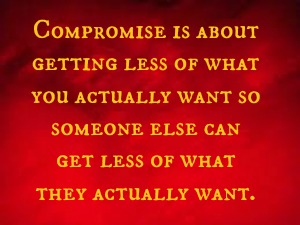
COMPROMISE

Like most words it’s a really interesting one when you stop and look at it and play around with it a little for in it I actually see two words Com and Promise – so what does it really mean?

Well according to one dictionary source com is a prefix meaning “with,” “together,” “in association,” and (with intensive force) “completely,” occurring in loanwords from Latin ( commit ): used in the formation of compound words before b, p, m: combine; compare; commingle.

Promise from my perception means that no matter what, I will do what I say I will. It may be that I can’t always do it exactly when I said I would but regardless of how long it takes I will do it anyway. For me a promise is linked in with a person’s integrity and honesty and displays, or not, their ability to “Walk their Talk” and whether or not they can be trusted and believed when they speak.

For me a promise is only ever something I can honestly make from the depths of my being, from the very core and heart of my soul and it is a sacred vow for me once spoken because regardless of what I have to go through, endure or deal with that vow will not ever be broken nor completed via the contract I have made by promising anything, until I have done what I have promised I will do.

Hence, I rarely ever make promises because life is so changeable and so much happens and the only time I make a promise is when I know with absolutely certainty and no doubt whatsoever within me that I can keep a promise, no matter what, which is why my book The Promise was given that title.

According to one dictionary there are several definitions for the word Promise:-

1. is a declaration that something will or will not be done, given, etc., by one: unkept political promises.
2. an express assurance on which expectation is to be based: promises that an enemy will not win.
3. something that has the effect of an express assurance; indication of what may be expected.
4. indication of future excellence or achievement: a writer who shows promise.
5. something that is promised.

So…. what happens when we put Com and Promise together well yes we get Compromise but what then does that word really mean?

When I put them together not only do I get compromise but I also get a binding and complete contract if you like with another person that no matter what will not be broken and that is my own personal standard definition of the word.

However, according to one dictionary when the words com and promise come together they actually create meanings such as these:-

1. A settlement of differences by mutual concessions; an agreement reached by adjustment of conflicting or opposing claims, principles, etc., by reciprocal modification of demands.
2. the result of such a settlement.
3. something intermediate between different things: The split-level is a compromise between a ranch house and a multistoried house.
4. an endangering, especially of reputation; exposure to danger, suspicion, etc.: a compromise of one’s integrity.
verb (used with object), com•pro•mised, com•pro•mis•ing.
5. to settle by a compromise.
6. to expose or make vulnerable to danger, suspicion, scandal, etc.; jeopardize: a military oversight that compromised the nation’s defenses.
7. Obsolete .
a. to bind by bargain or agreement.
b. to bring to terms.

With these second lot of definitions in mind, which are the ones most folk normally associate compromise with, and given that the majority of us involve ourselves in relationships that appear to involve compromise as a major component, how is it that any of us can be truly happy when we compromise ourselves in the context of the meanings the majority place on the word?

I was speaking with a friend a while ago now and said something like “it’s all about comprising” as we were discussing “relationships”. This friend shared with me that no they did not believe that and then told me the following story which I have remembered as best as I can from my perception of it.

It was a fairly typical story of two people who meet, both living in separate places some distance away from each other quite happily. Neither wanting to move into each other’s space due to the distance they would then have to travel to where they needed to be for children’s schooling, work etc.

They wanted to live together just not in each other’s current place of residence so they compromised and both moved to a house, into an area neither really liked, so that the distance they each had to travel to be where they needed to be was equal.

This resulted in both now needing to travel a greater distance than they were on a daily basis, adjust to living together with each other and their respective children all in a house and an area neither particularly liked.

So what are the chances do you think of all involved being happy when all have compromised (with the word meaning the second lot of definitions I have shared) living arrangements they were perfectly happy with prior to meeting each other and when their relationship in that house is now built on a foundational stone of compromise?

This story is one I have heard often and one I have also lived for there once was a time when I saw compromise as most see it.

I once had also thought myself that compromise with that meaning attached to it was a necessary factor in a relationship. The old give and take as opposed to give and receive (there is a huge difference) and give all you can to anything you really want to make happen or experience. Therein lays another issue in the word “make”. For truly we can never “make” anything happen where another is involved. At best we can give it a go and if both are committed plans are usually made and we create together whatever it is we have decided to create but we can never ever “make” another do anything.

I myself once compromised my way of life to move to another state to be with someone I loved because in many respects it was, at the time, easier for me to do so than him.

I gave up my whole way of life thinking my life would be better than it was at that time. Reality proved me wrong for it became a situation of me doing all the giving, me being the one constantly “compromising” what I wanted to experience in my life and in return I received a lot of abuse, ultimately ill health emotionally, financially, mentally and physically from another whose behaviour, lack of respect and narcissism, together with a previously unknown issue with alcohol which was being used to numb a heck of a lot of disenfranchised grief that had not been dealt with, all of which only became apparent once I had made the move over 1,000 kilometres away from my “home” area of some 28 years to an area I absolutely detested and often referred to as “the cess pit”. Essentially compromise in that situation wasn’t healthy for me or my son and cost me dearly in more ways than one. It also taught me much for which I was and am most grateful.

Compromise with the “normal” meaning of the word attached to it, from what I have seen from being on the planet for 50 years rarely ever turns out for the best when each and every one of us, by our very nature, requires the personal freedom to do whatever we want, whenever we want to within the confines or our societal structures, personal morals and values of course, independence and peace in our lives.

Compromise again with the “normal” definition from what I have seen leads to resentment and a host of other emotions that do not include joy, happiness or peace for how can we give another the best of us and experience joy, peace or happiness when we have in fact compromised ourselves and what truly makes us happy, joyous or peace full?

So … personally, like my friend, I can’t see that compromise, as so very many of us know it to be, actually really works too well for any of us and I can’t imagine that any time soon I will be choosing to compromise myself in that context again.

Compromise however as I have come to know it and define it appears to me to be a whole different ball game.

Cheers, Cheryl.

© Cheryl O’Connor 2014.

•*´☾☆☽`*•

‪#‎Cheryl‬ O’Connor.
‪#‎Holistic‬ ‪#‎Counsellor‬, Author & Writer.

* Cognitive & Body Based Counselling.
* Creative & Artistic Therapies.
* Specialising in ‪#‎Dream‬ ‪#‎Analysis‬/‪#‎Conscious‬ ‪#‎Dreaming‬ & ‪#‎Shamanic‬ Journeying.
* ‪#‎Reiki‬/‪#‎Seichim‬ Treatments & Attunements.
* Isis ‪#‎Meditation‬.

Newsletter Subscription @ bit.ly/CheocoNews – All subscribers will receive a 10% discount on their first initial consultation for any of my services along with 10 pages of awesome tips and tricks to help you start deciphering the language of your Soul, your dreams, as well as the symbolism of what appears to you daily.

Website @ www.cheocoenterprises.com
My book The Promise, Skype & Email Consultations Available – bit.ly/Cheocoshop

FB: https://www.facebook.com/cheocoenterprises
Skype: cheryloconnor333

Twitter: Cheryl O’Connor@Cheoco99
Email: cheoco99@yahoo.com.au