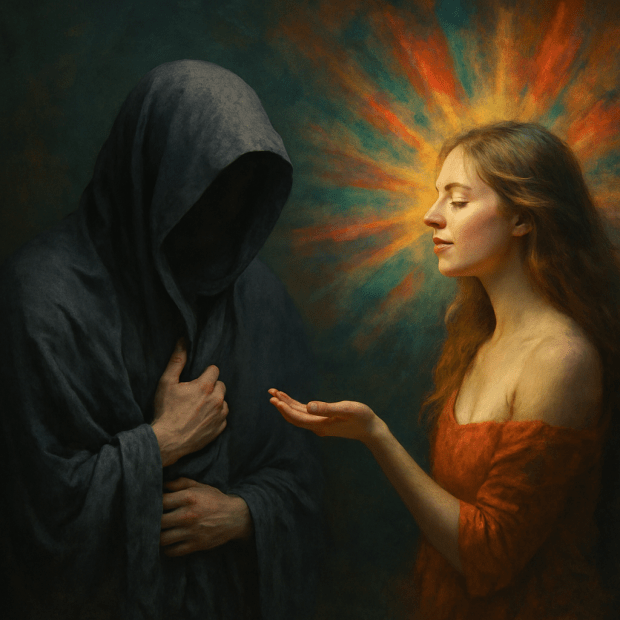
We all come with abundant courage, trust and love into this world. As infants, we trust our needs will be met. We’re fed, clothed, sheltered—and, ideally, loved. We play in nature, explore the world with awe, and live in the now. There’s no concept of lack or limitation.
So where does all that innate trust, courage and love go?
It gets smothered, slowly, by a blanket of fear-based conditioning.
“Don’t fall.” “Be careful.” “Don’t climb that.” “Don’t cry.” “Don’t speak to strangers.”
From the moment we begin exploring, we are bombarded with warnings. Many are well-meaning. But the message we receive is that the world is dangerous, our bodies are fragile, and our instincts can’t be trusted. Over time, our nervous systems internalise this. What starts as care becomes caution. What begins as protection becomes suppression. And what once was joy becomes fear.
This conditioning isn’t just psychological—it’s somatic. Repeated warnings trigger the body’s stress response, even when no real danger exists. Studies show that chronic activation of this response in childhood can lead to long-term dysregulation of the nervous system, laying the foundation for anxiety, depression, and autoimmune disorders. (See: Harvard Center on the Developing Child, 2010; Van der Kolk, 2014.)
We learn to mute our natural expressions. To cry quietly. To sit still. To put on masks.
We’re told to leave our feelings at the door. “Be professional.” “Leave your personal stuff at home.”
Yet humans aren’t machines. We carry our emotions, energy, stories and unprocessed grief into every space. Telling someone to leave their pain behind is like asking the ocean not to wave.
So, we cope. We numb. We perform.
We medicate ourselves with coffee, alcohol, sugar, nicotine, binge-watching, overworking—whatever dulls the ache. We long for weekends, dread Mondays, and confuse productivity with purpose. The more we ignore our inner world, the louder our bodies must speak—through illness, fatigue, or emotional outbursts.
This is not living. This is surviving.
And it’s no surprise that disconnection—internally and from others—leads to chronic stress, burnout, and a lack of meaning. As Gabor Maté writes, “When we have been prevented from learning how to say no, our bodies may end up saying it for us.”
Our systems reward burnout. We idolise busyness. We dismiss embodiment and emotional intelligence.
And yet, somewhere deep inside, we remember.
We remember the joy of dancing in the rain, the wonder of staring at clouds, the heartbeat of the earth beneath our bare feet. We remember what it feels like to trust ourselves.
What silences that voice?
Fear.
Fear, like all emotions, is energy. I see it as a contraction, a tightening of energy, whereas love is an expansion, a flow of energy.
When we sit with fear or anxiety, whether in our minds or bodies, it intensifies. We may feel stressed, unable to think clearly, or even slip into panic, neurosis, or paranoia. Fear can also paralyze us, or it may erupt as a reaction. Beneath anger, fear and pain often hide.
When we allow ourselves to fully experience and feel the anger, pain, regret, guilt, or shame that fear has been masking, the fear dissipates, and in its place, courage emerges. Often, this process also brings new insights and solutions that were previously hidden.
Our minds can amplify fear by spinning “what if” scenarios—often imagining outcomes that never come to pass. These imagined fears can cause unnecessary stress and anxiety, especially when they haven’t even materialized.
If we have a wound we’ve been protecting, and something triggers it, the “band-aid” comes off, exposing us to fear again. This can lead to a double layer of fear: the immediate reaction to the trigger and the deeper fear stemming from the original wound—or even multiple past wounds.
Shifting fear is no easy feat, and it can take time. But once we face it, and sit with the pain that lies beneath, fear melts away. In its place, we find love, peace, and clarity.
Fear of rejection. Of being judged. Of not being enough. Of failing. Of not fitting in. Of speaking our truth. Of losing love. Of death.
False Evidence Appearing Real.
Most of what we fear never actually happens. And the few things that do? We survive them. We grow through them. Sometimes, they become the very catalysts that awaken us.
So what if we re-learned how to trust ourselves? What if we began untangling the knots of fear-based conditioning, one thread at a time?
What if we let the grief rise instead of stuffing it down? What if we let our bodies dance when the music moved us? What if we started saying yes to what lights us up and no to what drains us?
This is not naive. It’s necessary.
Life isn’t meant to be a grind. It’s meant to be a creation.
If you’re ready to tear up the script of fear, I have scissors in my kit and a hand to hold. Together, we can unweave the tangle.
With love, C.
References for deeper reading:
- Bessel van der Kolk, The Body Keeps the Score, 2014
- Gabor Maté, When the Body Says No, 2003
- Harvard Center on the Developing Child, “Toxic Stress and Brain Architecture”
- Peter Levine, Waking the Tiger, 1997
- Stephen Porges, The Polyvagal Theory, 2011
© Cheryl O’Connor, 2025. All rights reserved. Please do not reproduce without permission. Sharing with credit and a link is welcome.

 Cheryl O'Connor