More Than Bedtime Stories
Most people think of fairy tales as sweet bedtime stories for children, pleasant little fables to pass the time before sleep. But when we look beneath the surface, their layers of meaning open like a map, guiding us through the inner and outer landscapes of our lives.
The Forest and the Journey
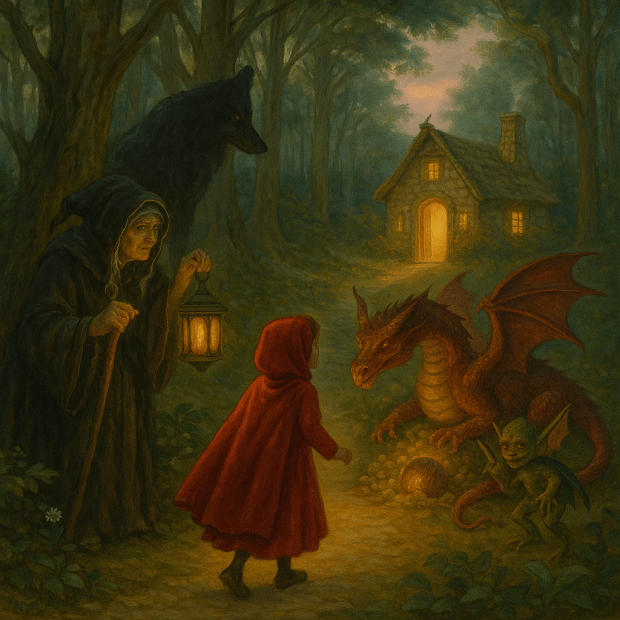
In almost every classic tale, the storyline begins the same way: a young soul leaves “home”, sometimes by choice, sometimes by circumstance, and ventures into the wider world. Along the way, they face trials and temptations: witches and wolves, dragons and goblins, wicked stepmothers and treacherous strangers. They may be imprisoned, lost in the forest, or lulled into a deep sleep.
The forest is one of the most enduring symbols in fairy tales. It is not simply scenery, but a living teacher. To enter the dark forest is to step into the unknown, leaving behind the familiar and the safe. It is here that old identities are stripped away, and we must learn to trust a deeper compass of soul. Every shadow and every clearing becomes a guide, showing us that what looks like confusion or danger is also the fertile ground of transformation. Rivers, storms, mountains, and caves serve the same role, thresholds that reshape us if we dare to enter.
Yet, just as often, help arrives, through animals, elemental beings, wise old helpers, or mysterious friends. And when they finally “return home,” they are not the same as when they left. For home is not a physical place at all, it is a return to one’s true self. The journey strips us bare, tests our faith, and teaches us who we really are.
It is important to remember these stories were never meant to be harmless diversions. Long before they were bound in books, fairy tales lived as oral traditions, told around firesides to transmit wisdom, warnings, and hope. They were teaching maps, guiding communities through danger, instinct, resilience, and transformation.
Villains, Helpers and Thresholds
And those so-called “villains”? I do not see them as villains at all. Patriarchy turned them into shadows, wolves, witches, dragons, fearsome figures to frighten us away from their power. But really, it is our own power they mirror back to us: instinct, intuition, raw life force, and the ability to transform. When we meet these figures within, we reclaim parts of ourselves long suppressed. The Witch becomes the Crone, carrying wisdom for thresholds and endings. The Wolf becomes a fierce protector of boundaries. And the Dragon? The Dragon is the guardian of our own inner treasure and power, waiting for us to grow strong enough to step forward and claim it.
Fairy tales also remind us of endings. Sometimes people leave our lives through choice, distance, or even death. As painful as this is, symbolically it may reflect a deeper truth: their energy is no longer aligned with where we are on our journey. In this way, every loss is also a threshold, one that asks us to meet more of ourselves, to grow into new awareness, and to walk forward carrying what was true in love.
Fairy tales remind us too that help often comes in overlooked forms. A talking bird, a humble servant, or a creature of the wild may hold the key to survival. The “simpleton,” mocked for being foolish, is often the one who succeeds where others fail, precisely because they trust what is small, quiet, or easily dismissed. These tales teach us that wisdom rarely arrives dressed in the power we expect. It slips in through the ordinary, reminding us that the sacred hides in plain sight.
Windows, Mirrors and Doorways
Windows, mirrors, and doorways are some of the ways life shows us these Selves. A window may let us see through to where another is truly coming from or reflect ourselves back depending on the angle of light. A mirror shows us our own reflection, sometimes sharply, sometimes kindly. And a doorway? That is the threshold another offers us into a new awareness. Often, whatever we see in another exists within us too, otherwise how could we see it? Some mirror to us where we are presently at and others where we have been at some point in time. Often, in any one interaction, all three roles are present at once. These are not accidents, they are guides.
The True Happily Ever After
Just like the characters in these tales, many of us spend years searching outside ourselves for happiness. We might long for “one true love” to sweep us away, believing they will complete us. And for a while, it might feel like they do. But no matter how romantic the promise, no person can be our everything, especially when we have yet to become that for ourselves.
This is where so many of us misunderstood the “happily ever after.” Disney did not exactly sell us a lie, rather, our culture mistranslated the deeper truth. Long before Disney, the tales themselves were pointing inward. The Prince and Princess were never really about someone else rescuing us. They are symbols of our own inner masculine and feminine. But growing up in a patriarchal system, we were taught to externalise everything: happiness, success, love, even salvation. No wonder so many felt or feel disillusioned when the promise did not hold.
When we look symbolically, the “kiss” that wakes the sleeping one is not about romance at all. It is about awakening, when our masculine energy of logic and clarity meets our feminine energy of intuition and creativity. In that inner union, something comes alive. Balance is restored. We no longer need someone else to complete us, though we may share life with another from a place of wholeness. This is the true happily ever after.
Every fairy tale also carries the rhythm of life itself, descent and return, death and rebirth, endings and beginnings. Sleeping Beauty is not just about a princess in slumber; it is about the necessity of rest and renewal before awakening to new life. Snow White’s glass coffin mirrors the suspended state we sometimes find ourselves in, when part of us has died but the rebirth has not yet arrived. To live consciously is to honour these cycles rather than resist them, recognising that every ending makes space for a new beginning.
The Hero Has Always Been Us
At the heart of it all, every fairy tale whispers the same truth: the hero has always been us. The dangers, helpers, and transformations we read about are mirrors of our own trials and triumphs. The quest is not about rescuing or being rescued, it is about remembering who we truly are. And in the end, to “return home” is to return to that true self, whole, awake, and fully alive.
When a child asks for a story, it may be the soul’s way of speaking, theirs, and yours. Children often choose the very tale that carries the medicine both need to hear. A bedtime request can be far more than whimsy; it can be a mirror of the family’s journey, a whisper of what the soul is trying to surface. In this way, our children become our teachers, reminding us of the truths we may have forgotten.
But we cannot hear these truths if our minds are always noisy. When we chatter constantly, whether in our heads or with our mouths, we block the whispers of Soul and nature wisdom. We need stillness. We need silence. As the saying goes: “When we speak, we only repeat what we know. When we listen, we may learn something new.”
For all of us, no matter our profession or path, this symbolic lens matters. We may find ourselves trapped in a “sleeping spell” of grief, stalked by a “wolf” of fear, or longing for the “helper” who reminds us of our strength and true nature. Fairy tales can be bridges, helping us name our inner landscapes in ways that ordinary language cannot.
The original tales of the Brothers Grimm or Hans Christian Andersen hold far more than quaint moral lessons. They speak to the courage, faith, and trust needed to walk through life’s dark forests and return with wisdom. And they remind us that when a child asks for a certain story, it may be speaking directly to your soul as much as theirs, holding a mirror to where you are on your own journey.
After all, the so-called “real world” is itself the greatest fairy tale of all, an unfolding adventure, full of shadows and helpers, mirrors and doorways, dragons and wolves, Crone wisdom and childlike wonder. And the ending? Well, that is always up to us.
•´☾☆☽`•
✨ Reflective Questions
-
Which “villain” or shadow figure, Wolf, Witch, Dragon, feels most alive for you right now? What part of your own power might they be guarding?
-
When was the last time you found yourself standing at a symbolic window, mirror, or doorway? What did it show you about yourself?
-
In what ways are you seeking “happily ever after” outside yourself, and how might you turn inward to find it instead?
-
Where in your life could stillness or silence help you hear what the story of your own soul is trying to say?
-
As the hero has always been you, what chapter of your journey are you living through right now?
•´☾☆☽`•
📚 Recommended Reading
On the Feminine, the Crone, and Women’s Stories
-
Women Who Run with the Wolves, Clarissa Pinkola Estés
-
Crones Don’t Whine: Concentrated Wisdom for Juicy Women, Jean Shinoda Bolen
-
The Crone: Woman of Age, Wisdom, and Power, Barbara G. Walker
On the Masculine & Feminine Archetypes
-
King, Warrior, Magician, Lover: Rediscovering the Archetypes of the Mature Masculine, Robert Moore & Douglas Gillette
-
The Heroine’s Journey, Maureen Murdock (a counterpart to Campbell’s Hero’s Journey)
-
The Dance of the Dissident Daughter, Sue Monk Kidd
On Fairy Tales & Symbolism
-
The Uses of Enchantment: The Meaning and Importance of Fairy Tales, Bruno Bettelheim
-
Iron John: A Book About Men, Robert Bly (draws from Grimm’s tales)
-
Baba Yaga’s Assistant, Marika McCoola (a modern take on the old witch archetype)
On Myth, Archetypes & Shadow Work
-
Man and His Symbols, Carl Jung
-
Owning Your Own Shadow: Understanding the Dark Side of the Psyche, Robert A. Johnson
-
The Hero with a Thousand Faces, Joseph Campbell
On Dragons, Treasure, and Inner Power
-
Facing the Dragon: Confronting Personal and Spiritual Grandiosity, Robert L. Moore
-
The Dragon’s Treasure: A Dreamer’s Guide to Inner Discovery, Tian Dayton
-
The Book of Dragons, Edith Nesbit (for a lighter, symbolic entry point)
On Silence, Listening & Stillness
-
The Sacred Embrace of Listening, Kay Lindahl
-
Silence: The Power of Quiet in a World Full of Noise, Thich Nhat Hanh
-
The Wisdom of the Enneagram, Don Richard Riso & Russ Hudson (includes silence as a transformative practice)
© Cheryl O’Connor, 1995, 2014 and 2025. All rights reserved.
Please do not reproduce without permission. Sharing with credit and a link is welcome.
•´☾☆☽`•

 Cheryl O'Connor