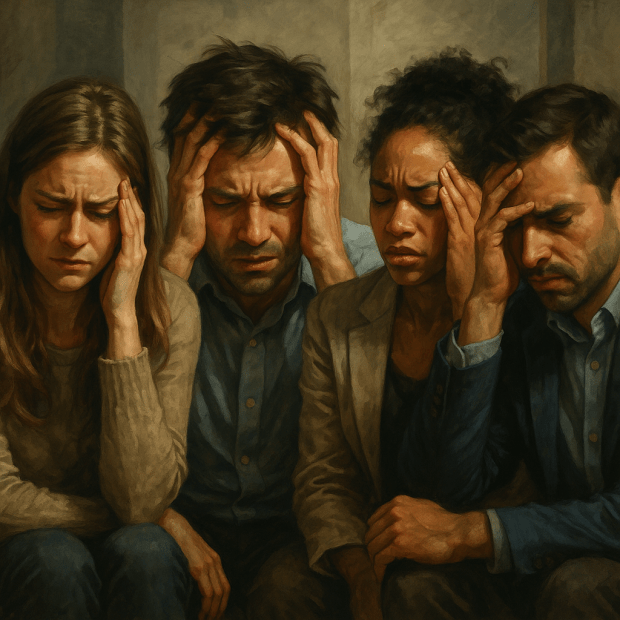
It seems fairly acceptable in our society these days to accept stress as “normal.” Technology designed to make life easier has, in fact, made life busier, with a constant flow of information, requests, and demands on our time. We live dictated by calendars, bank balances, and the ticking of the clock, numbers we react to as though they were threats.
More and more automated voice options on phones that fail to connect us to an actual human being add to our daily tension, offering less support and more frustration. Time for real food and deep connection shrinks as we all become… “so busy.”
Once, we wrote letters, posted them, and waited. Now, emails ping, and we feel a pressure to respond instantly. It’s not just a pace; it’s a mindset of urgency. Productivity is the new idol, and the pressure to outperform for profit isn’t just found in the workplace, it’s embedded in our nervous systems (Rosen, 2020).
We’re saturated with disasters, grief, and horror from every corner of the globe. Not only is this overwhelming, but our stress response is being constantly triggered by situations we can’t control (Sahakian et al., 2015). Gratitude for safety is real but so is the burden of helplessness. And the truth is: we can always turn it off. But often, we don’t.
The deeper issue is that when we do need to hibernate, retreat, rest, withdraw, we’re told we’re lazy, self-indulgent, or not resilient enough (Biron et al., 2012).
Even our own government has proposed raising the age at which people become eligible for support—further extending the years we’re expected to stay in the workforce. The message is clear: keep working, keep producing, keep pushing. And burnout? That’s just the cost of survival, apparently a cruel irony when burnout is already rampant.
Snappy voices, reactive outbursts, and social disengagement often stem from chronic stress. People aren’t present. They’re time-travelling, replaying the past or pre-living future disasters. And that lack of presence? That’s the real cost (Kabat-Zinn, 2005).
We are not machines. Yet we expect ourselves to operate like them. Even computers need a reboot. When was your last one?
The Myth of Multitasking
One of the greatest myths of modern life is that multitasking makes us more efficient. In reality, the human brain cannot focus on multiple complex tasks at once. We are constantly context-switching, splitting our attention and taxing our cognitive resources (Rosen, 2020). This increases errors, reduces memory recall, and heightens stress.
Multitasking is not mastery. It’s a nervous system constantly being yanked in different directions. No wonder we feel scattered.
Rest as Resistance
There is a growing movement that names rest not as a luxury, but as a form of resistance. Tricia Hersey, founder of The Nap Ministry, reminds us: “Rest is a spiritual practice. Rest is a form of resistance because it disrupts and pushes back against capitalism and white supremacy.”
We are not designed to be endlessly productive. We are cyclical beings, wired to ebb and flow, to rise and retreat. The feminine principle, whether expressed in any gendered body, calls for restoration, reflection, and radical slowness (Hersey, 2022).
Returning to Rhythm
There was a time when our rhythms followed the sun. When life was made, not consumed. When tribe, rest, music, growing, laughing, and storytelling were at the heart of our days.
What we now call “stress” was once a short-term survival response. Adrenaline kicks in when we’re under threat, giving us power to run or fight. It was never meant to be a way of life (McEwen, 2007). Fifteen minutes. That’s the optimal duration of a stress response before the body starts to take damage (Selye, 1976).
But when stress becomes constant? The effects show up in every system of the body: high blood pressure, anxiety, insomnia, digestive disorders, muscle pain, and emotional exhaustion. Stress is not just uncomfortable—it’s biologically destructive. And yet we carry on, until our bodies force us to stop (Sapolsky, 2004; van der Kolk, 2014).
Language That Triggers Stress
Even the language we use is steeped in nervous system activation. We’re “alarmed” out of bed. We hit “panic buttons.” We race to meet “deadlines.” We juggle tasks and “crash” by evening.
Words matter. They shape our perception and perception creates our reality. A slower, kinder vocabulary begins the rewiring process.
Pause Practices
To reclaim the present moment is an act of healing. Here are a few gentle ways to begin:
- Hand on Heart – Pause. Breathe. Feel the warmth of your own touch. You’re here.
- Barefoot Grounding – Stand on earth. Feel your soles reconnect with soil, sand, stone.
- Three Deep Breaths – Inhale through the nose. Exhale through the mouth. Let it go.
- Digital Sabbath – Choose one hour, one afternoon, or one day to unplug.
A Story Worth Remembering
There is a story in Women Who Run With the Wolves. You can find it on page 328. The story is called The Three Gold Hairs. It fits extremely well into the scenario of stress in our modern world. We become the old and withered dying man, lost in the dark forest of overwork. Until, finally, we remember. We are human beings, not human doings.
To nurture, to rest, to dream is not laziness. It’s medicine.
And like a steaming apple pie, fresh from the oven, everyone will want a piece of you. Just remember—leave some for yourself. And bake a new one before you run out.
With care,
Cheryl
© Cheryl O’Connor 2025. All rights reserved.
Please do not reproduce without permission. Sharing with credit and a link is welcome.
References
Biron, C., Brun, J. P., & Ivers, H. (2012). Extent and sources of occupational stress in university staff. Work, 42(4), 739–750. https://doi.org/10.3233/WOR-2012-1427
Ellis, A. (1994). Reason and emotion in psychotherapy. Carol Publishing Group.
Estés, C. P. (1992). Women who run with the wolves: Myths and stories of the wild woman archetype. Ballantine Books.
Hersey, T. (2022). Rest is resistance: A manifesto. Little, Brown Spark.
Kabat-Zinn, J. (2005). Coming to our senses: Healing ourselves and the world through mindfulness. Hyperion.
McEwen, B. S. (2007). Physiology and neurobiology of stress and adaptation: Central role of the brain. Physiological Reviews, 87(3), 873–904.
Rosen, L. D. (2020). The distracted mind: Ancient brains in a high-tech world. MIT Press.
Sahakian, B. J., et al. (2015). The impact of neuroscience on society: Cognitive enhancement in neuropsychiatric disorders and in healthy people. Philosophical Transactions of the Royal Society B, 370(1677), 20140214.
Sapolsky, R. M. (2004). Why zebras don’t get ulcers: The acclaimed guide to stress, stress-related diseases, and coping. Holt Paperbacks.
Selye, H. (1976). The stress of life (Rev. ed.). McGraw-Hill.
van der Kolk, B. (2014). The body keeps the score: Brain, mind, and body in the healing of trauma. Viking.



 Cheryl O'Connor